


What is a phrasal verb?
A phrasal verb consists of a verb followed by a preposition or adverb. Combining these elements creates a new unique phrase that differs from the meaning of each word.
Consider the phrase “drop by”:
Drop: A verb meaning to let or make something fall vertically.
By: Preposition that helps identify who/what acts or indicates how something is achieved.
Drop by: Phrasal verb that means casually visiting someone.
Phrasal verbs follow the same conjugating rules (changing the form of the verb to identify tense, number, gender, or voice) as other verbs.
Since phrasal verbs have a different meaning than their separate words, phrasal verbs almost act like idioms. Idiomatic words or phrases are most easily understood by native English speakers, as they are common in spoken English conversations.
Four types of phrasal verbs
The four types of phrasal verbs are transitive, intransitive, separable, and inseparable.
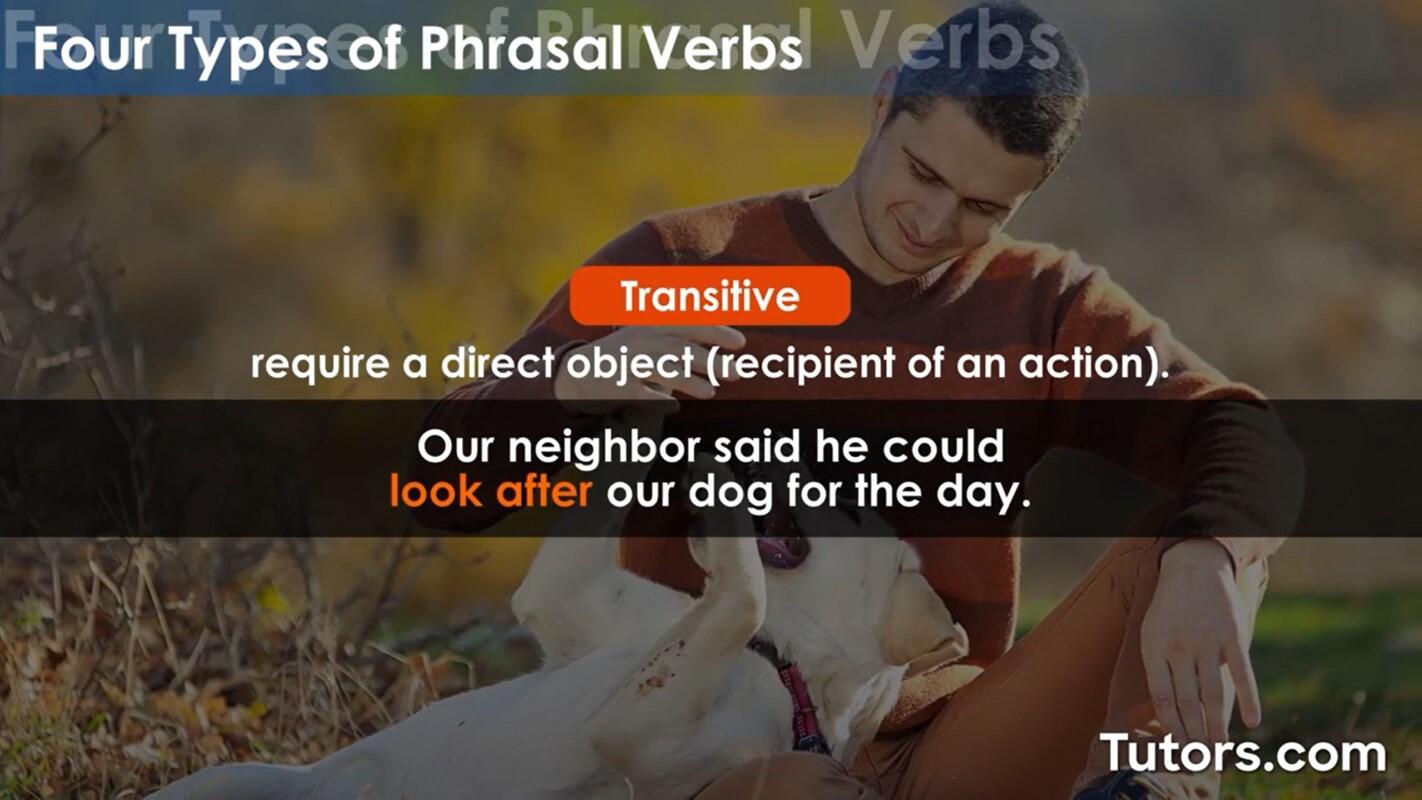
Transitive phrasal verbs require a direct object (recipient of an action).
Our neighbor said he could look after our dog for the day.
Intransitive phrasal verbs do not require a direct object.
We should hang out soon.
Words in a separable phrasal verb can be separated within a sentence.
Can you please turn the volume up?
Words in an inseparable or non-separable phrasal verb cannot be separated.
The class checked out the entire museum.
Word order of phrasal verbs
The order of words within a phrasal verb depends on its use.
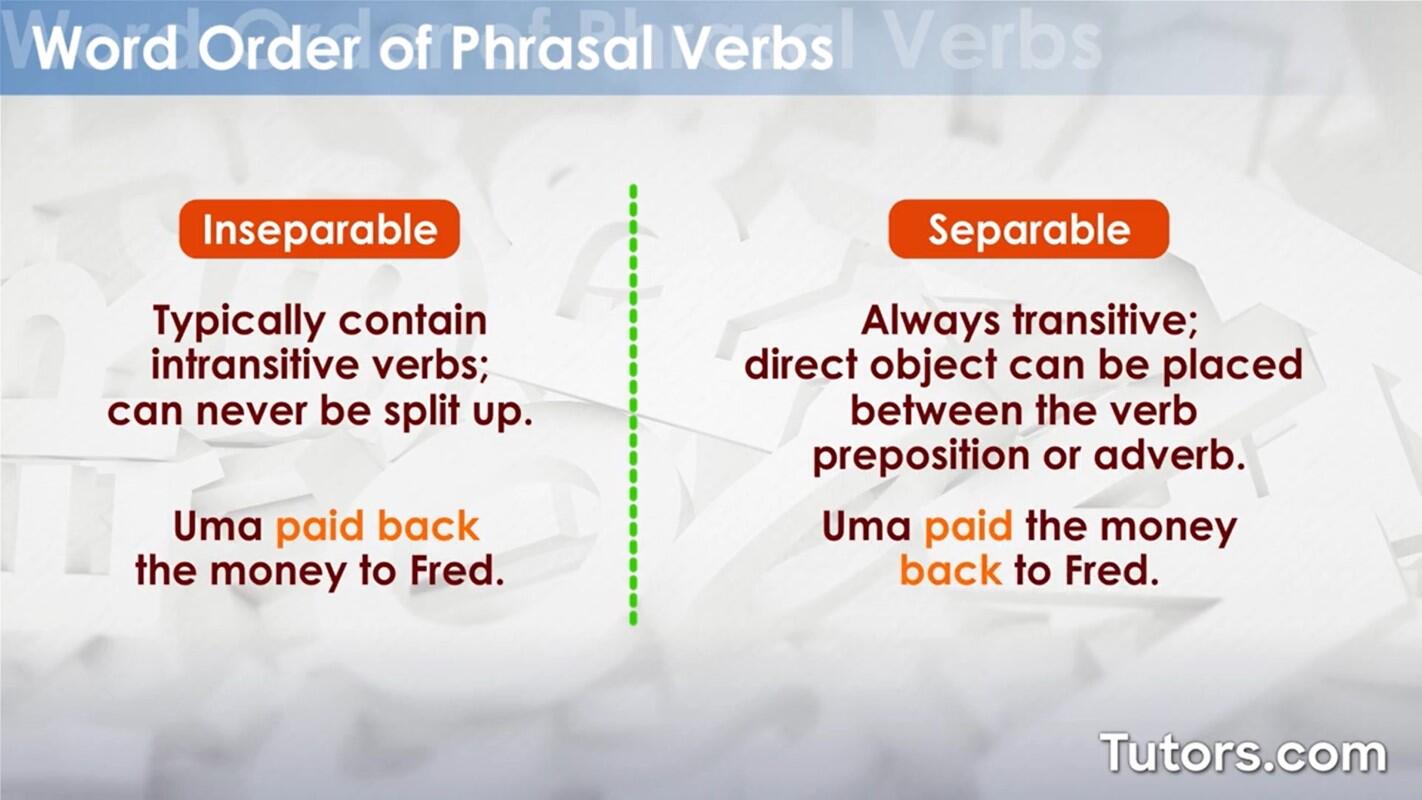
Inseparable phrasal verbs, which typically contain intransitive verbs, must always stay together; these phrases can never be split up.
Separable verbal phrases are always transitive; therefore, they always have a direct object that receives the action. The direct object can be placed between the verb and preposition or adverb.
Uma paid back the money to Fred.
Uma paid the money back to Fred.
Phrasal verbs list
The following chart contains a list of the most common English phrasal verbs along with their meanings and example sentences:
| Phrasal Verb | Meaning | Example |
|---|---|---|
| back down | stop doing something due to opposition | John never backed down from a fight. |
| back up | provide support for someone | I’ll back you up. |
| break down | suddenly stop functioning | After the car broke down, we had to walk. |
| bring up | mention something | Sam was surprised Levi brought up the party. |
| bump into | see someone unexpectedly | I can't believe I bumped into Jenn at the mall. |
| call off | cancel | We had to call off the trip because of the storm. |
| calm down | become more relaxed | He needs to calm down before we can leave. |
| catch up | reach a person who is ahead | Wait! Let me catch up with you! |
| check out | examine something | Judy went to the store to check out the prices. |
| come across | find something unexpectedly | We came across several different types of shells. |
| come up with | think of a plan | They had to come up with a way to help Stan. |
| drop by | casually visit someone | I dropped by Tina's on the way to school. |
| ease up on | become less strict | Our teacher eased up on the amount of work. |
| fall apart | break into pieces | The pinata fell apart in the rain. |
| fill up | become full | Will you please fill up my glass? |
| find out | discover | Did you find out why Erin left early? |
| get along | have a friendly relationship | Our parents get along fairly well. |
| get by | ability to live through a difficult situation | I was able to get by despite being laid off. |
| grow up | mature | Disney lets me feel like I never need to grow up. |
| hang out | spend time relaxing/socializing | We'll be able to hang out more over the summer. |
| look after | take care of someone/something | She needs someone to look after the dog today. |
| make up | become friendly after a disagreement | John and Terry made up after their fight last night. |
| pay back | repay money | I can pay you back when I get paid next week. |
| put off | delay something | They had to put off the trip because of the snow. |
| put up with | tolerate something | Luckily, they put up with my bad behavior. |
| run out | have no more of something | We almost ran out of gas looking for your house. |
| turn up | appear suddenly | My keys always turn up in the last place I look. |
| wait up | stay awake (waiting for something) | She waited up to make sure we got home safely. |
| watch out | be careful of danger | Make sure you watch out for falling rocks. |
Summarize with AI:
Did you like this article? Rate it!

 Loading...