


Thales of Miletus taught that 'all things are water'.
Aristotle, Metaphysics
The long and fascinating history of math has been shaped by influential thinkers. One of the earliest was Thales of Miletus. He moved toward rational reasoning, observation, and mathematical proof.
Key Takeaways
- Establishing early principles of Greek geometry, helping transform practical measurement into a mathematical science.
- Formulating geometric relationships later known as Thales’ theorem, which explores proportional relationships in triangles and parallel lines.
- Demonstrating how similar triangles and angles could be used to calculate distances and heights.
- Applying mathematical reasoning to real-world problems, including measuring the height of pyramids using shadows.
- Promoting observation and logical explanation rather than mythological interpretations, laying groundwork for early scientific thinking.


Thales Early Life and Education
In the life of a mathematics student, there are two names that are impossible to forget: Pythagoras and Thales. According to historical texts, the latter, a professor of the former, was a philosopher born in Miletus around 625 BCE.² Aptly named, the Greek philosopher Thales of Miletus is considered one of the Seven Sages of ancient Greece, along with Solon, Chilon of Sparta, Pittacus of Mytilene, Bias of Priene, Cleobulus of Lindos, and Periander of Corinth.³
Founder of the Milesian school, Thales began his academic career as a philosopher and scientist by traveling to Egypt at a very young age, thanks to good relations between Egypt and his maternal city, Miletus.⁴ It was there that a young Thales discovered the knowledge of Egyptian and Babylonian sciences. Once there, he learned geometry, astronomy, and philosophy – all core parts of the educational training of Egyptian priests.
According to ancient Greek historians, this trip to Egypt is not supported by the evidence. In fact, only some records written years after Thales's death have attested to his life and placed him in Egypt at the time. Once he reached adulthood, Thales returned to the Greek city of Miletus to establish the Milesian School. Thales used his position to spread his knowledge in mathematics and Greek philosophy, all the while continuing to perform observations and scientific experiments.
c. 624 BCE
Birth of Thales in Miletus
Thales was born in the Greek city of Miletus in Asia Minor. He would later become one of the most influential early thinkers in Greek mathematics and philosophy.
Early 6th Century BCE
Possible Studies in Egypt
Ancient sources suggest that Thales may have traveled to Egypt, where he encountered Egyptian geometry and astronomical knowledge that influenced his later work.
Early Mathematical Work
Development of Geometric Principles
Thales helped establish early geometric reasoning and is traditionally credited with several foundational principles later associated with Thales’ theorem.
c. 585 BCE
Prediction of a Solar Eclipse
According to ancient historians, Thales predicted a solar eclipse, demonstrating how observation and mathematical reasoning could help explain natural phenomena.
Later Life
Teaching and the School of Miletus
Thales’ ideas influenced the development of the Milesian School, where early philosophers explored natural explanations for the universe through observation and reasoning.
A great scientist and mathematician, Thales used his observations in order to discover how the world functioned. According to the legend, he calculated the height of the Great Pyramid, helped predict a lunar and solar eclipse, and put into practice the theorems of Thales.
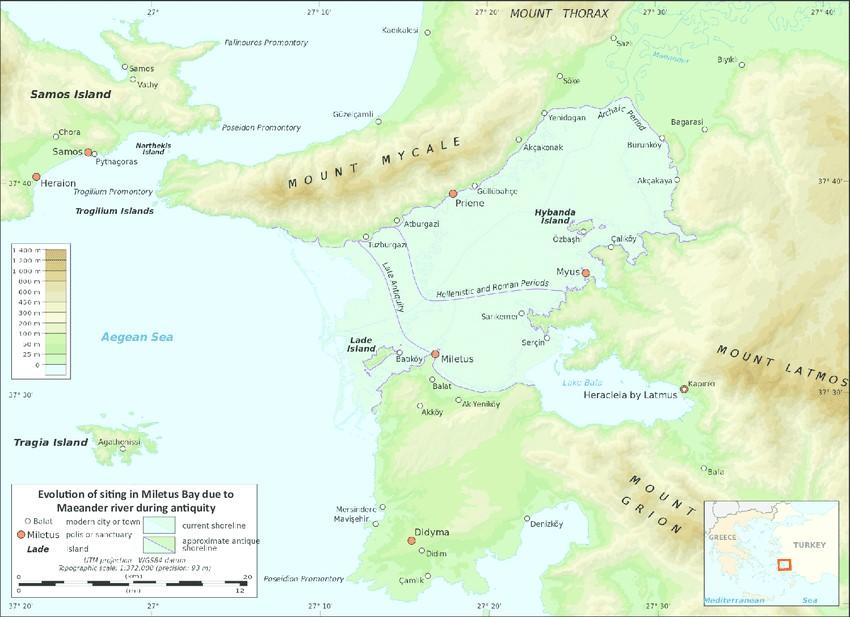
His mathematical and scientific research is considered to have revolutionized the times. Considered a sage, Thales always prided himself on explaining his discoveries from a rational point of view rather than a mythological one, as was the tradition at the time. For him, the process of observation and creating proofs was the basis of scientific reasoning.
According to some accounts written many years after his death, Thales died around 547 BCE in Miletus while attending a gymnastic competition. Found in the bleachers, he had apparently died of hunger, thirst, and age. Some other great mathematicians and philosophers from this area include Archimedes!
Thales’ Mathematical Theorems and Discoveries
Everyone has heard of, and even learned, many of the theorems that Thales discovered. Thales was the first to record the history of mathematics with his scientific formula and principle. Here are five of the geometric theorems he has been credited with:
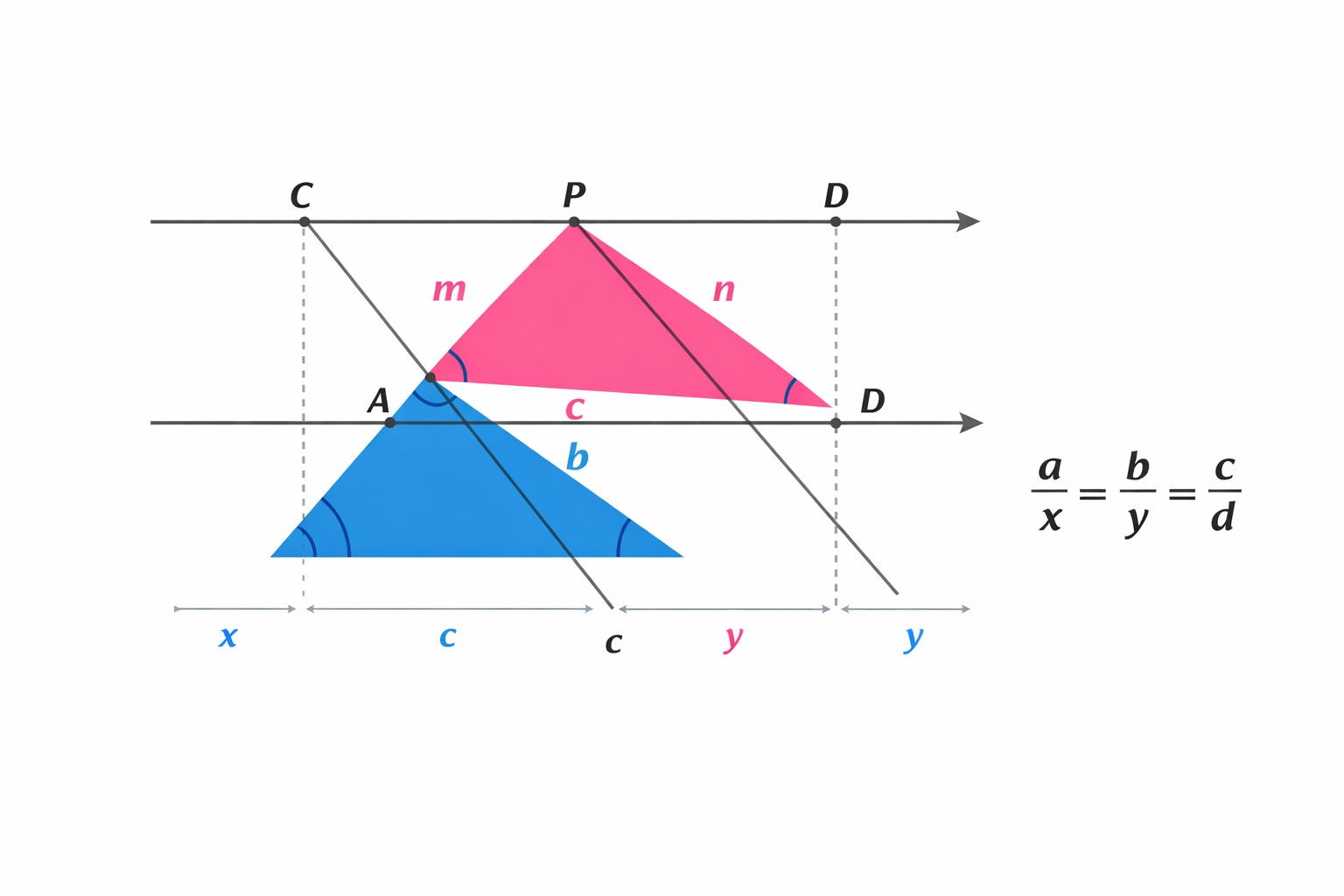
While these may sound too simple today to have ever been considered revolutionary, they actually give us a lot of information and were considered a major innovation at the time. Thales’ theorems are utilized to calculate certain relationships of longitude and proportions in geometric figures possessing parallel lines. They are also used to calculate many trigonometric concepts involving two parallel lines. According to legend, Thales discovered these theorems while calculating the height of a pyramid.
To do this, the mathematician calculated the pyramid's shadow on the floor. With the help of a cane, Thales was able to calculate the dimensions of the pyramid of Egypt in relation to the shadow of his cane. While Thales is credited with these theorems, they were already known by the Babylonians and Egyptians. We know this most notably thanks to the proof elaborated in the book Elements by the mathematician Euclid, which deals with the proportionality of areas of triangles of equal height.⁷
However, Thales was credited with putting words to the latter. Thales is not credited with some of his theorems in many countries. For example, the English call one of his theorems the Theorem of Interception, while the Germans call the same theorem the Theorem of Rays. However, these are not identical and more closely resemble the Pythagorean theory.
| Contribution | Field | What it is | Why it matters |
|---|---|---|---|
| Thales’ theorem (proportionality with parallel lines) | Geometry | A foundational result about proportional relationships formed when parallel lines cut the sides of a triangle. | Supports reasoning with similar triangles and is widely used in geometric proofs and measurements. |
| Right angle in a semicircle | Geometry | The angle subtended by a diameter in a semicircle is a right angle. | A core idea for constructing and proving right triangles in circle geometry. |
| A circle is bisected by a diameter | Geometry | A diameter divides a circle into two equal halves. | One of the simplest circle facts, useful for later geometric constructions and proofs. |
| Vertical angles are equal | Geometry | Opposite angles formed by intersecting lines are equal. | A basic proof tool used throughout Euclidean geometry. |
| Base angles in an isosceles triangle are equal | Geometry | If two sides of a triangle are equal, the angles opposite those sides are equal. | A key property for triangle proofs and constructions. |
| Triangle construction from a base and two angles | Geometry | A triangle can be constructed when a base segment and two angles are given. | Connects geometric reasoning to practical drawing and construction methods. |
| Measuring heights using shadows (similar triangles) | Applied geometry | A method for estimating heights by comparing the length of an object’s shadow to another known shadow. | Demonstrates how geometry can solve real measurement problems. |
| Prediction of a solar eclipse (traditionally dated c. 585 BCE) | Astronomy | Ancient sources credit Thales with predicting a solar eclipse. | Shows early attempts to explain natural events through observation and pattern rather than myth. |
| Using the Little Dipper for navigation | Astronomy | Guidance for sailors using stars for direction at sea. | Connects astronomical observation to practical navigation. |
| Estimating the length of the year (about 365.25 days) | Astronomy | An early estimate of the year’s length beyond 365 days. | Contributes to the long history of calendar refinement and seasonal tracking. |
| Natural philosophy: water as the fundamental principle | Philosophy of nature | The view that water is the originating principle of all things. | A landmark move toward natural, physical explanations in early Greek science. |
Thales’ Contributions Outside Mathematics
Throughout his life, Thales used mathematics to understand the natural world. Early in his career, Thales developed a strong interest in astronomy and the observation of the night sky. Because of this work, he is often considered one of the pioneers of Greek astronomy.⁸ As in his mathematical work, Thales relied on careful observation of constellations to understand how the universe functioned. He made many discoveries in these areas:
Among his observations, Thales analyzed the number of days in a year and concluded that it was approximately 365 days and a quarter. This idea later influenced the development of leap years. He also observed the movement of stars and studied the apparent size of the sun and moon, often using shadow measurements as a reference.
He also located the position of Pleiades and calculated the orbital inclination of zodiac. According to Aristotle, Thales even used his observations to predict a profitable olive harvest. Thales applied these observations to explain natural phenomena and improve practical knowledge. For example, sailors used his observations of the stars to navigate more effectively.
Astronomy and all of its associated fields owe a lot to Thales, who was not just a simple mathematician. To learn more about how these discoveries influenced the work of other great mathematicians like René Descartes! All of Thales’ discoveries have placed a special mark on the field of mathematics. Many of the mathematical ideas associated with Thales are still taught today.
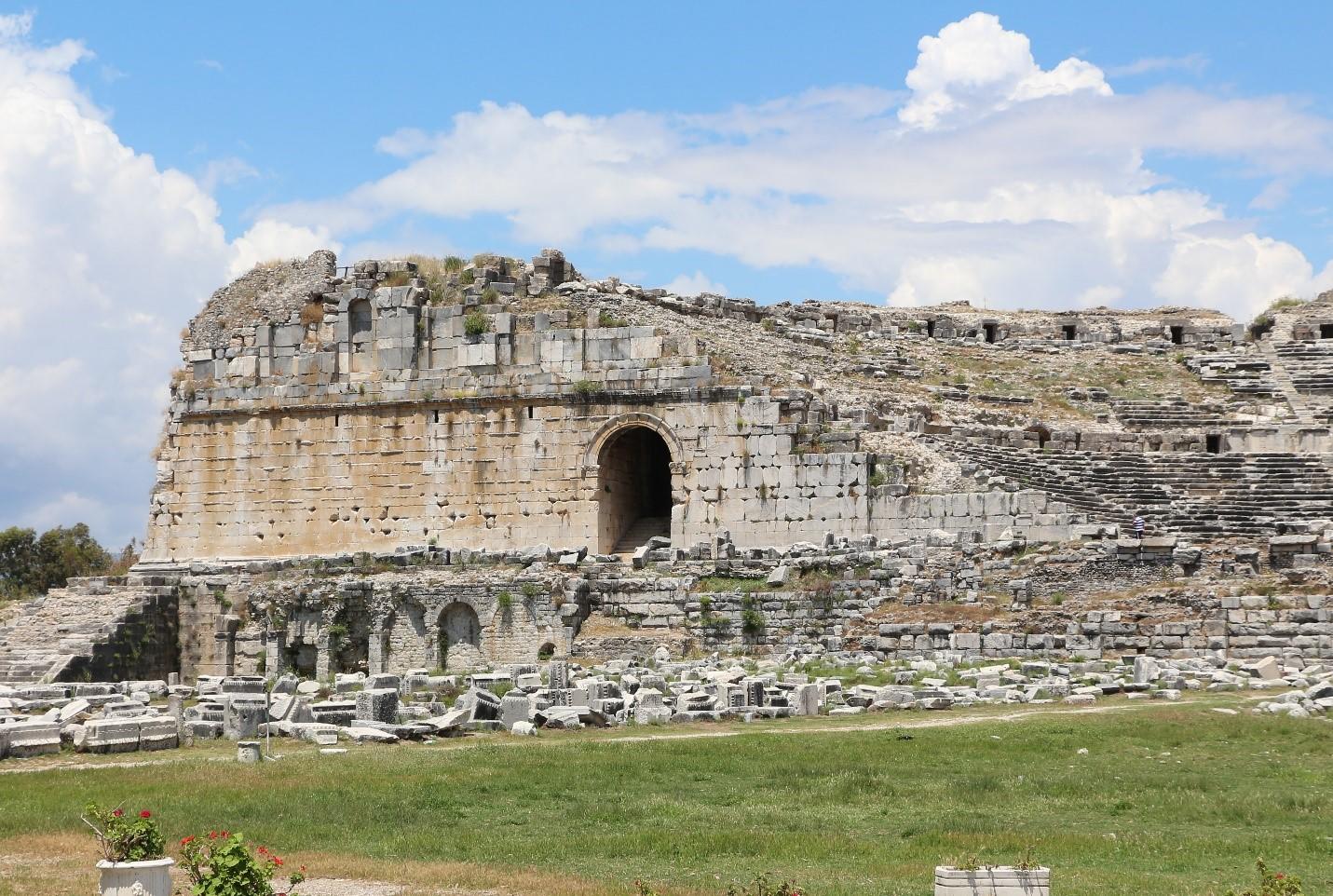
However, Thales also built on knowledge developed by Egyptian and Babylonian scholars. Rather than accepting mythological explanations, he attempted to observe and explain natural phenomena through rational reasoning. In this way, Thales baffled his contemporaries. In a book by Jean Voilquin, the French scientific editor explained that Thales sought to “replace mythological explanation of phenomena by physical explanation.” This is what leads Voilquin, along with many others, to name him as “one of the precursors to Greek science.” Thales’ scientific legacy is magnified by the discoveries made by his School of Miletus. Called the Milesian school, or “Ionian School”, their work revolutionized the field of science and they have come to be known as pre-Socratic philosophers.
His teaching emphasized observation and practical reasoning. The school included mostly geometry and astronomy, Thales’ two preferred fields, but it also worked on subjects like biology, physics, and metaphysics. They studied natural phenomena and sought rational explanations for the world around them. The Miletus School disciples utilized concepts like the four elements in order to give explanations over the function of the environment.
All these studies are considered the first scientific investigations into nature and have left an indelible contribution to the sciences.⁹ Thales didn’t just mark the field of mathematics in antiquity, but also the history of science as a whole, inspiring works of even Sir Isaac Newton. For that, we should remember his name and achievements.
References
- Boyer, Carl B., and Uta C. Merzbach. A History of Mathematics. Wiley, https://archive.org/details/historyofmathema00boye. Accessed 5 Mar. 2026.
- Heath, Thomas L. A History of Greek Mathematics. Oxford University Press, https://archive.org/details/historyofgreekma01heat. Accessed 5 Mar. 2026.
- Mark, Joshua J. “Thales of Miletus.” World History Encyclopedia, https://www.worldhistory.org/Thales_of_Miletus/. Accessed 5 Mar. 2026.
- O’Connor, John J., and Edmund F. Robertson. “Thales of Miletus.” MacTutor History of Mathematics Archive, University of St Andrews, https://mathshistory.st-andrews.ac.uk/Biographies/Thales/. Accessed 5 Mar. 2026.
- Stamatellos, Giannis. “Thales of Miletus: Life, Work, and Testimonies.” https://philosophy.gr/presocratics/thales.htm. Accessed 5 Mar. 2026.
- “Thales.” Internet Encyclopedia of Philosophy, https://iep.utm.edu/thales/. Accessed 5 Mar. 2026.
- “Thales and Early Greek Science.” University of Virginia Physics Department, https://galileoandeinstein.phys.virginia.edu/lectures/thales.html. Accessed 5 Mar. 2026.
- “Thales of Miletus.” Encyclopaedia Britannica, https://www.britannica.com/biography/Thales-of-Miletus. Accessed 5 Mar. 2026.
- “Thales’ Theorem.” Math Open Reference, https://www.mathopenref.com/thalestheorem.html. Accessed 5 Mar. 2026.
Summarize with AI:
Did you like this article? Leave a rating!


 Loading...
