


Ptolemy once asked Euclid if there was not a shorter road to geometry than through the Elements, and Euclid replied that there was no royal road to geometry.
Proclus
Over the centuries, the history of mathematics has witnessed the rise of many greats: Pythagoras, Thales, Newton, and Archimedes. Here, we will be discussing the infamous Euclid. A great mathematician from antiquity, Euclid revolutionized the established body of knowledge of his era in a single work: Elements.¹ In this way, Euclid forms the basis of mathematics as we learn it today. Trigonometry, algebraic reasoning, equations, fractions, and logarithms – all of these aspects of math are still marked by the mathematicians of antiquity. Euclid’s axiom, Euclidean division, Euclidean geometry, Euclid’s algorithm - keep reading to find out about the history of math throughout its various scientific discoveries.


The Life of Euclid the Mathematician
Like his predecessors, such as the mathematician Pythagoras, Euclid's history is not well documented. Only some written texts dating many years after Euclid’s death have been found, and it is only from these that we have managed to recover historical fragments of Euclid's career. There is no other mathematician from antiquity who is more celebrated than Euclid. Born in Athens around 330 BCE, Euclid studied in the beautiful Egyptian city of Alexandria, then under the reign of King Ptolemy I.¹ There, Euclid frequented the notorious Museum of Alexandria, the hub of intellectual life in the city.
Unlike his predecessors, Euclid did not create his own school for mathematics. However, the scientist certainly had many students and disciples who formed his own personal entourage, to whom he passed down all of his knowledge and wisdom. This entourage also helped develop many of his experiments. One legend has it that Euclid gave an insignificant amount of change to one of his students while asking him what he was getting out of his mathematical research. In other words, Euclid was not in search of money. Instead of big fortunes, the mathematician preferred to nourish his brain with mathematical formulas and numbers of all types.

Euclid is best known for his work Elements, which was written around 300 BCE.² Both a success in his time and in today’s world, this work was the second-most-printed book, after the Bible, when the printing press was invented in the 15th century. Elements, divided into thirteen books, is dedicated essentially to plane geometry and arithmetic.² Triangles, parallel lines, circles – Euclid proved many theorems in his book (including the Pythagoras theorem), introduced notions of GCD (greatest common divisor), and introduced repeated, successive subtractions which are now known as Euclidean divisions. These could be seen as the predecessor to what the British mathematician Isaac Newton would later create: calculus! Euclid’s knowledge was based on knowledge that had long been acquired from the greatest mathematicians of antiquity.
In this epoch, science was spreading through Greece and influencing a great number of budding scientists. Euclid and his contemporaries’ discoveries continued to inspire the sciences a long time after his death, estimated at around 265 BCE in Alexandria.
The Elements: Euclid’s Magnum Opus
Even though he wrote some other influential works, Elements is considered to be Euclid’s main work. A great scientific success, the mathematician catalogues in this work all the proofs of geometric knowledge known up to that time. The first six books in the Elements deal with the geometric plane. Here, we find information on triangles, parallel lines, the Pythagorean theorem, planes, the properties of a circle (in the presence of figures within a circle), the construction of the Pentagon, and the proportions between its sides. These first books are widely recognized as among the earliest to detail the basics of geometry, including the characteristics of figures and their applications.⁴
This later formed the basis of the creation of analytic geometry by the French mathematician René Descartes! The three books that follow don’t deal with geometry but with arithmetic. In this section, Euclid discusses prime numbers, the construction of the Greatest common divisor (GCD) of two or more integers, numbers in geometric progression, and the construction of perfect numbers. This first section of chapters in Elements is also known for introducing the repeated-subtraction process now called Euclidean division.
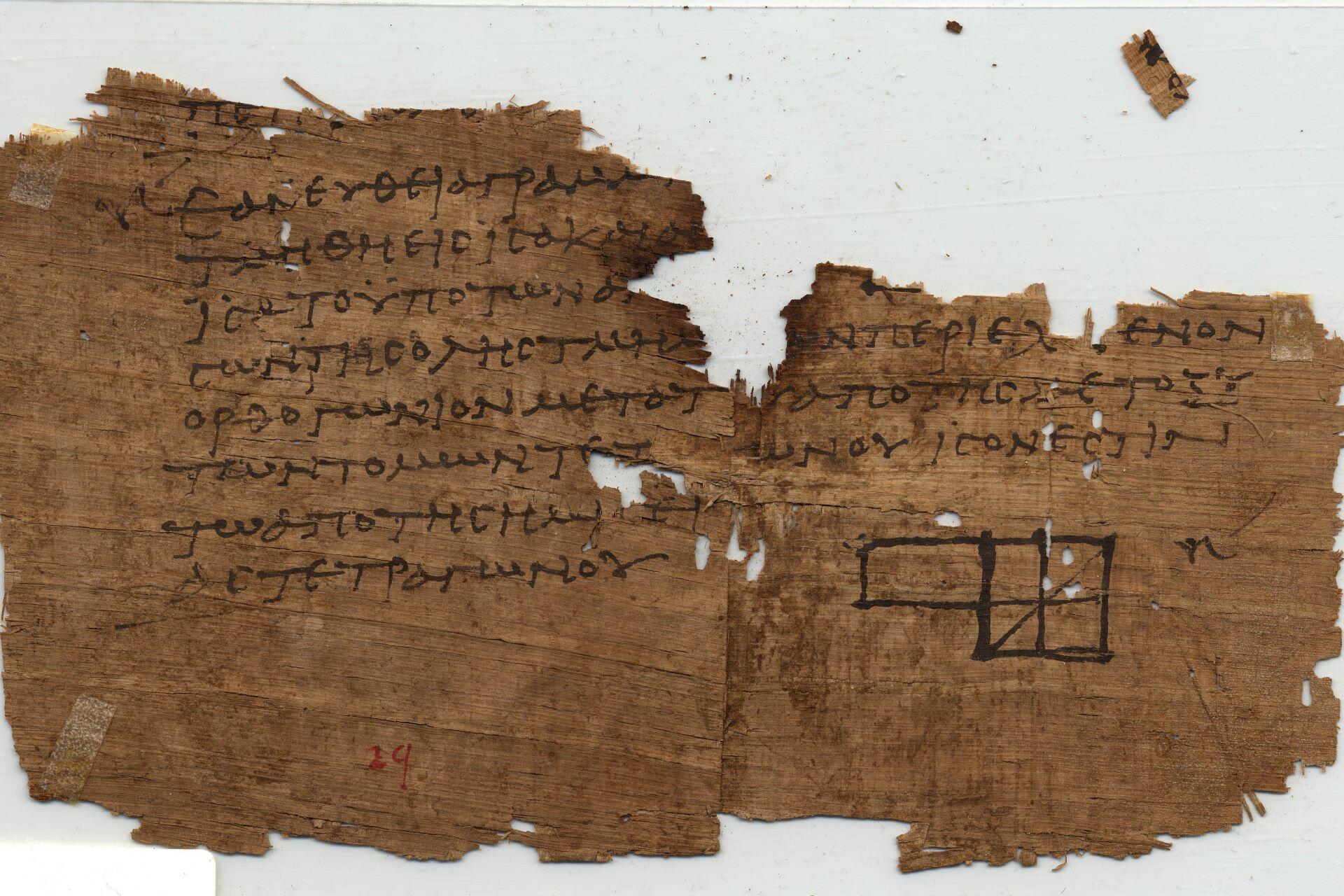
The second book is dedicated to irrational quantities. It comprises the last three books, which are devoted to geometry in space. Here, we see the construction of objects like the sphere, regular solids, the pyramid, the cube, the octahedron, the dodecahedron, the icosahedron, etc. Other books have been grafted onto Elements during the course of its centuries-long history. These were written by new mathematicians who wanted to develop and add to the chapters they're in. All of the books of the body of work, Elements, form the basis of the curriculum of mathematics that is taught today. The geometric plane, geometry in space, and arithmetic – all form part of the mathematical courses taught from primary school through higher education, which is why Elements is considered the Bible of mathematics. The seminal work was long considered the reference material for the mathematical world before being re-discussed centuries later. All of the information given by Elements can be seen as a photograph of the representation of the physical world in Euclid’s time.
Key Discoveries and Euclid Accomplishments
| Contribution | Description | Appears in Elements |
|---|---|---|
| Euclidean Geometry | A systematic approach to geometry based on definitions, axioms, and logical proofs that became the foundation of classical geometry. | Books I–VI |
| Mathematical Axioms | Basic principles used as starting points from which geometric theorems are logically derived. | Book I |
| Euclidean Division | A method of dividing integers that produces a quotient and remainder, forming the basis of arithmetic division. | Books VII–IX |
| Euclidean Algorithm | A procedure for finding the greatest common divisor of two integers through repeated division. | Book VII |
| Theory of Irrational Numbers | A geometric treatment of quantities that cannot be expressed as ratios of whole numbers. | Book X |
| Construction of Regular Polygons | Geometric methods for constructing regular shapes such as triangles, squares, and pentagons using a compass and straightedge. | Books I–IV |
Euclidean Division
In the section of the coursework and curriculum dedicated to arithmetic, Euclidean division is certainly one of the mathematical skills taught since antiquity⁵, which is just one reason we can consider him one of the greatest mathematicians ever. It is nothing more than the division that one learns in elementary school. Also called a whole division, it is composed of an operation between two whole numbers, called a dividend and a divisor, that yields the result called the quotient and the remainder. Making a Euclidean division of one number A (the dividend) by one number B (the divisor) permits us to try to find a whole quotient. That is to say, the whole integer found at the end of the division is called the remainder, which is the part of the dividend that we cannot divide further.
To better understand, here’s an example: With the dividend of 25, we divide by 4 (the divisor). The quotient turns out to be 6 because 6 × 4 = 24. What is left over is 1. The number 1, then, is the remainder. The common way to write this type of division is to place the dividend on the left side and the divisor on the right. The remainder is found under the dividend, while the quotient is found under the divisor. To verify that you have finished the operation, ensure the remainder cannot be divided further. It will necessarily be smaller than the divisor. It could be that the remainder is zero. In this case, we say that A is a multiple of B. Euclidean division is an integral part of our elementary courses, although it can and does become more complicated when adding decimals, etc. If you want extra practice beyond classwork, working with a math tutor can help you master long division and related arithmetic skills.
Mathematical Axioms
In his work Elements, Euclid wrote many axioms, mathematical propositions held as evident. It was at this moment in history that the mathematical world decided to designate the name “axiom” to all mathematical rules that were at once elementary and logical. Euclid gave 5 in his work:
- A straight line segment can be drawn joining any two points.
- Any straight line segment can be extended indefinitely in a straight line.
- Given any straight line segment, a circle can be drawn having the segment as radius and one endpoint as center.
- All right angles are congruent.
Euclid did not just collect mathematical facts. He showed how to start with clear definitions and a small set of axioms, then build reliable conclusions through proof. This step-by-step structure influenced how mathematics is taught and how scientific arguments are made, because it separates opinion from logical demonstration.
Euclidean Algorithm
The Euclidean algorithm is also an important concept taught in mathematics courses and deals with the greatest common factor.³ Also called the greatest common denominator, the GCD is the largest common divisor between two integers. Just like Euclidean division, it is considered a part of simple arithmetic. To find the GCD, list all the divisors of the two numbers. For example, take 10 and 26:
- 10: 1,2,5,10
- 26: 1,2,4,9,13
In this case, the greatest common divisor would be the number 2. In order to avoid having to make a list of all the possible divisors for each number, the Euclidean algorithm consists of making a series of Euclidean divisions. Applying this concept, it suffices to divide the largest number by the smallest one, then repeat the process until the remainder is 0. The Euclidean algorithm is explained in Book Seven of the Elements.⁷
Euclid first presents his research as a geometric problem, similar to other great mathematicians like Archimedes. He then searches to find the unit of measure for two segments. To do this, he decides to subtract the smallest segment from the biggest and to continue until he finds the ideal measure. This method is now the basis of all division and the cause of many headaches in primary school!
Theory of Irrational Numbers
Elements also addressed irrational numbers. Mathematicians in ancient Greece had assumed that all numbers could be expressed as ratios between whole numbers. Discoveries such as the diagonal of a square, however, showed that some quantities couldn't be represented this way. These quantities would later be called irrational numbers.
It was Euclid who helped formalize this concept. He carefully classified different types of magnitudes that couldn't be expressed as simple ratios. However, rather than using the modern language of algebra we use today, he approaches the problem with geometry. He compared lengths and areas to demonstrate that certain magnitudes were incommensurable, meaning they couldn't share a common unit of measurement.
Book X of Elements presents a systematic treatment of irrational quantities and geometric methods for analyzing them.⁶ By organizing these ideas into a logical framework, Euclid strengthened the foundations of mathematical reasoning, contributing to the long development of number theory.
Construction of Regular Polygons
Euclid also explored regular polygons. Using just a straightedge and a compass, Greek mathematicians attempted to construct geometric figures with precise proportions. Euclid provided clear instructions for constructing shapes like equilateral triangles, squares, and regular pentagons.

These constructions are presented in Elements as logical geometric procedures. The steps follow from previously established axioms and propositions. This approach showed how complex shapes could be created from simple principles, building geometry from a small set of rules.
Euclidean geometry describes space using points, lines, angles, and shapes that behave according to Euclid’s axioms. It explains why triangles, circles, and parallel lines follow consistent rules on a flat plane. For centuries, this model was treated as the default geometry of the physical world, and it remains a core part of math education today.
What's a Postulate?
Euclid had many great ideas, but not all could be proven. A postulate is an idea (also called an axiom) that is taken to be true even without proof. Contrast a postulate with a theorem, which is shown to be true by using proofs.
What Are Interior Angles?
Interior angles are the angles formed when a transversal crosses two other lines. The interior angles are between the two other lines; exterior angles are outside the two other lines. Same-side interior angles are the two angles on the same side of the transversal.
What Is the Parallel Postulate?
After Euclid knocked out four postulates (the foundation for absolute geometry), he waited before springing his fifth postulate, which in an English translation by Thomas Heath states: "If a straight line falling on two straight lines make the interior angles on the same side less than two right angles, the two straight lines, if produced indefinitely, meet on that side on which are the angles less than the two right angles."
Parallel Postulate Definition
If a straight line falling on two straight lines make the interior angles on the same side less than two right angles, the two straight lines, if produced indefinitely, meet on that side on which are the angles less than the two right angles.
Parallel postulate example
The fastest way to understand the Parallel Postulate is to set up some line segments. Use uncooked spaghetti. Take two strands and arrange them a bit apart from each other but leaning toward each other. Lay a third strand across the first two. You see you have created eight angles at the two intersections.
The sum of both same-side interior angles is less than 180°, so Euclid is saying the lines represented by the first two spaghetti strands will, if extended, eventually meet.
Draw the parallel postulate
Take a sheet of paper, pencil, and straightedge. Draw a short line, perhaps 10 cm long. Move away a few centimeters from it and draw another 10 cm line. Now draw a transversal (line crossing both of those first two lines). If the two interior angles on the same side add to less than 180°, the drawn lines will, if they continued, meet. Try it. See if they will meet.
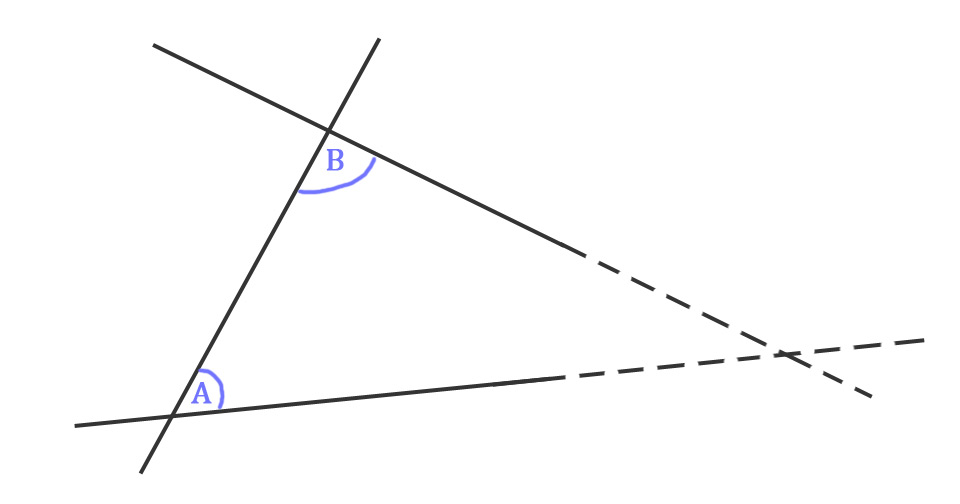
Now start again, but this time, draw two parallel lines. When you draw in the transversal, the two same-side interior angles will either be exactly 90° or will be a combination of an acute and an obtuse angle.
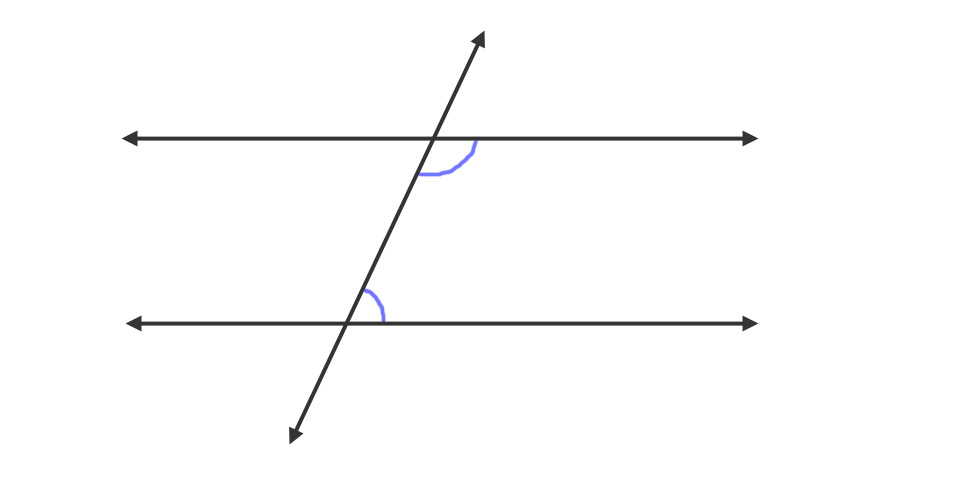
For any line and a point not on that line, Euclid shows us that only one line can be constructed through that point that will be parallel to that line. All other lines will eventually intersect with that original line.
Euclid's parallel postulate
Euclid's Parallel Postulate allows that transversal to create many different angles as it cuts across the two lines, but it all boils down to only three possibilities:
The lines are not parallel and two same-side interior angles are less than 180°; the lines will eventually meet on that side of the transversal.
The lines are not parallel and two same-side interior angles are greater than 180°; the lines will never meet on that side of the transversal.
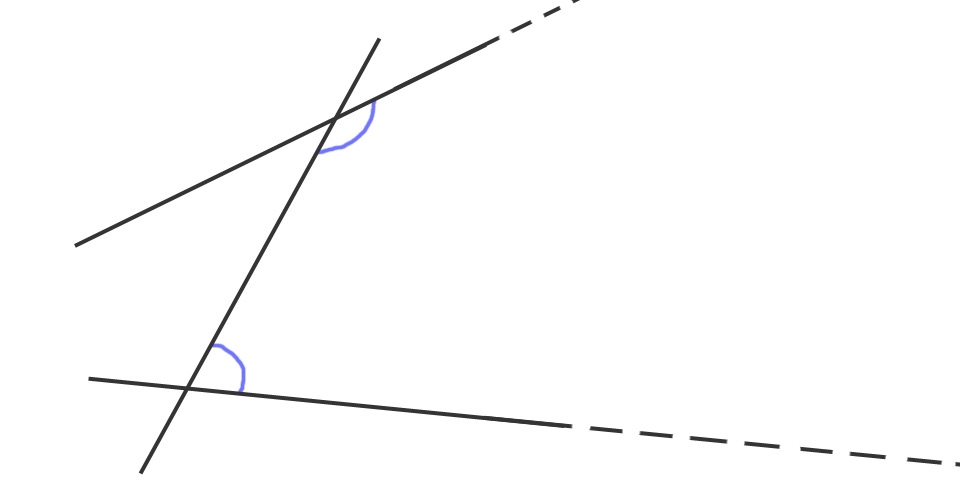
The lines are parallel and any two same-side interior angles will be equal to 180°; the lines will never meet.
As long as the two interior angles on the same side of the transversal are less than 180° (less than two right angles), the lines will meet. That allows the transversal to even be at a right angle to one of the lines, with the other line creating an acute angle.
Such a situation will create a triangle of the two lines and their transversal, which connects directly to the Pythagorean Theorem.
No matter the combination of lines, transversals, and same-side interior angles, Euclid's Parallel Postulate holds true. Only in the special case of parallel lines will a transversal of any angle create four interior angles such that two same-side interior angles are equal to 180°.
Euclid's Legacy and Influence
Euclid had an enormous influence on math and scientific thought. Much like the works of Ancient Greek mathematicians like Thales, Euclid's Elements was the standard mathematics textbook for over two thousand years, with students across Europe, the Middle East, and the later academic world studying its geometric proofs. His method of organizing knowledge, rather than simply listing mathematical facts, was one of his greatest accomplishments. Later mathematicians, such as René Descartes, would be inspired by his geometric principles. Euclidean geometry was the dominant model until the nineteenth century, when mathematicians began exploring non-Euclidean systems.⁴
Even today, Euclid's ideas still shape how mathematics is taught. Concepts such as axioms, geometric proofs, and logical reasoning are central to modern mathematical thinking. The lasting impact of Euclid is why he's known as the father of geometry, and his discoveries are still an essential part of mathematics.
References
- Britannica Editors. “Euclid.” Encyclopaedia Britannica, Encyclopaedia Britannica, Inc., https://www.britannica.com/biography/Euclid-Greek-mathematician. Accessed 5 Mar. 2026.
- Britannica Editors. “Elements.” Encyclopaedia Britannica, Encyclopaedia Britannica, Inc., https://www.britannica.com/topic/Elements-by-Euclid. Accessed 5 Mar. 2026.
- Britannica Editors. “Euclidean Algorithm.” Encyclopaedia Britannica, Encyclopaedia Britannica, Inc., https://www.britannica.com/science/Euclidean-algorithm. Accessed 5 Mar. 2026.
- Britannica Editors. “Euclidean Geometry.” Encyclopaedia Britannica, Encyclopaedia Britannica, Inc., https://www.britannica.com/science/Euclidean-geometry. Accessed 5 Mar. 2026.
- Britannica Editors. “Number Theory: Euclid.” Encyclopaedia Britannica, Encyclopaedia Britannica, Inc., https://www.britannica.com/science/number-theory/Euclid. Accessed 5 Mar. 2026.
- Fitzpatrick, Richard. Euclid’s Elements of Geometry. University of Texas at Austin, https://farside.ph.utexas.edu/Books/Euclid/Elements.pdf. Accessed 5 Mar. 2026.
- Weisstein, Eric W. “Euclidean Algorithm.” Wolfram MathWorld, Wolfram Research, https://mathworld.wolfram.com/EuclideanAlgorithm.html. Accessed 5 Mar. 2026.
Summarize with AI:
Did you like this article? Leave a rating!


 Loading...

