As a guitarist you can play and compose your own pieces of music. But you’ll probably also want to play pieces by your favorite artists, guitarists, and musicians. To build the skills needed to play your favorite pieces, consider private guitar lessons for personalized guidance.
Whether you like listening to rock guitar, jazz guitar, funk, blues, hard-rock, classical or even flamenco, there must be pieces that you want to learn to play on your guitar. Otherwise, why is it that you want to play the guitar?
To get learning all these different songs and guitar you don't have a lot of options - you’ll simply need to learn your chords to play the song. No discussion.
Guitarists that can't play chords are unheard of. And a piece without a chord is really pretty rare too!
But how do you read guitar chords, and how do you play them? Can you get help in the form of guitar lessons or tutorials? Do you need to know music theory?
In this piece, we'll answer all these questions - and show you some of the easy techniques to get to grips with learning, reading, and playing chords. If you want additional support while learning and playing chords, private guitar lessons can provide personalized instruction.





What's a Chord?
For the beginner guitar player, there's a lot to learn. But of all the things you could get to grips with, chords are one of the most important.
A guitar chord, like a chord on any other instrument, is a number of notes played at the same time. That's it, in theory - and chords can be anything from two notes played together to five or six.
On the guitar, the basic chords to know are open chords, major chords, and minor chords. There are power chords too, but we'll leave these aside for just a moment.
A major chord, firstly, take the first (the root note), the third, and fifth note of a major scale. So, in the key of C major, the notes here would be C, E, and G. A minor chord, on the other hand, would move the 'third' down a half step - so, in this case, you have E flat, or Eb.
(The three basic notes of the chord make up what we call 'triads'.)
Open chords refer to a type of chord shape - and they are the first chord shapes you will learn. On the guitar, they refer to the types of chords that use the notes of the open strings. They are opposed to the more complex barre chords that require you to fret all of the strings across the fretboard.
To power chords, briefly. These are unusually among chords as they don't have the minimum three notes. They just have two - the third and the fifth note of the scale! Because of this, they are neither major nor minor - and this, we guess, is where their 'power' comes from.
Guitar Chord Charts
To transcribe chords properly, musicians use what we call a chord chart or chord diagram. This is a visual representation of a chord on the guitar neck - meaning which fingers we would put where.
Thanks to this diagram, it is pretty simple to understand the movements you need to make for a chord.

In fact, every chord for guitar can be rewritten on a chord chart - as, with these chord diagrams, you can represent any arrangement of fingers on the neck. It's quite straightforward, meaning that you don't need to know anything about the theory of chord progressions or scales - because all these show is the physical demands of the fingering of the given chord on the fret board. (Although, to know how to play guitar fully, you should engage in a bit of music theory!)
Essentially, chord boxes simplify reading chords in the same way that guitar tabs simplify reading music.
A Chord on Guitar
The A Major guitar chord is a staple of the instrument -- and of many popular musical genres you'll be tackling on your way to guitar mastery. You'll be encountering this chord again and again, so today, we're going to be showing you the most common way to play it, a few variations that will allow you to play the chord in different positions on the fretboard, and some tips that will help these chords sound their best.
How to PlayA Chord on Guitar {#a}
The most common version of the A Major you'll come across is in open position near the top of the guitar, like this:
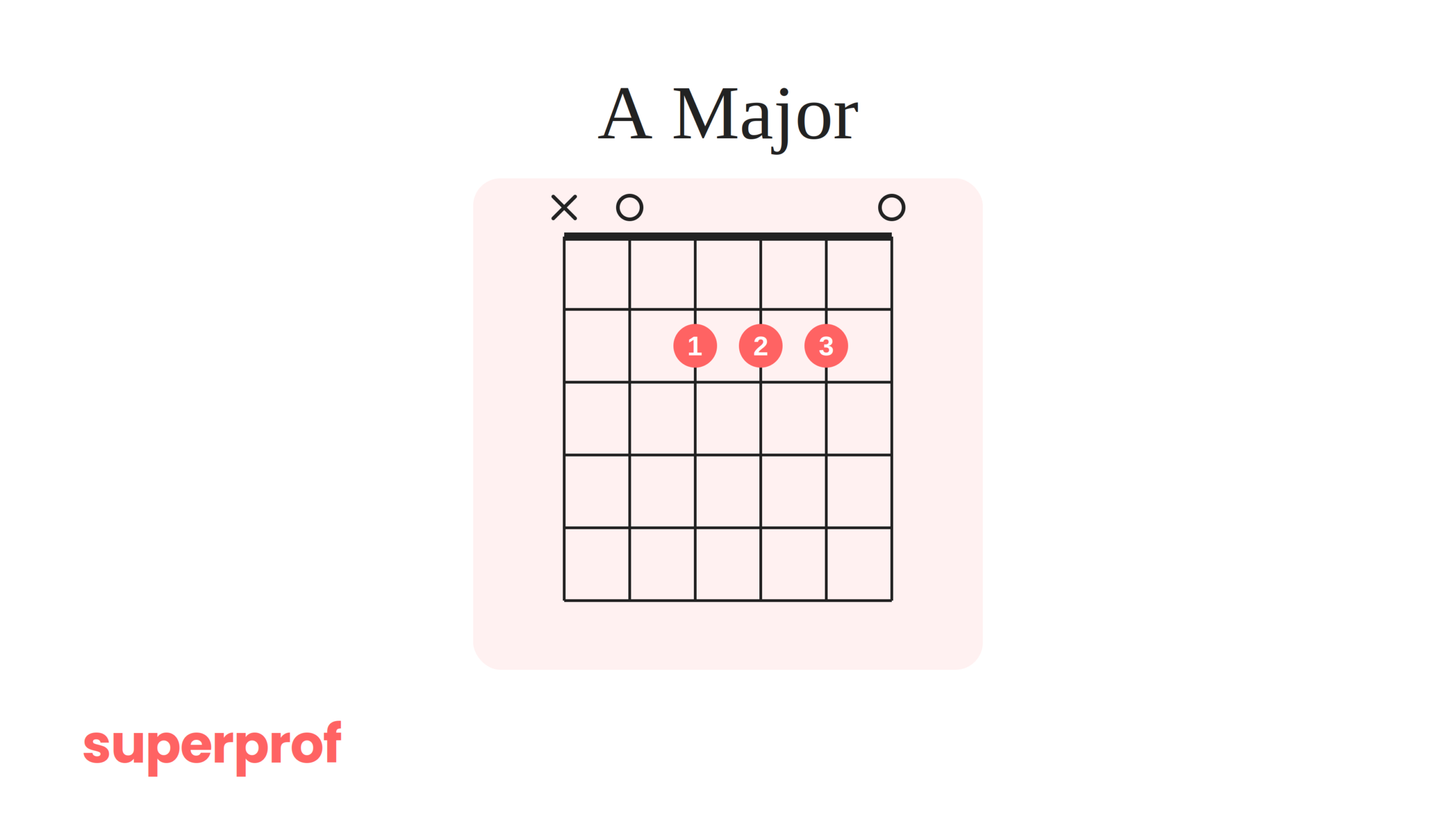
- Place your 1st finger on the 4th string/2nd fret
- Place your 2nd finger on the 3rd string/2nd fret
- Place your 3rd finger on the 2nd string/2nd fret
- Play strings 1 and 5 open
- Mute string 6
It's a simple configuration, but with all your notes being bunched together on the 2nd fret like that, you'll have to work hard at compressing your fingers to fit the tight space. What can help, however, is mastering the art of playing chords with your fingertips.
This will allow you to come down at a 90-degree angle, touching the strings only at the point you need and not obstructing your other fingers as you play.
A Chord Guitar Variant #1
Now, this isn't the only way to play an A Major chord. If you decide you want to mix things up in open position at the top of the fretboard, you can try this more complicated variant of the chord:
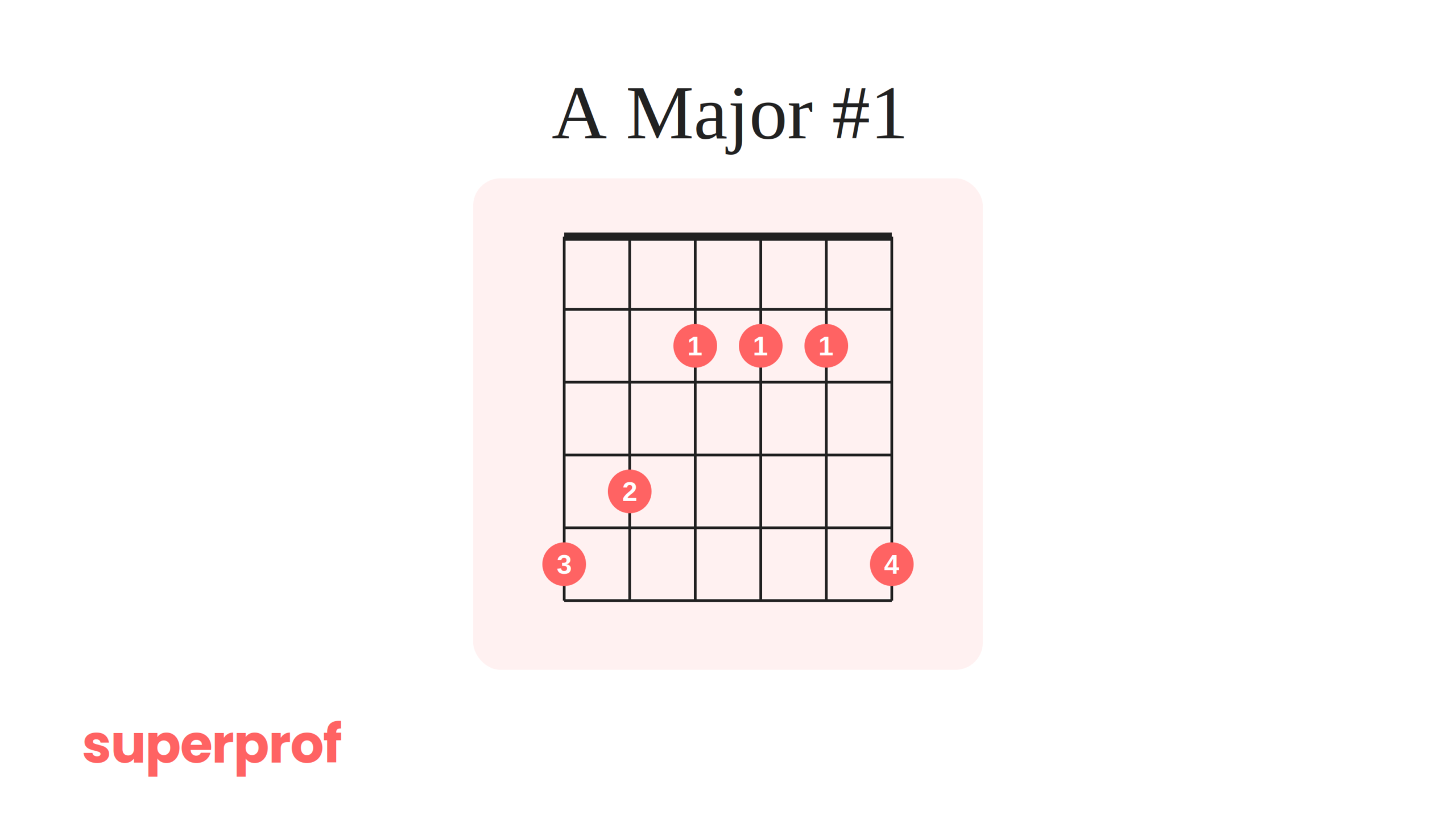
- Use your 1st finger to cover strings 2, 3, and 4 on the 2nd fret
- Place your 2nd finger on the 5th string/4th fret
- Place your 3rd finger on the 6th string/5th fret
- Place your 4th finger on the 1st string/5th fret
This is a big stretch, obviously, so if you have smaller hands you might not be able to pull it off.
A Chord Guitar Variant #2
You might instead try this variation near the 4th fret:
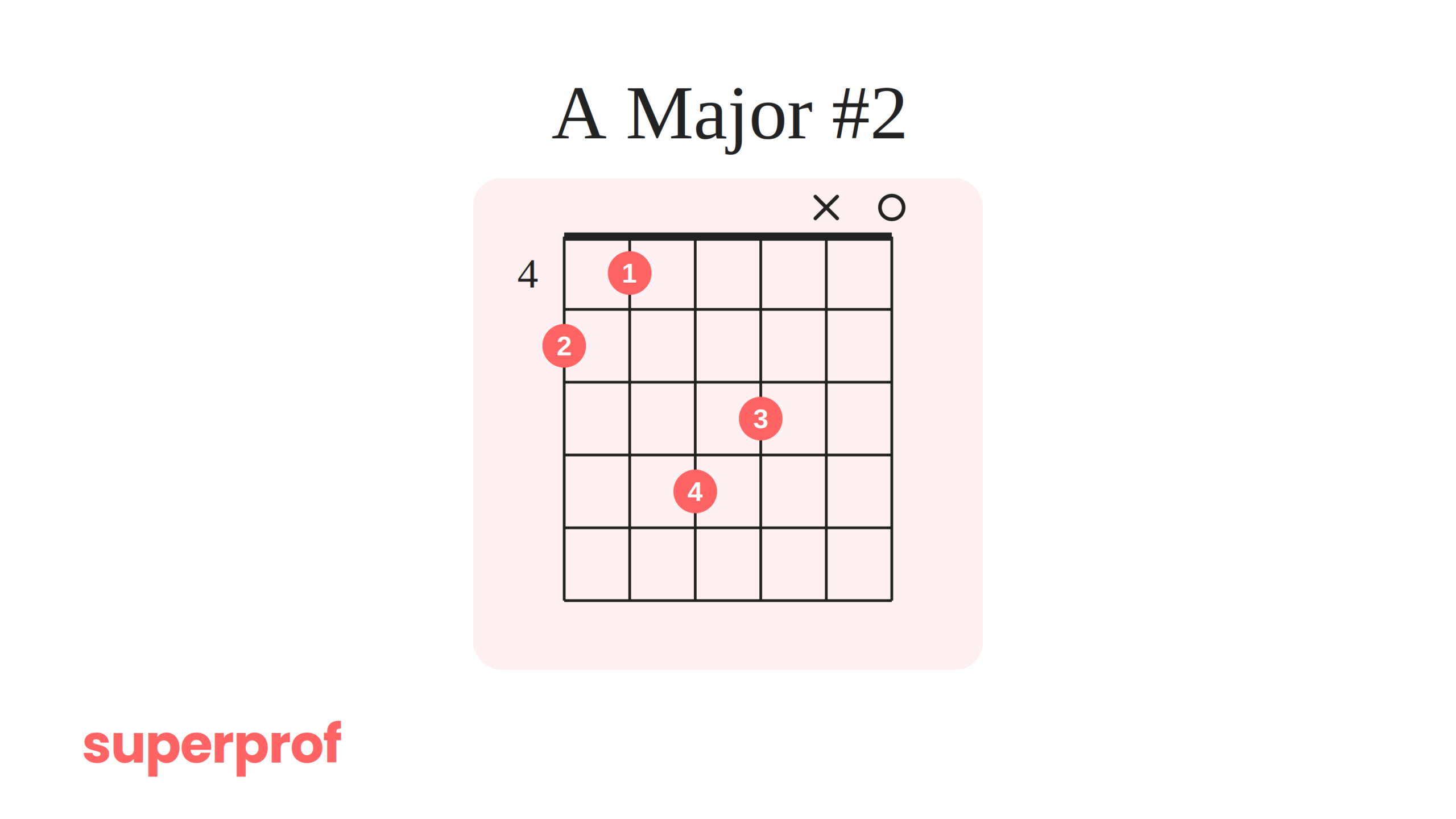
- Place your 1st finger on the 5th string/4th fret
- Place your 2nd finger on the 6th string/5th fret
- Place your 3rd finger on the 3rd string/6th fret
- Place your 4th finger on the 4th string/7th fret
- Play string 1 open
- Mute string 2
A Barre Chord Guitar
Finally, we can't forget the bar chord version of A Major, on the 5th fret:
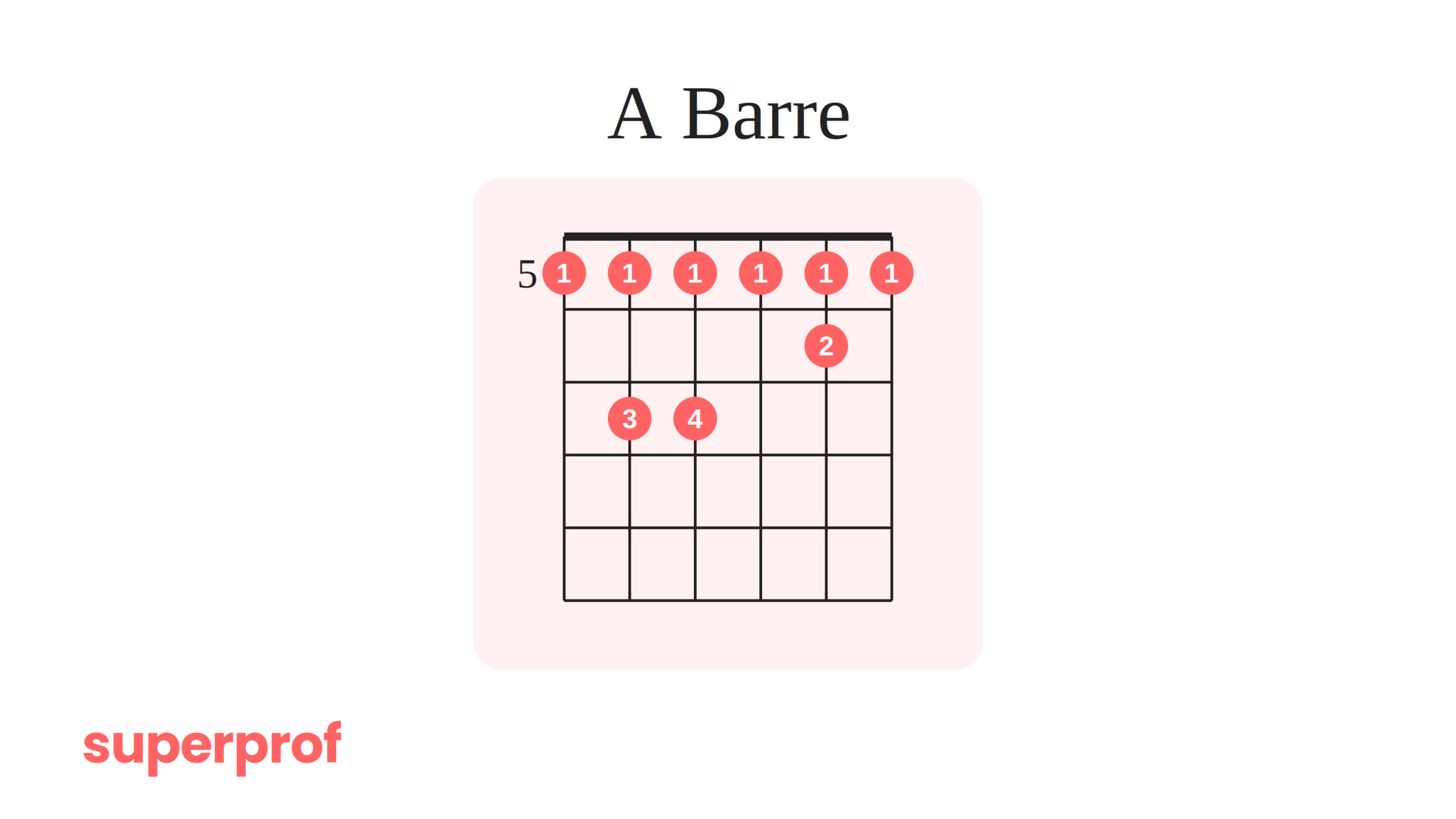
- Use your 1st to cover the strings at the 5th fret
- Place your 2nd finger on the 3rd string/6th fret
- Place your 3rd finger on the 5th string/7th fret
- Place your 4th finger on the 4th string/7th fret
There are even more variations of A Major that you can learn, and each will give you the ability to play the chord in a slightly different position on the fretboard. This will come in handy when moving around playing more complicated tunes.
How’s a Chord Chart Written?
To read and play guitar chords, you must learn how to read chord charts and then how to play your guitar chords.
On the box, you’ll see three kinds of information - strings, frets, and fingers. With these three factors, you can represent any chord. A chord box will tell you exactly which finger to place, and where to put it. It'll tell you, say, to put your first finger on the second fret of the first string.
To read a chord box you should know that your guitar strings are represented by the vertical lines, and that the frets are represented by the horizontal lines. It's like an inverted tablature.
The double horizontal line that you can see (or sometimes a thick black line) represents the nuts on the neck of your guitar. If you see this, your hand needs to be right up there in the open position.
A chord box also includes numbers - each finger on your left hand is associated with a number between 1 and 4. The thumb is often indicated with a ’T’ or a ‘P’.
Check for exceptional guitar lessons near me.
Differences between Guitar Tabs and Chord Charts
Tabs are a special way of writing music for the guitar. They are a visual representation of your guitar strings. They help you know where to put your fingers during many a guitar lessons.
Find guitar lessons in Chicago with affordable tutors on Superprof US.
On a chord box, you can see three key bits of information:
- fingers
- frets
- strings
The combination of these three factors can describe any chord, and therefore charts may seem immediately a bit more complex than guitar tabs.
However, this isn't really true. Guitar players use these diagrams just to see the shape of the chord. There is no rhythm, strumming pattern, or anything else shown. It's just merely the shape of your fingers.
With Superprof is easier than ever to get a personal trainer at home. Just click guitar lessons near me, and you'll find plenty of options on our site.
Reading a Chord Chart
On a chord box, you may see a few unfamiliar symbols. For example, an ‘X’ means a string should not be played or strummed. An ‘O’, meanwhile, indicates an open string which should be played without placing your fingers on a fret.
The numbers 1, 2, 3 and 4 correspond to the fingers on your left hand and tell you how the chord should be shaped.
- 1 is your index finger
- 2 is your middle finger
- 3 is your ring finger
- and 4 is your pinky.
If you see Roman numerals like I, II, III, IV, etc, they tell you the fret boxes on the neck of your guitar.
For example, if you see a III on a chord box, you know that the chord starts on the third fret on the neck.
If there’s no Roman numeral, but the double line for the nuts is there, that means that the chord should be played at the very top of the neck. This is common for the main major and minor chords on the guitar (the open chords!).
Take exceptional guitar lessons here now or find online guitar lessons for kids.
Get access to useful online guitar lessons here.

For those learning to play guitar, learning how to read chord charts is a valuable skill that will allow you to play different chords and to appreciate all of the different positions in which the same chord can be played.
The note that you generally begin to play your chord with, and the one that you start with when you’re breaking down a chord in arpeggio.
It’s also the bass note which gives the chord its name.
Some Chords You Really Need to Know.
If you want to quickly progress to playing chords and recreating pieces of your favorite music, there are a few key chord charts that you need to study, practice, and learn by heart.
The key chords to know are A minor, E minor, C major, D major, and G major.
Just by using these five chords you can play many popular pieces of music, especially segments of pop and rock songs.
Of course, this list of five chords is not exhaustive (not by any means!), and nothing requires you to limit yourself to them. All five are from the same chord progression, G major.
Practice to Improve Your Chords on the Guitar
This exercise isn't necessarily appropriate for beginners, but is more suited to people who’ve already had a few practice sessions with the guitar and are starting to feel comfortable.
- Place your hand correctly on the neck of the guitar.
- Position your fingers for a chord as you would normally, but keep your hand hovering over the neck and don’t actually touch the frets.
- When all of your fingers are hovering in the right place, push them all down onto the neck at the same time and don’t move.
- Lift your hand and repeat
- If the chord sounds right, you can repeat this exercise with other major and minor chords to test your positions.
- But if the chord sounds wrong, don’t try and check for the right position. Instead look at your hand to see if you can understand where you’ve gone wrong and try to fix your position.

It’s excellent practice that helps to recreate a real situation. When you’re playing a piece of music on the guitar, you can’t make any mistakes and all of your positions need to be right the first time around. Otherwise your playing will be sloppy and slow and you will lose the rhythm of your guitar playing.
Another advantage of this exercise is that it will help you gain speed - moving all of your fingers at once will help you get into the right position quickly, especially if you’re playing arpeggios. Your dexterity and fluidity will be improved.
Guitar Fingering Charts and Finger Placements
There are thousands of chords you could learn to play on the guitar. There are only five, however, that you should learn to play first. They are (in an order made for easy memorization): C, A, G, E, and D.
In addition to being an easy bunch to remember, you can play these chords in an "open string" position, which makes them easy for guitar newbies to master. Beyond that, though, they also form the basis of hundreds of popular songs.What's a Guitar Fingering Chart?
A guitar fingering chart is a group of notes that create a harmony when they are played together. There are multiple ways you can play a note on the guitar. You can play the string open, without holding down any frets, or you can play by holding the guitar string down at a specific fret on the guitar’s fingerboard.
How do I Read a Guitar Chord Fingering Chart?
In case you've forgotten (or never learned) how to read a chord chart, this refresher will get you up to speed.
Chord charts are a visual representation of different chords when they are played on the guitar. They include a series of vertical lines, which portray the different guitar strings, and horizontal lines, which show the guitar frets.

Dots on the chart show where you should place your fingers, and the associated numbers indicate which fingers you should use to hold the strings. "X's" above a string denote that you should mute (or not play) the string, while "O's" mean you should play the string open.
Keep these details in mind as you learn the basic chords and refer to these notes if you forget how to read a chord chart.
Guitar Finger Placement & Numbers
If you're not familiar with finger numbers, here's a quick review:

- "1" is your index finger
- "2" is your middle finger
- "3" is your ring finger
- "4" is your pinky
Very rarely, you'll see a "T," which indicates you should fret the string with your thumb. For most chords, though, "1" through "4" are all you need.
Guitar Fingering Chart Examples
Now, onto the chords themselves. Here are the chord diagrams for C, A, G, E, and D, along with an explanation on how to play each and where to place your fingers.
C Major Guitar Fingering Chart

C Major Guitar Chord Finger Placement
- For this chord, you'll be muting the 6th string
- Place finger 1 on the 2nd string/1st fret
- Place finger 2 on the 4th string/2nd fret
- Place finger 3 on the 5th string/3rd fret
- Play strings 1 and 3 open
A Major Guitar Fingering Chart

A Major Guitar Chord Finger Placement
- For this chord, you'll be muting the 6th string
- Place finger 1 on the 4th string/2nd fret
- Place finger 2 on the 3rd string/2nd fret
- Place finger 3 on the 2nd string/2nd fret
- Play strings 1 and 5 open
G Major Guitar Fingering Chart

G Major Guitar Chord Finger Placement
- No muted strings on this one
- Place finger 1 on the 5th string/2nd fret
- Place finger 2 on the 6th string/3rd fret
- Place finger 3 on the 1st string/3rd fret
- Play strings 2, 3, and 4 open
E Major Guitar Fingering Chart

E Major Guitar Chord Finger Placement
- No need to mute anything on this chord either
- Place finger 1 on the 3rd string/1st fret
- Place finger 2 on the 5th string/2nd fret
- Place finger 3 on the 4th string/2rd fret
- Play strings 1, 2, and 6 open
D Major Guitar Fingering Chart

D Major Guitar Chord Finger Placement
- Be sure to mute strings 5 and 6 for this chord
- Place finger 1 on the 3rd string/2nd fret
- Place finger 2 on the 1st string/2nd fret
- Place finger 3 on the 2nd string/3rd fret
- Play string 4 open
Advice for Playing Guitar Chords
To achieve success reading and playing guitar chords, here are a few tips that apply to any guitarist whether you’re a beginner or experienced.
- Learn to position your fingers correctly on the neck of the guitar. At the beginning, focus on your left hand and make sure that each finger is only touching one string at a time. Once you feel comfortable with the position of your hand on the neck, begin strumming the strings with your right hand.
- If one of your fingers is in the wrong position, move it and put it in the right one. Don't try and move your fingers around too much, or you'll begin to pick up bad habits, make your position uncomfortable, and you won't be able to reproduce the sounds afterwards.
- Keep it simple, begin each chord and position from the beginning. Pay attention and think about how each chord should be shaped.
- Why are you having trouble? Is it because your fingers are touching other strings? Are you not pushing hard enough? Or are you accidentally pushing on other strings with your right hand?
- When you’ve finally hit all of the strings right to play the chord, then try and play each string separately and keep the fingers of your left hand in the same position. Each note should sound cleanly without any muting or interference. If there's a lot of interference on the note, it means your finger positions aren't quite right. Either your fingers are touching other strings, you aren't pushing hard enough, or your palm is muting the sound.
- Teach yourself to just push on the strings with the tips of your fingers. Work on your positions during every guitar lesson until you can play each chord without any errors. Your playing should be fluid and natural.
- Practice regularly, at least 10 minutes every other day. Regular practice will help you build up calluses on your fingers. Your speed of playing will improve and you'll gain muscle memory.
- Once you've mastered your chords, try playing them in one order and then in another. Do the exercise again, positioning your fingers above the neck without actually touching it. If you want to improve your skill playing guitar, this is the way in which you'll become better. This exercise will improve your precision, sound, and dexterity.
Every guitarist learns how to read and play chords, but you can distinguish yourself by making your playing precise and strong.
This is why we recommend starting slow, and breaking down each chord to its composite notes. Once you're comfortable, you can begin to increase your speed. This will help you stay motivated during your guitar lessons!
And whatever happens, make sure that you learn your chords by heart and then begin to integrate them into your playing.
Summarize with AI:
Did you like this article? Leave a rating!


 Loading...