If you want to get better at guitar and one day play classics like Led Zeppelin’s Stairway to Heaven - or the famous slow rock Still Loving You by Scorpions - you need to work on one guitar technique in particular: arpeggios.
But how do you get started? Are there guitar tutorials?
What are the basics you need to know before you start to learn guitar?
These things are essential for knowing how to play the guitar - for both rhythm guitar and for guitar solos, for music theory and for guitar practice.





What are Arpeggios?
Arpeggios are a basic guitar technique and one of the first things you should learn as you begin to play.
Lots of musicians use them, whether they’re playing rock, hard-rock (Slash), blues (Clapton) or jazz guitar.
Arpeggios are one of those tools that are great for jamming and improvising, because they consist of taking the notes of a chord and playing them separately. So, rather than taking a guitar chord as played altogether, arpeggios all you to play the notes at different times.
Whilst this helps you to practice, and understand, your guitar chords, it's more than that too.
A Bit of Theory
Arpeggios are intimately linked to learning your guitar chords and they are often taught along with the chords themselves.
This is particularly true of music theory, in which you are tested, for ear training, on the sound of the major scale - say the C major - and the harmonic structure of the corresponding chord shapes. These arpeggios are the basis of many melodies - including those of your favorite songs - so they are worth learning.
If you want to improve your guitar playing technique, the arpeggio of a chord contains the same notes as the chord. Knowing the notes of the chord is a key part of playing its arpeggio. The base note of the chord will normally become the tonic note of the arpeggio.
However, there are as many variations of an arpeggio as there are notes in a chord.
There are two different types of chords - major and minor. A minor chord has a root or base note, minor third, and perfect fifth, while a major chord has a root, major third, and a perfect fifth.
So for either triad, an arpeggio would begin with the base note, followed by the third and then the fifth.
For example, in G major the dominant note is G, and it would be followed by B and D.
You can search for some of the most effective guitar lessons in Atlanta here.

Why Play Arpeggios for Rhythm Guitar?
Arpeggios can sometimes be considered finger picking, since it’s a method that consists of playing the strings of your guitar one by one, instead of playing them all at once. This is a soothing style that is great as a backdrop to singing, as the melody will stay soft and soothing.
Specifically, here, we are using this style of guitar for rhythm guitar - i.e. to accompany a voice or another instrument.
Knowing how to play arpeggios means that you can play many different chords and tab sets. Arpeggios complement the other combinations of notes and sounds with their melodious and harmonious background - but without giving that heaviness that strumming would give the piece.
In popular guitar music, you can’t really just play arpeggios on their own. Playing arpeggios is a great exercise to practice your guitar, but it may quickly become boring for you and your audience if they aren’t accompanied by other instruments, rhythms, or a singer.
But they also may well not. In classical guitar music, whole pieces can be made of arpeggios, and there is nothing boring about it at all. Arpeggios allow you to play very complex chord progressions - that are incredibly interesting to listen to. Check out Bach's Cello Suites for some incredible uses of arpeggios.
How to Play Arpeggios for Rhythm Guitar
Arpeggios are often recommended to beginners as an exercise because they help to build up your experience playing guitar and help you to learn more about the instrument and the chromatic and melodic structure of the fretboard.
Two Styles of Playing Arpeggios
There are two different styles of playing arpeggios on your guitar - the vertical and the diagonal method.
In the vertical method you play one or two notes per string. In the diagonal method, you play at least two notes per string, which allows you to play arpeggios based on 4 note chords.
Why Play Arpeggios?
- The loops in arpeggios are repetitive patterns on the neck of the guitar. This is great for any guitar player to practice their technique.
- Playing arpeggios will help you play faster and more precisely in general - the speed of your playing is very important because each note is played back and forth in a range that goes up and down.
- Your fingers will become quicker and more agile - think of the amazing Django Reinhardt who played arpeggios with only two fingers!
With or Without a Pick
Often people use a pick to play guitar. However, arpeggios can easily be played with your fingers - in what we refer to as 'fingerstyle'.
Each method has its advantages and disadvantages. Playing with a pick will give you more control as you pick strings - however, it is a technique for higher skill levels to cross strings whilst picking quickly. Playing with your fingers will allow you to go faster - as you can cross strings naturally.
There’s also the option of using a long fingernail - you’ll get a sound close to that of a pick, but with your fingers.
It’s all about using the thumb of your right hand to play the three bass strings - E, A, and D.
Take some of the most effective guitar lessons here.

Next, place each finger on a string.
- Put your index finger on G
- Middle finger on B
- And ring finger on E.
Each finger goes in a specific order, and it will be numbered on the guitar tabs:
- 1 for your index finger
- 2 for the middle finger
- 3 for the ring finger
- and 4 for your pinky.
The Position of Your Hand
To gain flexibility and avoid a cramp, the position of your wrist is crucial. It should be slightly bent, so that it almost makes a right angle from your forearm. However, make sure that you don’t exaggerate the bend; the shape should stay natural.
The 3 Best Guitar Fingerpicking Patterns
Guitar Fingerpicking is a commonly used technique for guitar playing and can be heard in classic hits like "Stairway to Heaven." Unlike strumming with a guitar pick, your finger plucks each string without a guitar pick.
When it comes to fingerpicking your guitar, there exist three essential fingerpicking patterns. Learning each of these patterns is essential because they'll help you acquire the manual dexterity and muscle memory needed to play the many songs that you've been eager to learn.
Guitar Fingerpicking Pattern #1: Roll Technique
The first guitar finger pattern starts with a simple roll, which is a technique that can be done up or down. This fingerpicking pattern involves "rolling" your finger across several strings in a smooth manner. It's a cross between fingerpicking each string separately and strumming the strings all at the same time.
Not only do guitar rolls help you develop guitar-playing muscles but they're great to use when playing music with others.
Rolling Up:
Rolling up is the easiest roll pattern to learn. When rolling up, you'll first use your thumb, then your index, middle and ring finger. Until you build up dexterity in your fingers, you'll want to start out slow.

What is PIMA? The letters in PIMA stand for the Spanish words for your fingers. P = pulgar (thumb), I = indice (index finger), M = medio (middle finger), A = anular (ring finger). When the pinky shows up, it is normally labeled with the letter ‘c’ or ‘e’.
Rolling Down:
Rolling down is a little harder to do but uses the same concept as rolling up. Start out a bit slower until you get the hang of it. Use a metronome to help you to keep time and build up speed.

Rolling Up and Down:
Try combining the technique of rolling up and rolling down. Once you get accustomed to rolling, this is how you'll play many tunes. Although you can use the rolling pattern to play any chord, realize that some chords may require the use of different strings.

Guitar Fingerpicking Pattern #2: 4-Step Technique
The second pattern, called the 4-step fingerpicking pattern, is much more difficult to learn than the simple roll. This pattern is named as such because you must make four motions using independent fingers to complete the entire pattern.
Simplified 4-Step:
This technique takes a simplified approach as an introduction to learning the 4-step. Instead of alternating the first three low pitch bass strings (strings 6, 5, 4) with your thumb, you simply pick the first bass string with your thumb and then the other strings with your index, middle and third finger.

Alternating 4-Step:
When you get good at the simplified way to fingerpick, you can try adding another bass string and alternating back and forth using your thumb. In general (but there are exceptions to the rule), you'll typically use your thumb to pick string 6, 5 and 4; then finger 1 (index finger) for string 3; finger 2 (middle finger) for string 2 and finger 3 for string 1. You can then move on to more advanced chord progressions.
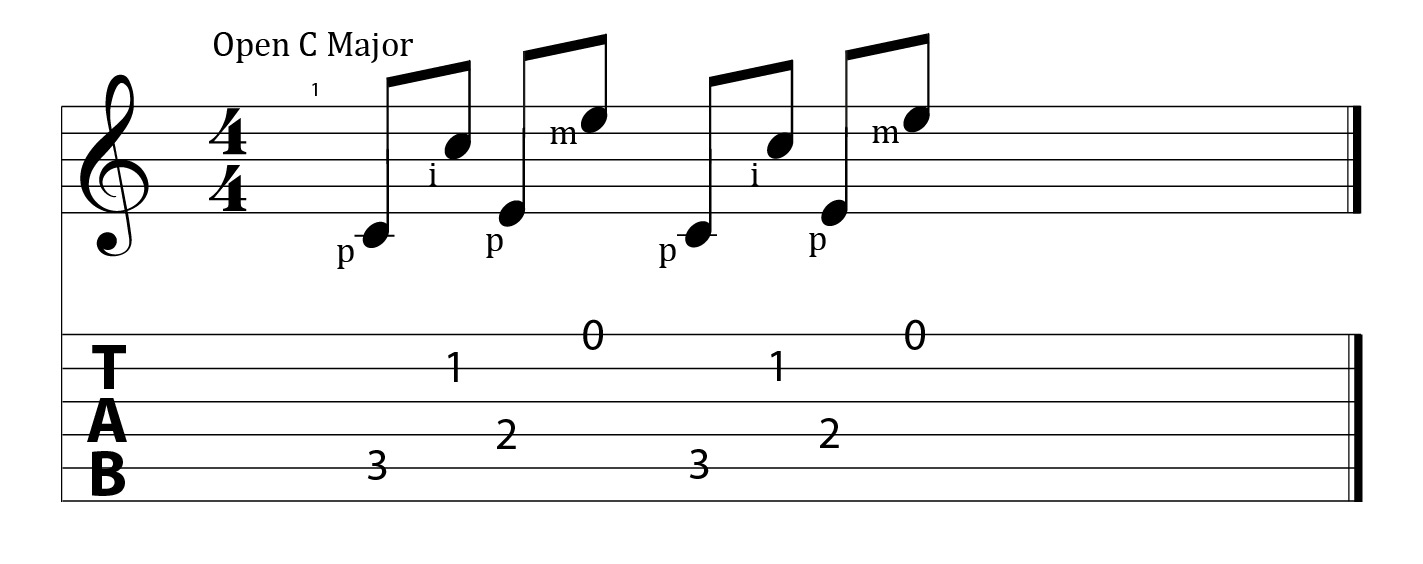
Guitar Fingerpicking Pattern #3: Travis Picking Technique
The basic Travis guitar picking pattern is named after Merle Travis, a famous country singer, songwriter and guitar player. To make it easier to understand, we'll break this technique down into four steps.
- For the first step in Travis fingerpicking, you simply use your thumb to play all quarter notes.
 Travis picking technique step 1
- The next step is similar to the alternating 4-step pattern in that you alternate between bass notes using your thumb to pick the A string (5th string) and D string (4th string).
 Travis picking technique step 2
- Step 3 is performed by mixing in a melody note while you're fingerpicking the alternating bass pattern. For example, to make a C chord simply add in a C note on the B string (2nd string).
 Travis picking technique step 3
- In this step, you add in even more melody notes along with the alternating bass notes. This step can get a bit complex, so it pays to take your time by going through each note and measure carefully. Over time, you'll build up speed.

Although it'll be slow going in the beginning, continue practicing these techniques and use a metronome until you're able to play at a faster rate.
Whether you use the simple roll, 4-step or Travis picking pattern, you can play any chords. Just remember to make any necessary adjustments to chords that require the use of other guitar strings. Different styles of music use different patterns and chords, so try them all out and experiment to see which you like playing best.
Using Arpeggios for Lead Guitar.
By breaking down the chords and learning them as arpeggios, it’ll be easier for you to learn the chords, point blank.
However, there is another way to use your arpeggios. Working on arpeggios will help your improve your jamming and composition. During an arpeggio you’re just playing up and down a sole chord, which is a great way to frame your guitar solos - but you don't have to use these arpeggio shapes as whole units.
To explain this better, let's have a brief look at the theory of soloing.
What is a Guitar Solo? and How is it Relevant to Arpeggios?
If you want to play jazz guitar, or blues guitar, you're going to need to learn how to solo and how to improvise. This will come in handy in rock guitar songs too - but most guitar teachers teach it through jazz.
We know that you are beginner guitar player, and might not really yet know how to play guitar. However, this stuff, although a little complex, is dead important.
When guitar players solo, what are they doing? Just playing random notes? Or is there something special going on here?
Every jazz standard, or famous blues song, is based around a chord progression, in which major chords, minor chords, and every other sort of chord that's used follows sequential chord changes. If the piece is in the key of C, say, this C will be the root note of the piece.
Now, a C chord is made up of C, E, and G. (The same is true of the C major arpeggio, obviously.) So, when the rhythm section of the jazz band plays a C major chord, the soloist knows that any of the notes C, E, or G will sound nice over the top of this chord. If the soloist plays a C#, however, he might have hit a wrong note.
But the C chord will ultimately change (because the best guitar songs or jazz standards ain't gonna stay on the same chord the whole way). Say it moves to E. The notes of the E arpeggio are E, G#, and B. Now, we have to play some different notes over the top (because playing a G - as you would over a C chord - might sound a little strange).
Throughout all these different chord changes, a good guitarist will be able to play notes that make sense in their solos. This happens by learning the arpeggios and turning them into interesting melodic lines that, in the guitar world, we call 'guitar licks' or just 'licks'.
If you are serious about soloing, you will need to learn some scales - the pentatonic, the harmonic minor, the blues scale, the mixolydian, if you are feeling out there - as well as the chords that these can be played above. However, the arpeggios provide an incredibly easy way to remember these, as the arpeggios are halfway between a chord - any chords, from jazz chords to open chords, to barre chords - and its corresponding scale.
Get the best online guitar lessons here.
Working on an Arpeggio
There are plenty of ways to practice arpeggios - and if you take a guitar lesson, you will definitely learn more. But here we want to suggest some ways to incorporate your arpeggios into your jazz or blues licks.
These are best done when you have the basics of arpeggios down a little.
- Arpeggios, if you play just three of the notes together, are known as triads. These are like the bare bones of the chord. Try it. You need to make sure you only have one note on each string.
- Once you have an arpeggio down, try and find different places on the fingerboard where you can play the same arpeggio. So, for the C major arpeggio, where else can you play that?
- Don’t hesitate to work on both major and minor chords. And, when you are ready, and a seventh in their too.
- Extended arpeggios - another way to play an arpeggio is to do them all the way up and down your guitar neck. This means that you are not only playing the basic triad, but are stringing a long line of notes, repeating the arpeggio across different octaves.
- Use all of these elements to develop your guitar techniques. When you practice all this stuff, you'llll improve your dexterity and comfort in the whole range on your guitar, and it will help you prepare for improvisation.
Advice to Improve Your Arpeggios
Just like anything else, learning arpeggios will take some training, practice, and patience. Whilst they are, in some respects, a basic guitar technique, they are also used in some of the most outrageously complex guitar tricks there are.
Teach Yourself
You can easily teach yourself arpeggios by following online guitar tutorials on your computer or tablet. You can find free online guitar lessons on YouTube, for example.
Learn Arpeggios with a Teacher
Alternatively, you could sign up for private guitar lessons with a qualified teacher. Classes will take place at home over a set period and your instructor can walk you through arpeggios and all the main major, minor, and major seventh chords - either in fingerpicking accompaniment or for soloing. Alternatively, consider exploring private guitar lessons to receive personalized guidance on arpeggios and chord techniques.
If you’re trying to find a guitar class, get in touch with a local music store or check out noticeboards in supermarkets and post offices - there’ll often be ads posted by professionals offering private guitar lessons. A guitar course is a great thing to do, because alongside arpeggios, you will learn all sorts of things from power chords to vibrato to the pentatonic scale.
Check out for some of the most effective guitar lessons in Philadelphia here.

The advantage of taking private guitar lessons is that you can avoid picking up any bad habits and learn the proper way to sit and hold yourself. For acoustic guitars or electric guitars, it's a really excellent way to ensure that you make the most out of your new guitar.
A teacher can give you advice and appropriate exercises that will help you gain the dexterity and speed you need to master arpeggios. You can also find other free guitar tutorials with our other article or online guitar lessons for kids on our website! For focused support with dexterity, speed, and other guitar skills, private guitar lessons can provide valuable instruction.
A last bit of advice:
To succeed at arpeggios, here are a few final tips:
- In accompaniment, work on the articulation of your thumb and fingers to gain agility and speed.
- Don’t jump in at the deep end, but begin with easy guitar pieces and gradually increase in difficulty.
- Don’t hesitate to play with a metronome to help regulate your rhythm. At the beginning, you may have to slow down songs to learn them, and then gradually increase your speed to 100%. It's a good way to learn to play songs because it ensures you get your technique right.
- Don’t limit yourself to just one piece of music - make sure you’re working on a few different pieces and styles of music so that you can really learn all of the different subtleties of arpeggios.
- Don’t struggle to find time to play - make sure you’re practicing regularly. Just 10 or 15 minutes a day is better than 2 hours all at once at the weekend.
- An ideal breakdown might be spending 5-10 minutes working on your range and technique and then 10 to 15 minutes working on your pieces.
- And finally, stay motivated and keep playing guitar!
For bass guitar lessons, see here.
Summarize with AI:
Did you like this article? Leave a rating!


 Loading...