

Marathon running has increased in popularity over the last few years, both for athletes and spectators. Applicants for marathons are reaching incredible numbers, while millions of supporters flock to the sidelines each year. Are you looking to get into running, and maybe even completing the major marathons in the world and earning a Six star medal (or maybe even a Nine!)? Find out all about this marathon series and start planning your marathon year, or years!
What are the 7 major marathons?
- Tokyo
- Boston
- London
- Sydney
- Berlin
- Chicago
- New York


What Are the Seven Major Marathons?
The World Marathon Majors (WMM) are a series of championship-style competition marathons. The competition began in 2006, incorporating several existing marathons from around the world that had amassed a reputation for high standards. These races allow competitive, professional, elite athletes from around the world to compete for points and win the jackpot.
The vast majority of participants are not professionals, and instead are amateur athletes or enthusiasts. The level of competitiveness among this group varies, so you can be as serious or relaxed as you’d like!
participants finished the seven World Marathon Majors combined
Runners often pursue finishing all seven races to earn exclusive recognition from the Abbott World Marathon Majors organization. Here are the current awards you can win by participating in this marathon series:
- Six Star Medal & Six Star Hall of Fame: Athletes who complete the “original” six marathons.
- Seven Star Hall of Fame: Participants who complete the original six marathons plus the newly added Sydney Marathon
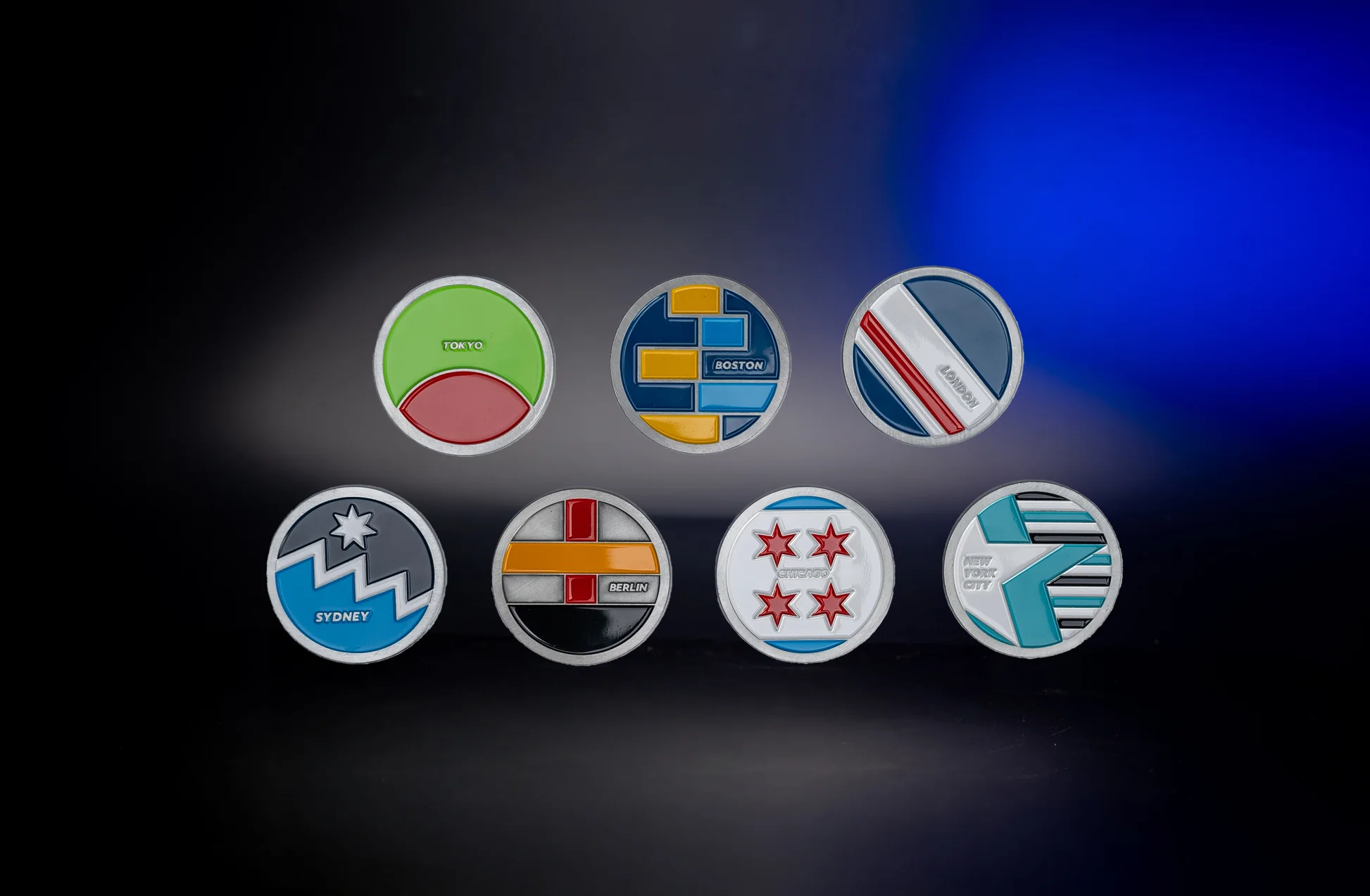
Athletes can also collect coins for each race and display them in a variety of coin holders, including a six-coin circle, a seven-coin circle, a three-coin holder for the “American Treble” collection, and a two-coin holder for the “Euro Double” collection.
In 2024, the Cape Town Marathon and the Shanghai Marathon began the process of evaluation to be included in the WMM program. Both marathons have passed part of the evaluation process and could be included as early as 2027.
In that case, the WMM will release a new challenge for runners: a Nine Star Medal and Nine Star Hall of Fame (along with two new collectible coins).
Beyond the glam and goodies, athletes love completing these marathons for the sense of achievement they grant. Truly, marathons can only be completed through lots of hard work and dedication. Nobody else can do the work for you. Finishing a marathon is a testament to your mental, physical, and emotional strength.
Here’s what you need to know about the current races and how to start planning for attendance in the major marathons 2026 and 2027.
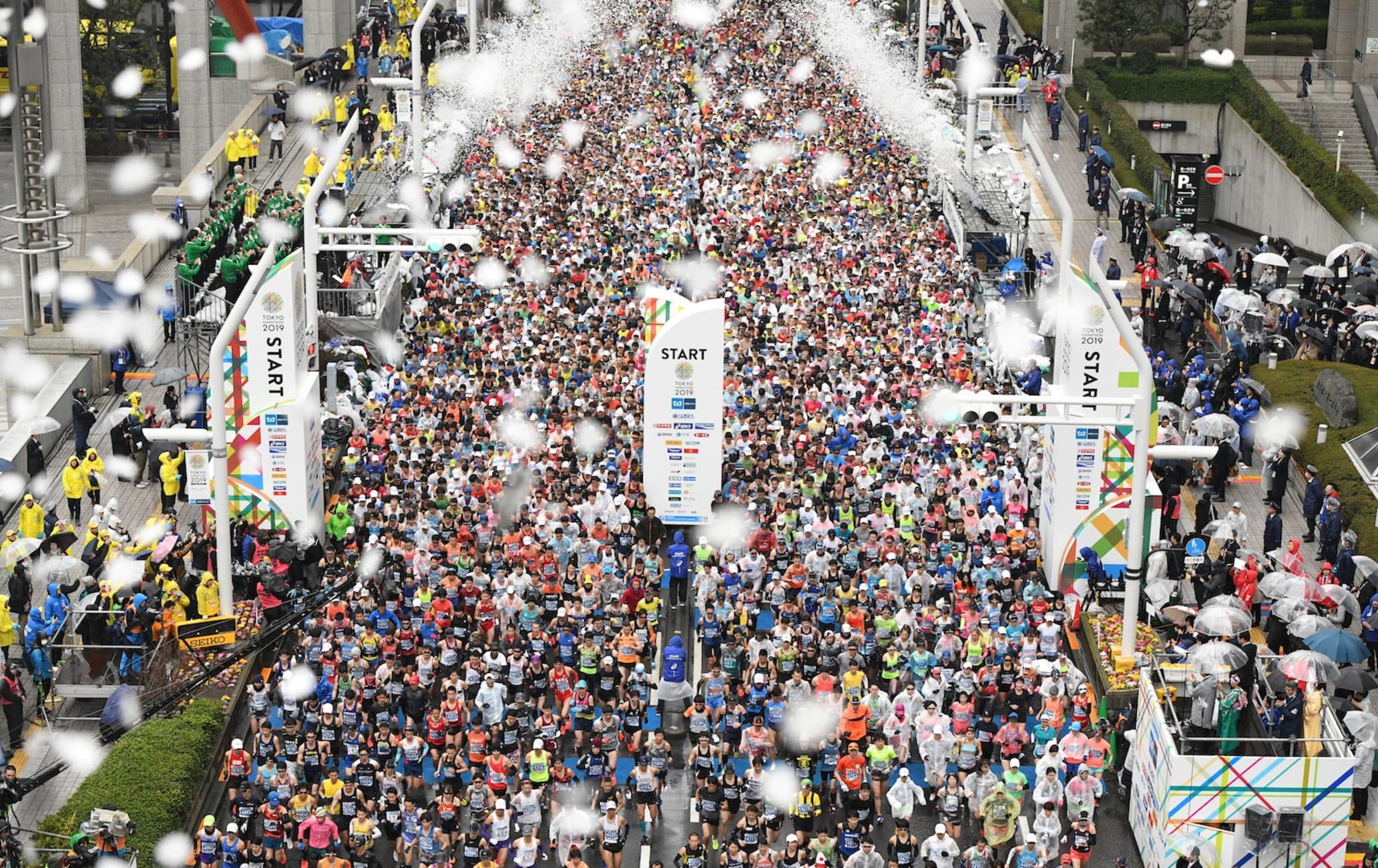
Tokyo Marathon
2026
- Date: Sunday, March 1, 2026
- Application Window: August 15-19, 2025
- Entry Fee: about $230
2027
- Date: Sunday, March 7, 2027 (tentative)
- Application Window: Expected mid-August, 2026
The Tokyo Marathon course is known for its flatness, along with Chicago, London, and Berlin. Runners can attempt a personal best while getting a great tour of the city, including many different types of architecture and green spaces.
It has the highest age requirement of all the races, indicating entrants must be at least 19 years old by race day to compete. There are several entry pathways: athletic tour, charity donation, qualifying times for semi-elite athletes, and general (lottery), which can be supplemented with a ONE TOKYO GLOBAL membership for a better chance at selection.
The first-ever Tokyo Marathon took place in 2007, and it was incorporated as a world major in 2013.
Participants are not required to submit qualifying times (unless they’re trying to enter as a semi-elite athlete), but they will be subjected to strict cut-off times along the course. Participants who are too slow will be asked to remove themselves from the race, will be transported to the finish line, and will not be recorded as an official finisher.
Learn more about the Tokyo Marathon registration options and schedule.
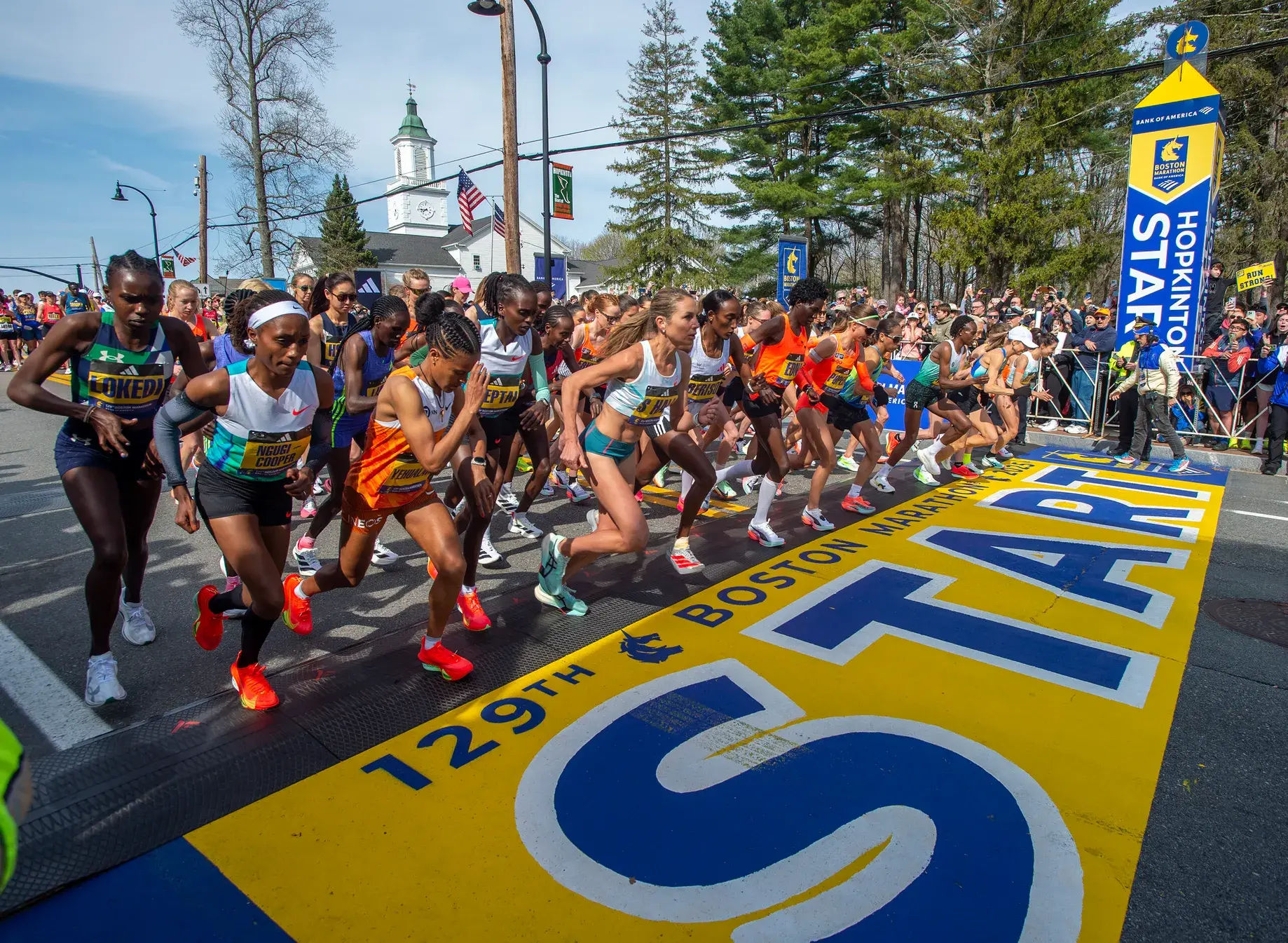
Boston Marathon
2026
- Date: Monday, April 20, 2026
- Application Window: September 8-12, 2025
- Entry Fee: $260
2027
- Date: Monday, April 19, 2027
- Application Window: Expected mid-September, 2026
The Boston Marathon is the oldest annual marathon in the world. The inaugural run was in 1897, and it was one of the founding five marathons in the WMM in 2006.
It’s the only world major marathon that requires all entrants to submit qualifying times with their applications, making it the most difficult race to get into on the basis of skill. Only the fastest applicants in each gender and age category are accepted for registration; the spots are not first-come, first-served. There is also no lottery option, unlike all other marathons on this list.
The window for runners to secure an official qualifying time typically opens two years before race day and closes one year before race day.
That means that the qualifying window for 2027 opened in September 2025 and is expected to close September 2026; then, the 2028 window will open in September 2026 and close in September 2027, and so on.
Participants can opt to donate to an official charity for a guaranteed entry, and international athletes can secure a place through a tour program.
The Boston Marathon course is known for its hilly layout, sending entrants up and down substantial gradients, especially the famous “Heartbreak Hill.” If you’re preparing for this course, it’s vital to add uphill and downhill training to your regimen.
Learn more about how to enter the Boston Marathon!
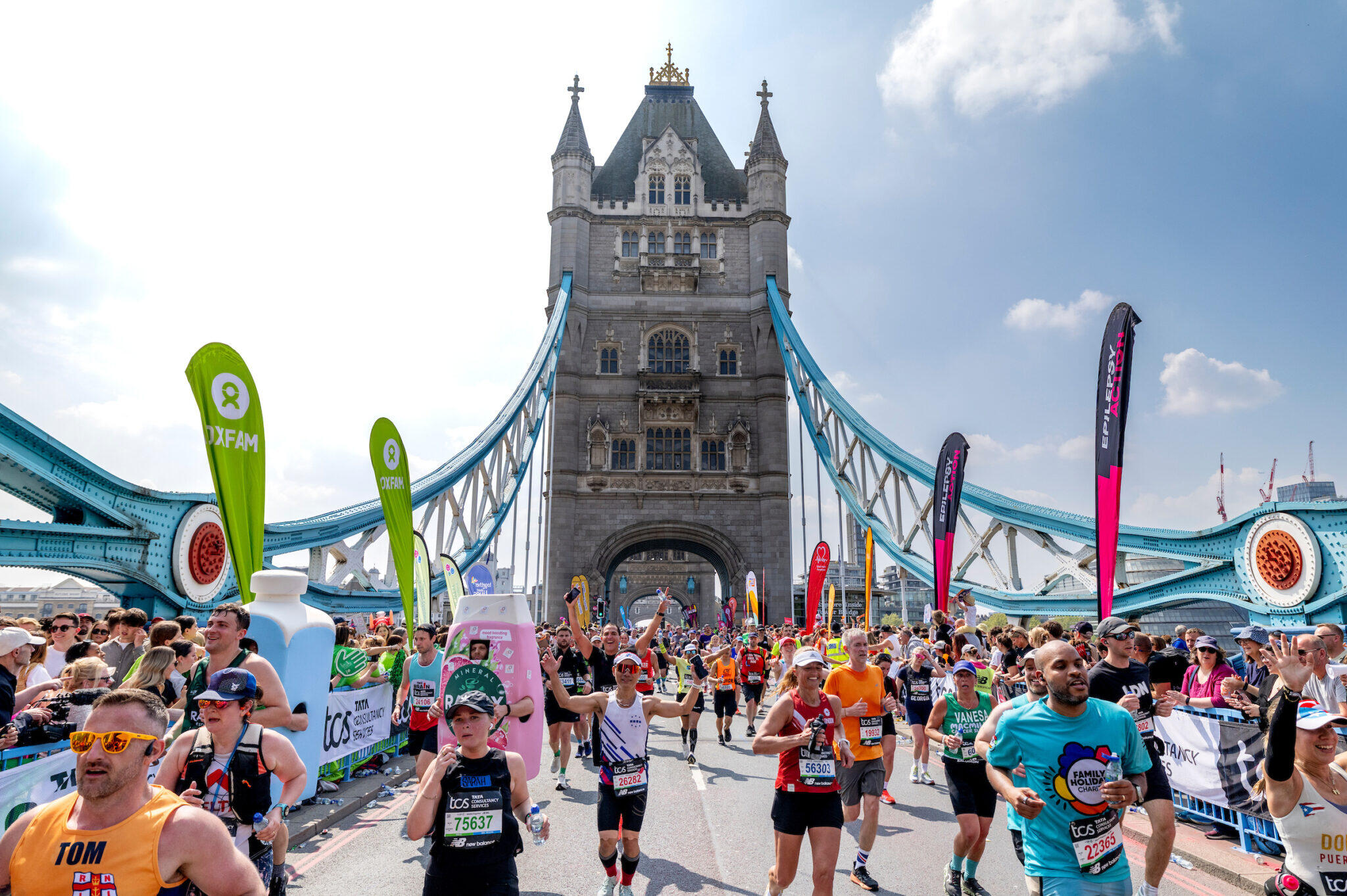
London Marathon
2026
- Date: Sunday, April 26, 2026
- Application Window: April 25 to May 2, 2025
- Entry Fee: about $300
2027
- Date: Sunday, April 25, 2027
- Application Window: Expected late-April, 2026
The very first London Marathon was held in 1981, and in 2006, the London Marathon became one of the five original races in the WMM.
It’s one of the most iconic routes among all marathons, providing participants with incredible sights, both up close and far away. Athletes get to cross Tower Bridge, see Big Ben, and run to The Mall in front of Buckingham Palace, among other landmarks. The course is generally flat, with only a few elevation changes throughout.
Runners can try for a spot through the ballot (lottery), though you’ll likely need to pursue an alternative route since the lottery is extremely competitive. Entrants can secure a place through fundraising for a charity or with a sports travel agency.
The London Marathon incorporates “activations,” or activities, throughout the race route for runners and spectators. Participants can enjoy live music, while spectators can gather at cheer points, and all can benefit from the various afterparties held around the city!
Alternatively, you can apply to be a pacer at the race, which means you get to participate, but you already know what your time will be before you finish. It’s a serious role that is well-screened, but if you’re an experienced runner who can reliably keep the pace you’re meant to set, it can be a great way to participate.
Find out more about the London Marathon and how to take part.
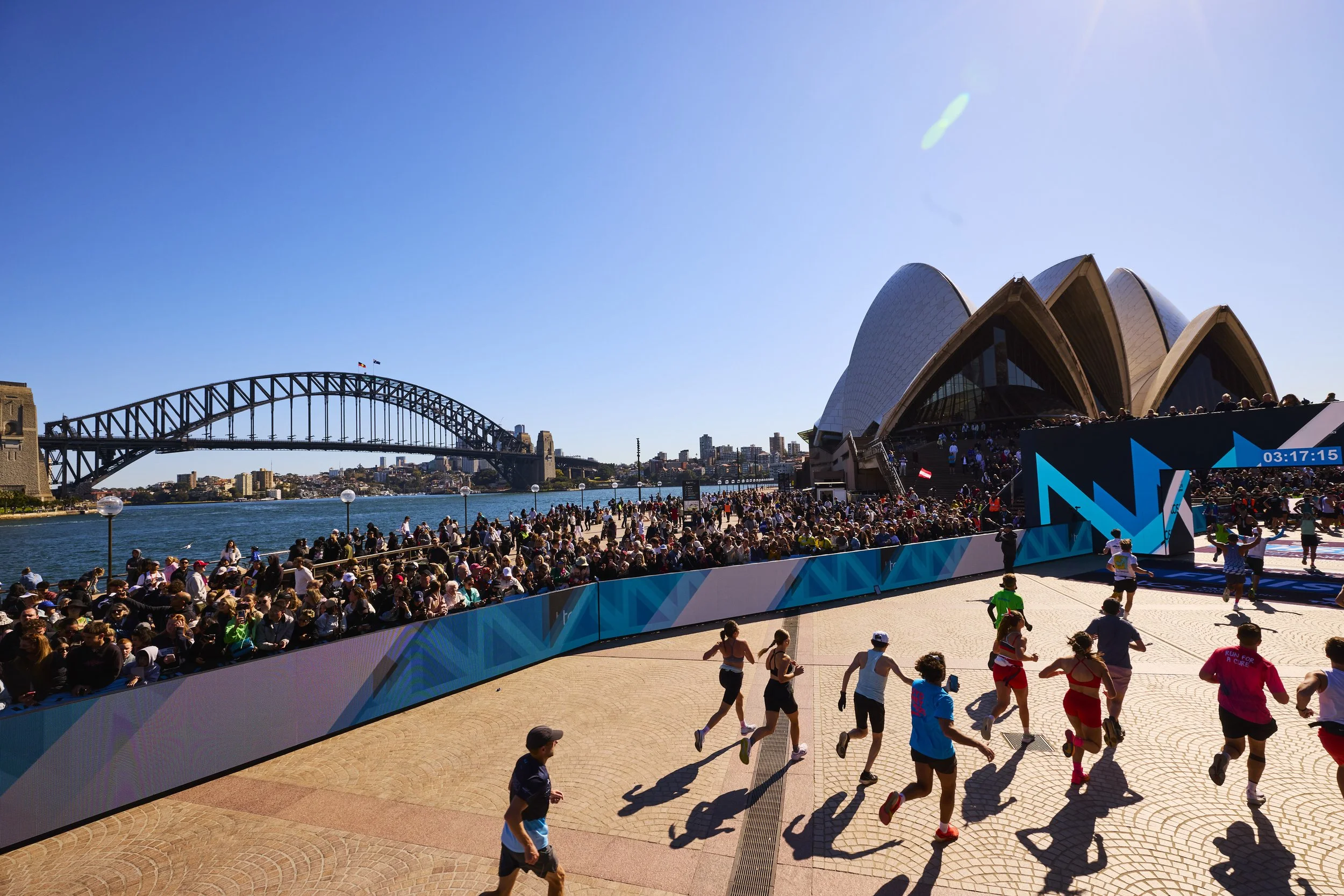
Sydney Marathon
2026
- Date: Sunday, August 30, 2026
- Application Window: September 24 to October 17, 2025
- Entry Fee: about $230
2027
- Date: Late August or Early September, 2027
- Application Window: Late September, 2026
The newest member of the WMM, the Sydney Marathon was added to the roster in 2025. The first Sydney Marathon was held in 2000 as part of the Summer Olympics. Since then, it’s been an annual tradition, garnering popularity worldwide.
The course is demanding and difficult. It features many turns and elevation changes, making it a challenging course even for experienced athletes. You probably won’t secure a personal best, but you’ll have a great time traversing the bustling Australian city.
The Sydney Marathon begins at 6:30 AM, with the final wave crossing the starting line at 8:30 AM. It’s important to beat the intense Australian heat and sun. The race ends at 3:15 PM.
Athletes have several entry pathways to try. The Sydney Marathon utilizes a general ballot (lottery) that most runners make a first attempt through. Other types include charity, travel packages, and the High Performance Program for elite athletes with adequate qualifying times.
Be sure to plan your travel as early as possible for this trip, since Australia has notoriously high standards for granting visas to visitors.
Learn more about how to qualify for the Sydney Marathon.
Berlin Marathon
2026
- Date: Sunday, September 27, 2026
- Application Window: September 25 to November 6, 2025
- Entry Fee: about $240
2027
- Date: Expected Late September, 2027
- Application Window: Late September, 2026
The first Berlin Marathon took place in 1974, before the fall of the Berlin Wall. It was one of the original five races to establish the WMM in 2006.
The Berlin Marathon has a unique history. In 1990, it was a direct symbol of unification between East Berlin and West Berlin. Runners were able to freely pass through the Brandenburg Gate for the first time since the city was divided in 1961. A few days later, the wall was dismantled entirely.
The course is known for its flatness, and many world records and personal bests have been set on it.
It is the only WMM to hold an inline skating competition, which takes place on the same day as the running marathon.
The Berlin Marathon offers several entry pathways for athletes. The lottery is split into three categories: singles, teams, and fast runners. Singles and teams do not need to submit any qualifying times for a fair chance at being randomly selected.
The fast runners pool actually acts like a guaranteed entry method. As long as your times meet the standard and can be verified, you’ll almost certainly be accepted into the race.
Participants can also secure entrance through charities or tour operators.
Prepare for unpredictable weather in Berlin! Though the autumn in Germany is usually temperate and cool, record highs in 2025 (the temperature reached 81.7℉!) caused many athletes to drop out of the race and face problems due to heat and dehydration.
Discover how to enter and prepare for the Berlin Marathon.

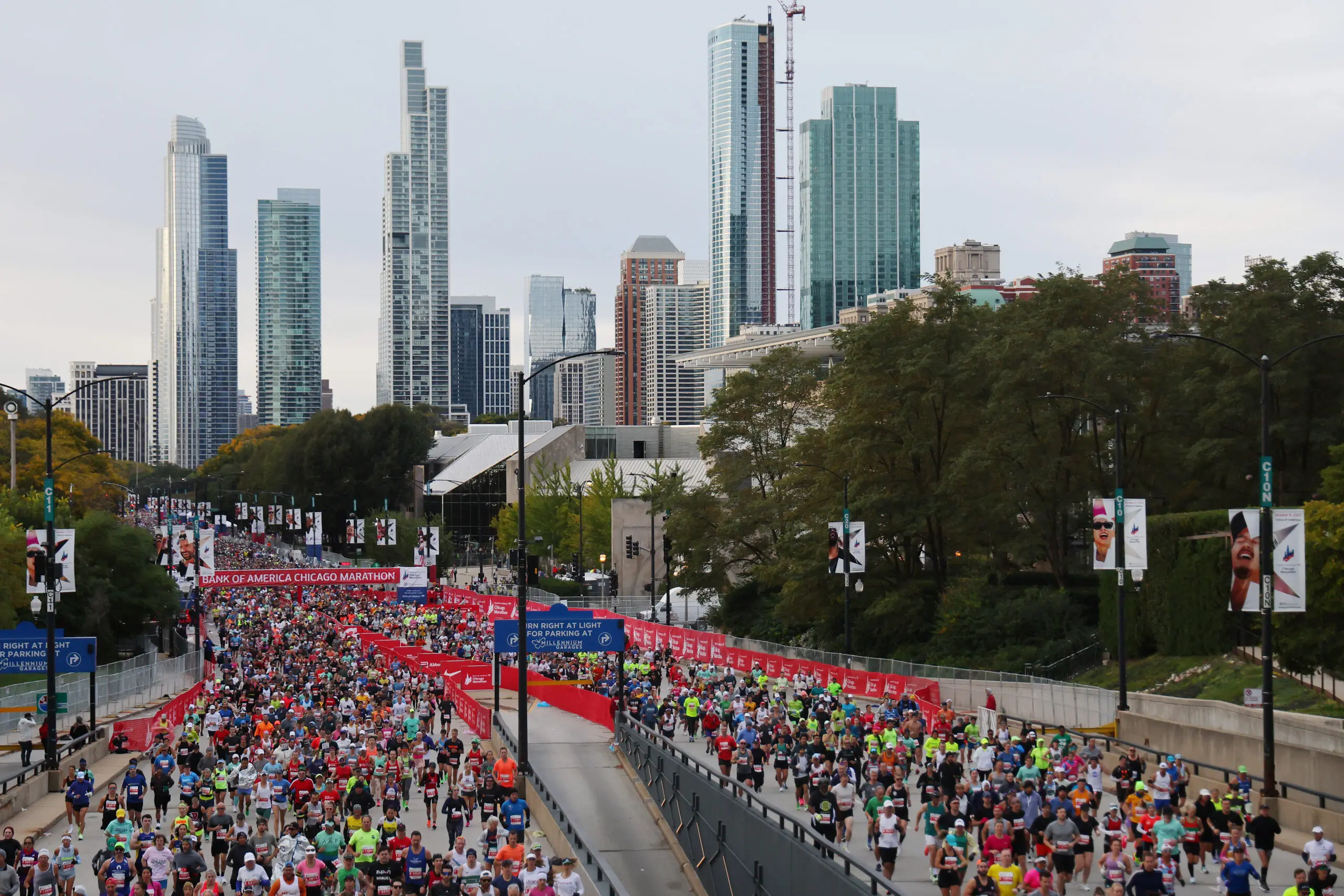
Chicago Marathon
2026
- Date: Sunday, October 11, 2026
- Application Window: October 21 to November 18, 2025
- Entry Fee: $250
2027
- Date: Sunday, October 10, 2027
- Application Window: Expected October 2026
The Chicago Marathon has the lowest age restriction for participants. Runners age 16 and 17 (as of race day) can join, as long as their parents or guardians submit the proper paperwork granting permission.
The first Chicago Marathon was held in 1905, inspired by the Boston Marathon, New York City Marathon, and the original 1896 Olympic Marathon in Athens. It was a founding member of the 2006 WMM.
There are many ways to enter the Chicago Marathon, including unique initiatives. Runners can enter the lottery and try to win a random place, or they can submit a qualifying time for an automatic entry. The race also offers guaranteed entrance through the Legacy Finisher program, which is for those who have completed the Chicago Marathon at least 5 times in the last 10 years.
The HPP at the Chicago Marathon features strict time qualifications and is intended for elite or professional athletes. Amateur athletes and running enthusiasts can try to meet the times in the qualifying time category instead.
Avid runners can also participate in the three major marathons held in Chicago each year to secure a guaranteed entry.
Of course, the option for securing registration through a charity or a tour operator is also available.
The Chicago Marathon course is one of the flattest, making it an ideal place for runners to set personal best records as well as world records. Participants should be aware of the many bridge crossings, which feature a red carpet. The unique texture can cause problems if you’re not prepared.
Learn more about how to get into the Chicago Marathon.
New York City Marathon
2026
- Date: Sunday, November 1, 2026
- Application Window: February 4-25, 2026
- Entry Fee: $333.11 for non-NYRR members; $269.66 for members
2027
- Date: November 7, 2027
- Application Window: Expected February 2027
The New York City Marathon is an integral part of the city. The first race was in 1970, and it quickly grew (after a few bumpy early years) in local and international popularity. It has the most participants and spectators, with close to 60,000 participants and over 2 million fans attending every year. The race was one of the original five races to found the WMM in 2006.
The course is world famous for its sights, especially the crossing of the Verrazzano-Narrows Bridge, which doesn’t usually allow any foot traffic. Runners get to traverse the streets through all five boroughs, several historic neighborhoods, and the carriage roads in Central Park.
U.S. residents cannot use a tour program to secure a place in the NYC Marathon. Only international residents can use tour operators.
The New York City Marathon has many entry pathways for athletes to contemplate. First, there is the drawing (lottery); however, it’s extremely competitive. If you really want to run, you’ll likely need to secure a different method of registration.
Members of the NYRR (New York Road Runners) get exclusive chances to secure a place in the race. They can participate in the 9+1 program (which requires completing other races throughout the year and volunteering), be a philanthropic donor, and get a second chance in the lottery.
Non-NYRR members can participate in the virtual marathon to earn a guaranteed entrance the next year, submit qualifying times, join a charity, or have 15+ NYC Marathons under their belts already.
Find out the details of applying for the New York City Marathon.

World Major Marathon Standards
What makes these races so special? The WMM features races that meet specific criteria for every major facet of the race. As of 2017, they have partnered with Wanda Group, a conglomerate that promotes and amplifies sports, among other things.
Together, the groups are setting standards that marathons must meet to ensure the safety of participants and spectators, the financial well-being of athletes, and overall proven logistics handling of large-scale events. WMMs attract thousands of athletes and millions of spectators each year; a new race must be prepared for a surge in attendance.
[Completing my first] marathon changed my life. I used to believe that marathon runners were like superstars and never thought that I had it in me, but accomplishing that proved me wrong.
Merili Freear, marathon runner and author
The exact criteria have not been released to the public, but in general, every city’s race must:
- Be certified by AIMS or accredited with USATF
- Have enough prize money to cover the elite athletes’ pay day
- Have a proven track record of functional and effective logistical planning and execution (registration, fee handling, onboarding for participants on arrival, staff, adequate hydration, medical, and bathroom facilities, etc.)
- The city must have the infrastructure to handle increased tourism
The goal of making a marathon a World Major is to promote the sport of running and the city. Events must be well-run to ensure all athletes and spectators have a fun, safe experience.
How to Participate in a Major Marathon
Entering a WMM is different from signing up for a typical local marathon event. Athletes are held to very high standards and are required to meet certain criteria. The WMM dictates some of the standards, while each individual race also has its own parameters.
If you’re just getting into running, thinking about the requirements for the WMMs might be intimidating. Rest assured, the running community is full of fellow enthusiasts and trainers who want to help you navigate the qualification and registration process!
Here, we’ll cover the basics of what you need to know so you can start planning your marathons.
Registration
The first thing you need to do is read about the registration requirements and entry pathways available for each individual marathon.
In general, runners must be at least 18 years old on race day to apply (except for the Tokyo Marathon and the Chicago Marathon). It’s expected that participants be conditioned enough to finish the marathon within the imposed time limit, which is usually 6.5 to 8 hours, or a 16-minute-per-mile pace, depending on the event. Typically, those who are slower than these guidelines will be removed from the event or not recorded as official finishers.

Most marathons have a variety of entry pathways that typically include options like:
- Random lottery places
- Charity places
- Qualifying times (for guaranteed places or a better chance in a lottery)
- Purchasing an entry through a tour operator
However, each marathon has its own unique and specific options. Some are more expansive, and others are very limited.
Each marathon will require you to visit the respective official website and create an account. You’ll need to enter information like your date of birth and any other relevant information regarding the entry pathway you’re pursuing. For example, if you’re attempting to gain entrance through a qualifying time, you’ll need to upload official proof of your time record. Official times can only be claimed on certain courses at certain events.
You can learn more about the pathways for each marathon in our detailed guides, linked above in each respective marathon’s section.
Remaining Opportunities for 2026 Registrations
The 2026 registration period has all but closed, with the New York City Marathon being the final race open for registration, which closes at the end of February. However, some marathons are still allowing runners to register through charity programs or tour operators.
These are the marathons still allowing participants to apply through paid methods:
- London (charity and tours)
- Sydney (charity and tours)
- Berlin (charity and tours)
- Chicago (charity until September 15, 2026, and tours until August 16, 2026)
- New York City (charity)
Registration Timeline for 2027
If you hope to participate in any of the WMMs but haven’t started planning yet, your best bet will be to aim for 2027. You need lots of time to plan your attendance, since there’s so much to consider!
Athletes need to keep in mind:
- Funds for entry fees, charity donations, and/or tour operators
- Travel arrangements and fees
- Visa applications for going abroad
- Which events to secure qualifying times at, if needed
- At least 20 weeks for a training program before the marathon (and/or before the event(s) for qualifying times!)
It’s a lot to juggle! Take a look at this timeline for dates to keep in mind for the 2027 marathon cycle.
April, 2026
🪙 Charity Entry Applications - 🇬🇧 London Marathon
Charities begin allowing applications after the conclusion of that year's marathon. Many charities fill up fast, but others will have spaces until next April.
Late April to Early May, 2026
❗Registration Deadline - 🇬🇧 London Marathon
Registration open for 1 week
Late June to Mid July, 2026
🪙 Charity Entry Applications - 🇯🇵 Tokyo Marathon
Tokyo Marathon: registration open for about 3 weeks
August, 2026
❗Registration Deadline - 🇯🇵 Tokyo Marathon
ONE TOKYO GLOBAL and Semi-Elite open early to mid-August. General entry open mid to late August.
Summer or Early Fall, 2026
🪙 Charity Entry Applications - 🦄 Boston Marathon
Some charities fill up fast, while others remain open up to race day.
Mid-September, 2026
❗Registration Deadline - 🦄 Boston Marathon
Applications open for 1 week
Late September to Early October, 2026
❗Registration Deadline - 🇦🇺 Sydney Marathon
Open for about 3 weeks
Late September to early November, 2026
❗Registration Deadline - 🇩🇪 Berlin Marathon
Registration open for about 6 weeks
October, 2026
🪙 Charity Entry Applications - 🍕 Chicago Marathon
Charity entries are generally open until slots fill up or until just before race day.
Late October to Mid-November, 2026
❗Registration Deadline - 🍕 Chicago Marathon
Open for about 3 weeks
December, 2026
🪙 Charity Entry Applications - 🇩🇪 Berlin Marathon
Some charities begin allowing applicants. Many charities will fill up quickly, while others will still have places available leading up to race day.
December, 2026
🪙 Charity Entry Applications - 🇦🇺 Sydney Marathon
Some charities fill up fast, while others remain open up to race day.
February, 2027
❗Registration Deadline - 🗽 New York City Marathon
Open for about 3 weeks
Spring, 2027
🪙 Charity Entry Applications - 🗽 New York City Marathon
Some charities fill up fast, while others remain open up to race day.
March 7, 2027
👟 Race Day! - 🇯🇵 Tokyo Marathon
April 19, 2027
👟 Race Day - 🦄 Boston Marathon
April 25, 2027
👟 Race Day - 🇬🇧 London Marathon
Late August or Early September, 2027
👟 Race Day - 🇦🇺 Sydney Marathon
Late September, 2027
👟 Race Day - 🇩🇪 Berlin Marathon
October 10, 2027
👟 Race Day - 🍕 Chicago Marathon
November 7, 2027
👟 Race Day - 🗽 New York City Marathon
Runners who want to participate in more than one marathon per year will need to start their planning far in advance. There are so many ways to try to enter every Marathon that it really takes a ton of logistics and monetary planning to achieve. Not to mention, making sure you're in shape to participate in multiple marathons, some of which are scheduled very close together!
Training
The core element to remember when preparing for a marathon is training. The perfect travel plans mean nothing if you’re not prepared to get on the course and do your best while feeling your best.
Athletes typically begin training about 20 weeks in advance. Training plans need to include:
- Exercises and routines that promote endurance, stamina, and conditioning
- Strength exercises specific to runners
- Recovery exercises or physical therapy for joints and ligaments
- Proper nutrition and hydration to support rigorous workouts
- Progressions in routine and diet to gradually improve

Experienced personal trainers can help you come up with a game-day plan for when to take in water, sports drinks, or energy gels while you run.
They can also guide you into a pacing plan specific to each course, considering the unique elevation profiles.
Unless you’re already an experienced marathon runner, using a personal trainer is essential to help you make sure your workout plan and day-of plan are sound.
It’s very easy for inexperienced athletes to injure themselves during training accidentally.
Now that you know more about the application and preparation processes for the Major Marathons, you’re better prepared for the process of meeting your athletic goals. There’s simply no other experience in life that can match the excitement and sense of accomplishment that comes with completing a marathon - or seven!
References
- Alger, K. (2018). World Marathon Majors Expansion: New Races. In Man v Miles. https://www.manvmiles.co.uk/2018/03/17/abbott-world-marathon-majors-expansion
- Dredge, M. (2026). When Are The World Marathon Majors In 2026? In The Running Channel. https://therunningchannel.com/marathon-majors-2026
- How to earn a Six star Medal. (n.d.). In www.worldmarathonmajors.com. https://www.worldmarathonmajors.com/six-star/how-it-works
Summarize with AI:
Did you like this article? Leave a rating!

 Loading...