Integration by Parts Formula
Unlike derivatives, there is no formula that can integrate any product of functions.
The closest thing we have to a rule for integrating products of functions is integration by parts. Interestingly, it is based on the formula for differentiating a product of functions.
However, integration by parts transforms an integral of a product into another integral. This formula does not work for integrating all products of functions.
The integration by parts formula is:

Notice that we have to differentiate  and integrate
  , so it will be convenient for the integral of to be simple.
In general, polynomial, logarithmic, and arctangent functions are chosen as . Meanwhile, exponential, sine, and cosine functions are chosen as .
Derivation of the Formula
Suppose we have the functions  and
and  . Then their derivative is given by:

If we integrate both sides of the equation, we obtain:
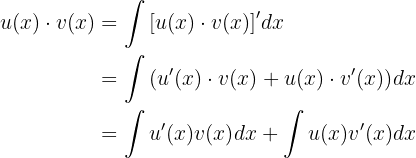
Then, if we move  to the left side, we obtain:
which is the formula we were looking for.
Proposed Exercises

We have a product between the function  and
and  . As mentioned previously, in this type of case we choose
  and
and  .
.
We differentiate :

We integrate  :
:

So the integral becomes:
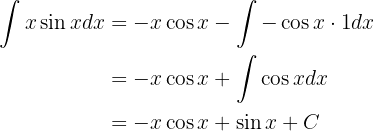
Thus,


We have a product between the function  and . In this type of case we choose and
  .
.
We differentiate :
We integrate :

So the integral becomes:
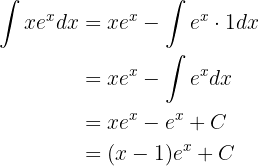
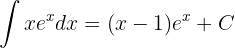
Thus,
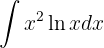
We have a product between the function  and
and  . In general, both functions are usually taken as ; however, in this type of case the logarithm takes preference and we choose
  and
and  .
.
We differentiate (this is the reason we chose the logarithm):

We integrate :

So the integral becomes:
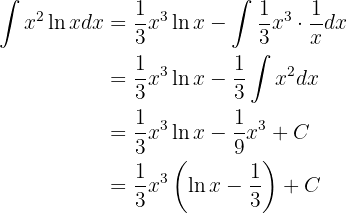
Thus,


We have a product between the function and  . Again, in this type of case we choose and
 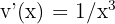 (the logarithm function is always chosen as ).
We differentiate :
We integrate :

So the integral becomes:
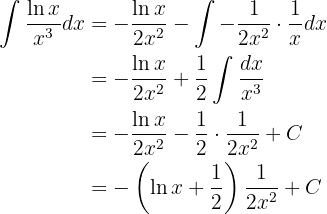
Thus,

Summarize with AI:
Did you like this article? Rate it!

 Loading...