What Does the Definite Integral Represent and How Do We Calculate It?
Recall that the Fundamental Theorem of Calculus tells us that the definite integral can be calculated using:

where  is any antiderivative of
  (or primitive).
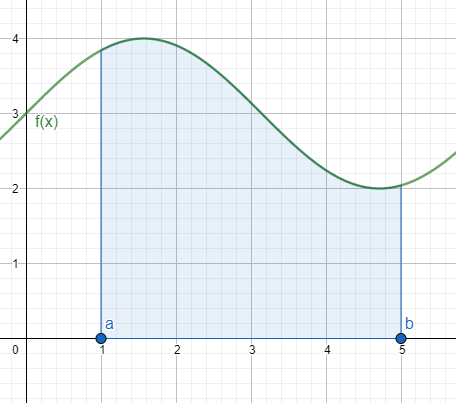
Furthermore, recall that the definite integral measures the area under the curve of between points  and
and  , as shown in the following figure:
Proposed Exercises
Solve the following definite integrals:
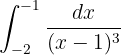
The first integral can be solved with the formula for integrating a power. First note that:

So we can use the formula:
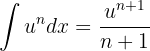
with the substitution  and
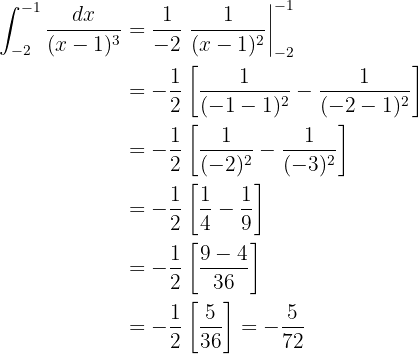
and  (note that in definite integrals the constant of integration is not necessary). Thus, we obtain:

That is:
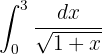
As in the previous case, we solve this integral with the power rule formula:

Simplifying a bit:
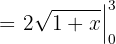
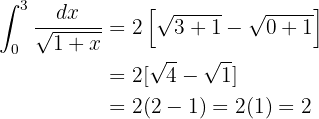
And we evaluate at the limits of the integral:
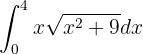
This integral is solved with a change of variable. Note that inside the square root we have  . If we differentiate, we have
  ; solving for
  , we get:

Furthermore, since we're making a change of variable, we must also change the limits of the integral. In particular:
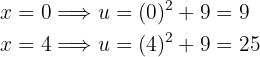
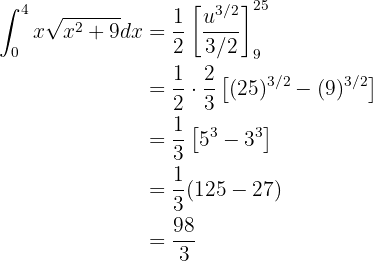
Therefore, the integral becomes:

Now we solve the integral using the power rule formula:
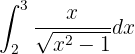
As in the previous case, we make the following change of variable:

where, upon differentiating, we have . Therefore, solving for (since that's what we have in the integrand), we obtain:
Now we obtain the new limits:
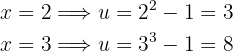
Therefore, the integral becomes:

We integrate with the power rule formula:
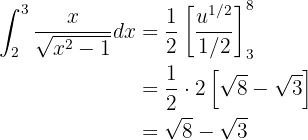
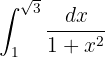
This integral is solved very quickly if we recall that:

So the integral is solved immediately:
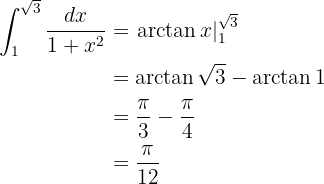
Recall that  and
and  (remembering these values is useful when we want to find arctangent values).
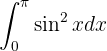
To solve this integral we need a trigonometric identity. In particular, since we have  raised to an even power (2 in this case), we need some power that reduces it to an odd power. We can obtain this from the double angle identity for cosine:

which, when solving for  , gives us:
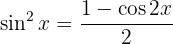
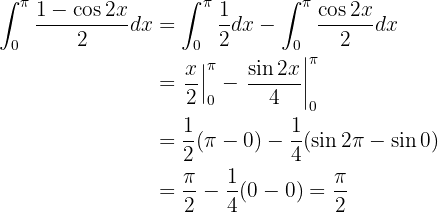
Thus, the integral becomes:

Which can now be integrated in a simpler way:
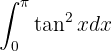
It's somewhat difficult to find—by trial and error—some function such that  . For this reason, it's better to transform
  using a Pythagorean identity. That is:

So  . Thus, the integral becomes:

Since:
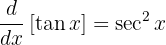
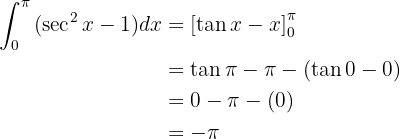
then we can solve the integral immediately:
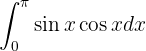
For this integral we don't need to use any trigonometric identity, since neither nor  are raised to any power. Therefore, we can take:
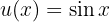
Therefore:

Note that the change of variable is not bijective (one-to-one) on the domain. Therefore, it will be necessary to return to the original variable before evaluating:

We calculate the antiderivative:

We return to the previous variable:

Now we evaluate at the limits of the integral:

Which is the result we were looking for.
Note: if we had taken  we could have also calculated the integral simply.
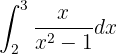
Note that in this integral we also have a change of variable. In particular:
from which it follows that . Therefore:
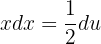
Furthermore:
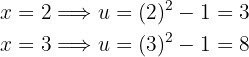
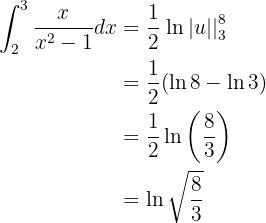
Therefore, the integral becomes:

Which when solved and evaluated, gives us:

Although it may not be immediately obvious, this integral can also be solved with a change of variable (note that not all integrals are solved with change of variable). Let's take:
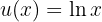
So:

Then, the limits transform to:
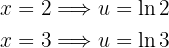
Therefore, the integral transforms to:

Thus, solving the integral and evaluating at the limits, we have:
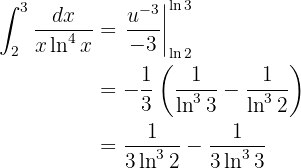
Which is as much as we could simplify.
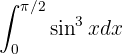
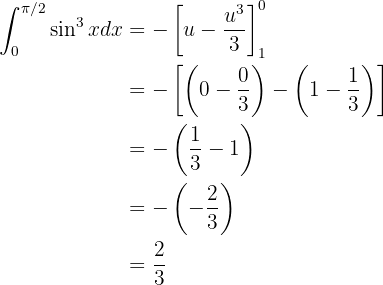
In this integral we have an odd power of . We need to make a change of variable, where  will be part of the differential of the new variable. Therefore, we separate as follows:

now we use the Pythagorean identity  to obtain:

We can take the change of variable , so  , thus:

Furthermore, the change of variable is injective on the integration interval, therefore:
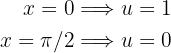
Thus, the integral becomes:

Upon solving the integral, we obtain:
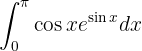
Here we can immediately see that we have a change of variable. We take:
so  . Thus, the integral becomes:

Which when integrated, becomes:
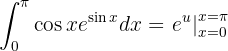
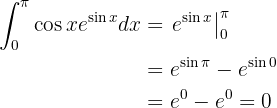
We return to the previous variable and evaluate at the limits:
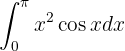
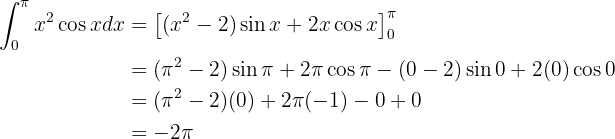
This integral is solved by integration by parts. First we solve the integral without worrying about the limits and then we evaluate:

Since we have a polynomial multiplying , we'll take  and
and  . Thus:

Therefore, the integral is now:

We repeat the procedure again, now with:
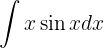
where we take  and
and  . Here we have:

therefore, this second integral becomes:
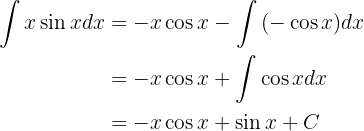
Substituting into the original integral, we have:
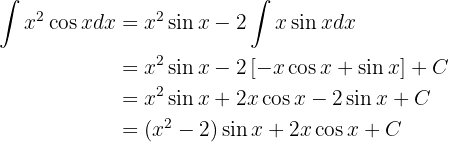
Now that we have the indefinite integral, we evaluate at the integration limits:
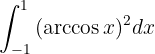
Solving integrals with inverse trigonometric functions is a bit more complicated. Usually, we try some change of variable such as:

(although it doesn't always work). Solving for  , we have
  . Therefore:

From this it follows that:

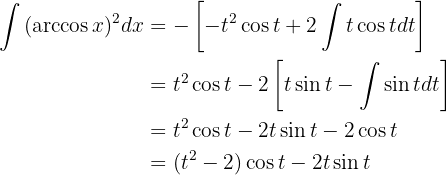
This integral is also solved by parts. We first take  and
and  , therefore:

And the integral becomes:

Now we take  and
and  , thus:

With this, the integral is:
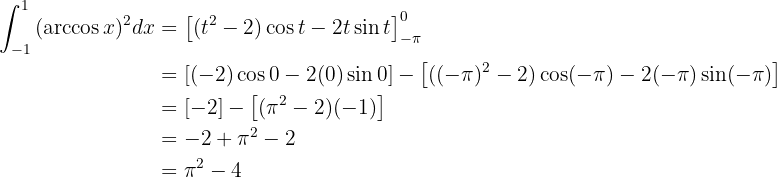
We can return to the interior variable or we can change the limits of the integral. We opt for the second option:

Thus, the integral is:

Finally, we'll solve this integral with a change of variable to eliminate the radical. We take  , thus:

where we take  . Thus,
  and:
and:
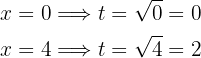
Therefore, the integral becomes:

Note that we must transform the integrand a bit. Observe that:

Thus, we have:
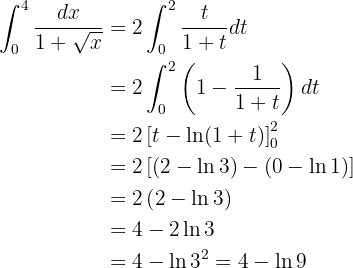
Which is the result of the integral.
Summarize with AI:
Did you like this article? Rate it!

 Loading...