Fundamental Properties of Integer Exponents
1. Any number  raised to the exponent 1 is the same number :

2. Any number  raised to the power 0 is 1:

Note: The expression  is an indeterminate form. That is, it is not defined.
3. The result of raising any number to an even power  is positive. That is,

if  for some
 .
Note: this can be remembered more easily by looking at the following expression:

which means that any number (positive or negative) raised to an even power results in a positive number.
4. The result of raising any number to an odd power has the same sign as . That is,

and

if  for some .
Note: this property can be remembered with the following expression:

5. Negative exponents satisfy the following property (for ):
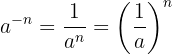
that is, it is equal to the reciprocal of the base raised to the positive power.
Examples
Let us consider the following examples:
1. ,
 ,

2. ,

3. since 6 is an even natural number. Likewise,

4. since
 and 3 is an odd number. Similarly,

since 
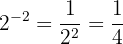
5.
Rational Exponents
We define the nth roots of real numbers as follows:
Definition: given a number  , the nth root of
 is that number such that

and we usually write  or
 .
It is by means of radicals that rational powers are introduced. The following properties hold:
1. By definition, we have

2. Also by definition, we have
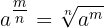
3. Furthermore, we have

Note: the even root of a negative number is not defined in the real numbers. If we are working with real numbers, then we can say that this root does not exist.
Examples
1
2
3
Laws of Exponents with the Same Base
The following laws hold for any  and any
 . Note that, in some cases, using
 may lead us to indeterminate forms.
1. The product of two powers with the same base is equal to the base raised to the sum of the exponents:

2. The division of two powers with the same base is equal to the base raised to the difference of the exponents:

3. Raising a power to another power is equal to raising the base to the product of the exponents:
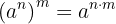
Note: pay attention to the parentheses in the previous expression. First we perform the operation  and then raise it to the power
 . This is different from the following operation:

and they are almost never equal, that is,

Examples
Consider the following examples:
1
2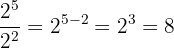
3
Operations with Powers with the Same Exponent
The following laws hold for any  and any
 and
 .
1. The product of two powers with the same exponent is equal to the product of the bases raised to the exponent. That is,

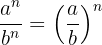
2. The division of two powers with the same exponent is equal to the division of the bases raised to the exponent:
Examples
Consider the following examples:
1
2
Exercises
Perform the following powers:
a
b
c
a) Note that the base is negative and the power is odd. Therefore, the result is negative:

b) Note that the base is negative and the power is even. Therefore, the result is positive:

c) We have that the base is negative and the power is even. Therefore, the result is positive:

Write the following expressions with positive powers:
a
b
c
Note that the power is negative, so the expression is equal to its reciprocal with positive power.
a

b

c

Write the following expressions with radicals:
a
b
c
a) Note that the power is fractional. Therefore, we use the formula  :

b) Note that the power is fractional. Therefore, we use the formula  :
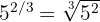
c) Note that the power is fractional and negative. Therefore, we use the formula  :
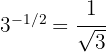
Write the following radicals as fractional powers:
a
b
c
Note that to write a radical as a fractional power, we use the formula :
a

b

c

Write the following operations as a single power. That is, in the form  :
a
b
c
d
a) Note that we have multiplications of powers with the same base only. Therefore, the exponents are added:

b) Now we have a division between two powers with the same base. Therefore, the exponents are subtracted:
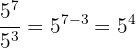
c) We have, now, a power raised to another power. Therefore, the exponents are multiplied:

d) Note that, in this case, we have three powers with the same exponent. Therefore, we can multiply the bases:

Write the following operations as a single power. That is, in the form :
a
b
c
d
a) The first case is a power raised to another power. Thus, the exponents are multiplied:

b) This case is similar to the previous one. We have a power raised to another power, and this raised in turn to another power. In this way, the exponents are multiplied:
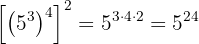
c) We have, again, a power raised to another power:
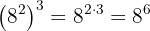
However, note that  . Thus, we can simplify a bit more:

d) We have, again, a power raised to another power. Furthermore, observe that  . Therefore,

Write the following operations as a single power. That is, in the form :
a
b
c
d
a) We have a multiplication of powers with the same base. Therefore, the exponents are added:

b) Now we have a division between powers with the same base, so the exponents will be subtracted:

c) Observe that we have a power raised to another power. In this way, the exponents are multiplied:

d) We have, now, multiplication of powers with the same exponent. Therefore, we can multiply the bases:

Write the following operations as a single power. That is, in the form :
a
b
c
d
a) We have a power raised to another power. Therefore, the exponents are multiplied:

b) Observe that we have a power raised to the exponent 0. Since

then we can conclude that

c) We have a power raised to another power. Likewise,  :

d) Again we have a power raised to another power. Furthermore,  :

Perform the following operations with powers:
a
b
c
d
a) Observe that we have multiplication of powers with the same base. Therefore, the exponents are added:

where we extract the sign since we are raising to an odd power.
b) Just like in the previous case, we have multiplication of powers with the same base:

Again we extract the sign since we are raising to an odd power.
c) Once more, we have multiplication of powers with the same base:

d) Now we have a division of powers with the same base. Thus, the exponents are subtracted:

Perform the following operations with powers:
a
b
c
a) We have division of powers with the same base:

b) Again, we have division of powers with the same base:

c) Once more, this is a division of powers with the same base:

Calculate the following powers:
a
b
c
d
Recall that fractional exponents involve roots.
a) This expression can be written as
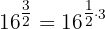
Then, using the property of multiplication of exponents:

b) We can write the expression as

If we use the property of multiplication of exponents:

c) Note that 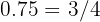 . Therefore,

Then,

d) Now the exponent is  . Thus

Simplify the following expression:
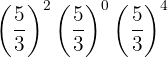
We must simplify the following expression, which we will denote as  :
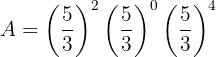
We start by noting that any number raised to the exponent 0 is 1. Furthermore, we can use the property of multiplication of exponents:
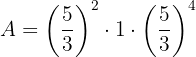
Then we add the exponents that have the same base:
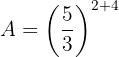
that is,

Simplify the following expression:
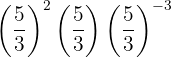
We must simplify the following expression, which we will denote as :
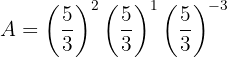
We can use the property of multiplication of exponents:
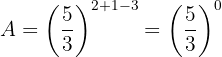
We apply the property that any number raised to the exponent zero is one:

Simplify the following expression:
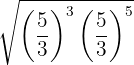
We must simplify the following expression, which we will denote as :
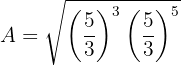
We can use the property of multiplication of exponents:
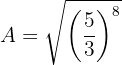
We write in the form of fractional power:
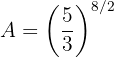
that is,

Simplify the following expression:
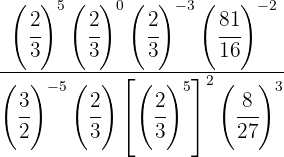
We must simplify the following expression, which we will denote as :

We start by noting that any number raised to the exponent 0 is 1 (in the numerator). Furthermore, in the denominator we can use the property of multiplication of exponents:
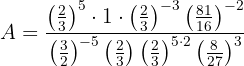
Then we add the exponents that have the same base:
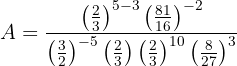
that is,
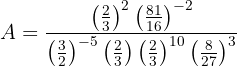
We convert those exponents that are raised to a negative exponent, using the reciprocal of the base:
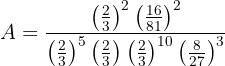
Again, we add/subtract the indices of those powers with the same base:

Now note that

and that

Therefore, the expression becomes
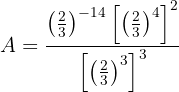
We use again the property of multiplication of exponents:
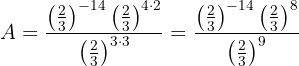
We add/subtract the exponents:

Therefore, we have

Summarize with AI:
Did you like this article? Rate it!

 Loading...