We invite you to explore the fascinating world of polygons, where area and perimeter are key protagonists in geometry. In this section, we will guide you through the resolution of problems related to these two fundamental measures that characterize polygons.
From triangles and quadrilaterals to more complex polygons, each solved exercise will include a step-by-step description of how to calculate the area, which represents the extension of the surface, and the perimeter, which measures the length of the outline. These practical problems will help you understand the importance of these measures and develop solid skills in calculating areas and perimeters.


Definition of Perimeter and Area
The perimeter of a polygon is equal to the sum of the lengths of its sides.
The area of a polygon is the measure of the region or surface enclosed by the polygon.
Perimeter and Area of Triangles
The perimeter of a triangle is obtained by adding the lengths of its three sides. According to the type of triangle, we have the following formulas for perimeter:
| Equilateral Triangle | Isosceles Triangle | Scalene Triangle |
|---|---|---|
 |  |  |
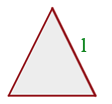 | 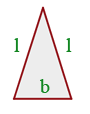 | 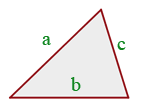 |
The area of a triangle is equal to half the product of its base and height.
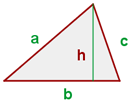
For the triangle with base  and height
 , the area formula is:

Perimeter and Area of a Square

The perimeter of a square is obtained by adding the lengths of its four sides; since these are equal, the perimeter formula of a square with side  is:

To find the area of a square, we raise its side to the second power:

Perimeter and Area of a Rectangle
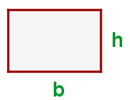
The perimeter of a rectangle is obtained by adding the lengths of its four sides; the perimeter formula of a rectangle with base and height is:

To find the area of a rectangle, we multiply its base by its height:

Perimeter and Area of a Rhombus
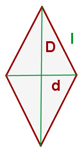
The perimeter of a rhombus is obtained by adding the lengths of its four sides; since these are equal, the perimeter formula of a rhombus with side is:
To find the area of a rhombus with major diagonal  and minor diagonal
 , we apply the formula that consists of calculating half the product of its diagonals:

Perimeter and Area of a Parallelogram
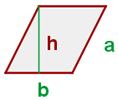
The perimeter of a parallelogram is obtained by adding the lengths of its four sides; since opposite sides are equal, the perimeter formula of a parallelogram with sides  and is:

To find the area of a parallelogram with base and height , we apply the formula that consists of the product of its base and its height:
Perimeter and Area of a Trapezoid
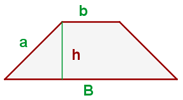
The perimeter of a trapezoid is obtained by adding the lengths of its four sides, that is:

To find the area of a trapezoid with major base  , minor base , and height , we apply the formula that consists of half the product of its height and the sum of its bases:

Perimeter and Area of a Regular Polygon
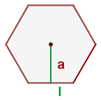
The perimeter of a regular polygon with  sides of length is:

To find the area of a regular polygon with side and apothem , we apply the formula that consists of half the product of its perimeter and its apothem:

Perimeter and Area of an Irregular Polygon
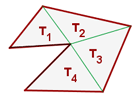
The perimeter of an irregular polygon is obtained by adding all of its sides.
To find the area of an irregular polygon, we triangulate the polygon and sum the area of each triangle:

Examples
Find the area and perimeter of the following triangle:
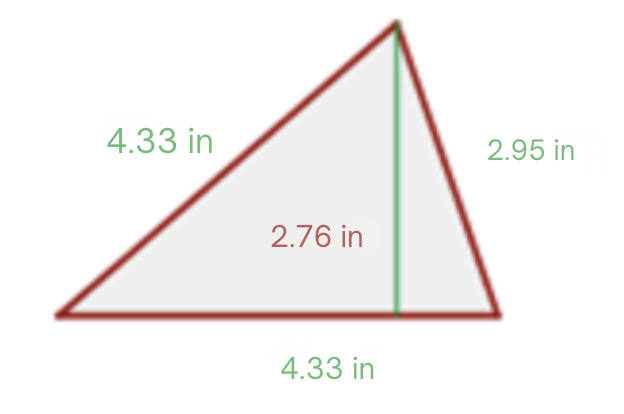
This is an isosceles triangle, so the perimeter is:

We observe that the base is 4.33 inches and the height is 2.76 inches:

Calculate the area and perimeter of the square with side 1.97 inches:
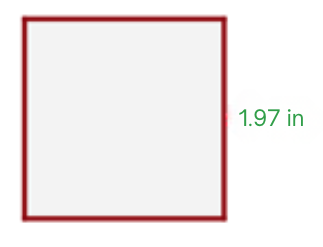
The side  . We calculate the perimeter:

We calculate the area:

Calculate the area and perimeter of the rectangle with 3.94 inches base and 2.36 inches height:
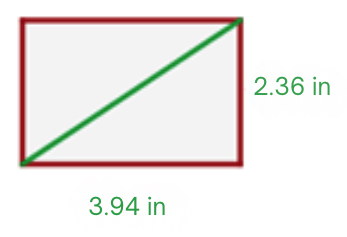
We calculate the perimeter:

We calculate the area:

Calculate the area and perimeter of the rhombus whose diagonals measure 11.81 and 6.30 inches and its side measures 6.69 inches:
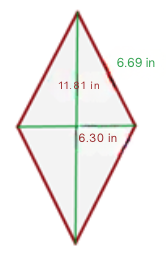
We calculate the perimeter:

We calculate the area:

Calculate the area and perimeter of the parallelogram whose sides measure 1.57 and 1.77 inches and its height measures 1.57 inches:
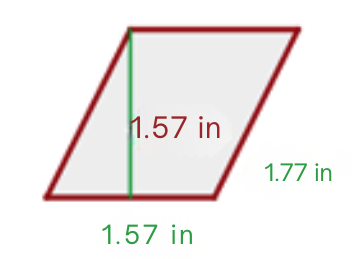
We calculate the perimeter:

We calculate the area:

Calculate the area and perimeter of the trapezoid whose major and minor bases measure 3.94 and 1.57 inches respectively, its slanted sides 1.97 inches, and its height measures 1.57 inches:
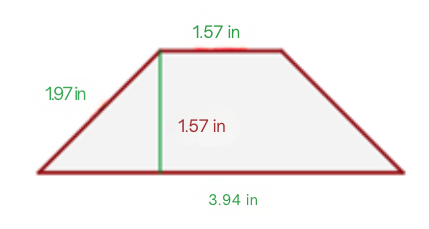
We calculate the perimeter:

We calculate the area:

Calculate the area and perimeter of a regular pentagon with side 2.36 inches and whose distance from the center to one of its vertices is 1.97 inches:
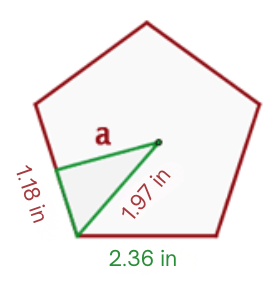
We calculate the perimeter:

We calculate the area. To do this, we apply the Pythagorean theorem and obtain the value of the apothem:

We substitute the perimeter and apothem in the area formula:

Calculate the apothem and perimeter of a regular hexagon inscribed in a circle with radius 1.57 inches:
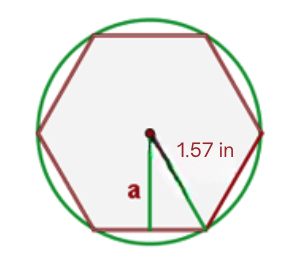
Since this is a hexagon, we can divide it into six equal equilateral triangles, from which we obtain that each side measures 1.57 inches. We calculate the perimeter:

We calculate the apothem. To do this, we apply the Pythagorean theorem:

Calculate the area and perimeter of the following polygon:
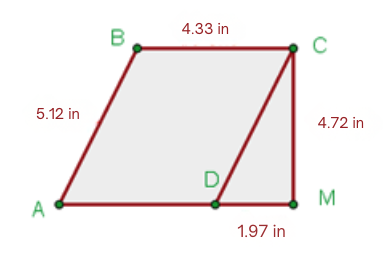
We calculate the perimeter:

We calculate the area. To do this, we calculate the area  of the parallelogram
 and the area
 of the triangle
 :


Thus, the area of the irregular polygon is:

Summarize with AI:
Did you like this article? Rate it!

 Loading...