The calculation of polygon areas is a fundamental skill in geometry, with applications in diverse fields such as architecture, design, surveying, and many other practical disciplines. Understanding how to determine these areas not only reinforces basic geometric concepts but also develops analytical and logical reasoning skills.
In this material, you will find a series of solved exercises covering different types of polygons, such as triangles, quadrilaterals, pentagons, and more complex figures. Each exercise is designed to help you apply specific formulas, interpret data, and solve problems step by step.
A rectangular field has a base of 557.8 feet and a height of 91.87 feet. Calculate:
A. The acreage of the field.
B. The price of the field if the square foot costs $16.50.
Solution 1A:
We calculate the area of the rectangle by multiplying the base by the height.

We know that one acre is equal to 43,560 ft², so the number of acres is:

Solution 1B:
To calculate the price of the field at $16.50 per square foot, we perform:

A baseball diamond has a side length of 90 feet. Find the area of the diamond.
The diamond of a baseball stadium is actually a square, so the requested area is:

A basketball court is 91.87 feet long by 49.21 feet wide. If maintenance costs $12 per square foot, find the total cost to maintain the court.
The total area of the basketball court is:

The total maintenance cost is:

A soccer field measuring 344.49 feet long by 223.10 feet wide uses 14,543 gallons of water per day for irrigation. A new sprinkler technology can irrigate one square foot with 0.132 gallons of water. How many gallons of water per day will be saved with this new technology?
The total area of the soccer field is:

The total water savings is:

One quart of paint covers fifty square feet of surface to paint. How many quarts of paint are required to paint a wall that is 32.81 feet long and 13.12 feet high?
The total area of the wall is:

The number of quarts required is:
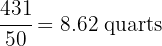
Calculate the number of square tiles, with a side of 3.94 inches, needed to tile a rectangular surface measuring 13.12 feet in base and 9.84 feet in height.
1. We calculate the area of the rectangle by multiplying the base by the height.

2. We know that 1 ft² is equal to (12 inches)² = 144 in², so the area of the rectangle in square inches is:

3. We calculate the area of one tile.

4. To calculate the number of tiles required, we divide the area of the rectangle by the area of one tile.

Find the area of an isosceles right triangle whose sides measure 3.94 inches each.
1. We draw the isosceles right triangle.
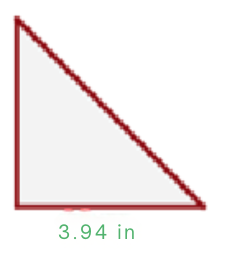
2. We observe that the equal sides correspond to the base and height of the triangle.
3. We calculate the area of the triangle, which equals the product of its base and height divided by two.

The perimeter of an equilateral triangle is 2.95 feet, and the height is 10.21 inches. Calculate the area of the triangle.
1. We draw the equilateral triangle.
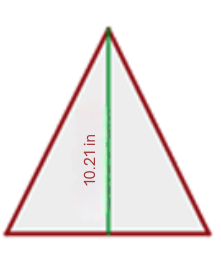
2. We note that the perimeter is given in feet and the height in inches. We convert the perimeter to inches.

To calculate the area of the triangle, we need to know its base and height. Since the triangle is equilateral, its three sides are equal. One side is obtained by dividing the perimeter by three.

We calculate the area of the triangle, which equals the product of its base and height divided by two.

Calculate the number of trees that can be planted in a rectangular lot measuring 104.99 feet long and 98.43 feet wide if each plant needs 43.06 ft² to develop.
1. We calculate the area of the rectangular lot, which equals the product of its length by its width.

We observe that each plant needs 43.06 ft², so to calculate the number of trees, we divide the area of the lot by 43.06.

Thus, the number of trees that can be planted is 240.
The area of a trapezoid is 1,292 ft², the height is 26.25 feet, and the smaller base measures 32.81 feet. How much does the other base measure?
1. We write the formula for the area of a trapezoid, which equals half the product of the height times the sum of the bases.
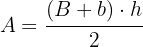
2. We substitute the known data.

3. We simplify the right side by dividing 26.25 by two.

4. We want to isolate  , so we divide both sides by 13.125.

5. We subtract 32.81 from both sides and obtain:

Thus, the other base measures 65.59 feet.
Calculate the area of a parallelogram whose height measures 0.79 inches and whose base measures 3 times its height.
1. To calculate the area, we need to know the base and height. The height measures 0.79 inches and the base is three times its height, so the value of the base is:

2. We calculate the area, which equals the product of the base and height.

Calculate the area of a rhombus whose major diagonal measures 3.94 inches and whose minor diagonal is half the major.
1. To calculate the area, we need to know the major and minor diagonals of the rhombus. The major diagonal measures 3.94 inches and the minor measures half the major, so the value of the minor diagonal is:
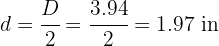
2. We calculate the area, which equals half the product of the diagonals.

In the center of a square garden measuring 492.13 feet on a side, there is also a square pool measuring 82.02 feet on a side. Calculate the area of the garden.
1. We represent the problem graphically and note that the total area equals the area of the garden plus the area of the pool.
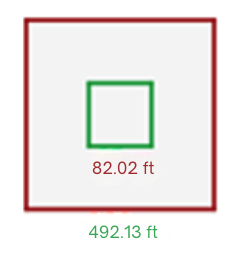

2. We calculate the total area, which equals the product of the sides of the square.

3. We calculate the area of the pool, which equals the product of the sides of the square.

4. Thus, the area of the garden equals the total area minus the area of the pool.

Calculate the area of the quadrilateral that results from connecting the midpoints of the sides of a rectangle whose base and height measure 26.25 and 19.69 inches.
1. We represent the problem graphically and note that the total area equals four right triangles with base 13.12 inches and height 9.84 inches.
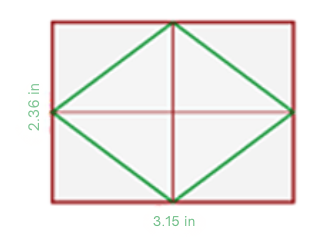
2. We calculate the area of the triangle.

3. We calculate the area of the quadrilateral.

How much is the area of the shaded part of the figure if the area of the hexagon is 1,487 in²?
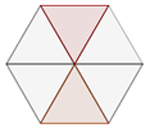
1. We observe that the hexagon is composed of six equal triangles.
2. We calculate the area of one triangle.

3. We calculate the shaded area.

A forested area has the shape of a trapezoid with bases measuring 420 feet and 302 feet. The width of the area measures 131.2 feet. A pathway measuring 13.12 feet wide is built perpendicular to the two bases. Calculate the area of the wooded zone remaining.
1. We represent the problem graphically and note that the area of the trapezoid equals the sum of the area of the wooded zone and the area of the pathway.
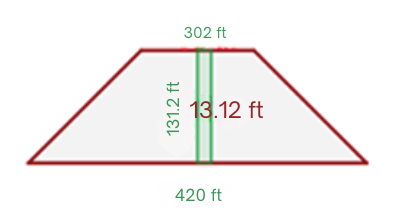

2. We calculate the area of the trapezoid.

3. We calculate the area of the pathway.

4. We calculate the area of the wooded zone.

A rectangular garden measures 98.43 feet by 65.62 feet. The garden is crossed by two perpendicular paths that form a cross. One has a width of 2.62 feet and the other 2.30 feet. Calculate the garden area.
1. We represent the problem graphically and note that the garden area equals the area of the rectangle minus the areas of the paths plus the area of their intersection.
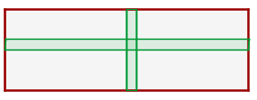

2. We calculate the area of the rectangle.

3. We calculate the area of the first path.

4. We calculate the area of the second path.

5. We calculate the area of the intersection of the paths.

6. We calculate the garden area.

Given the square  with a side of 13.12 feet, point
 (the midpoint of segment
 ) is connected with vertex
 . Calculate the area of the trapezoid formed.
1. We represent the problem graphically and note that the area of the trapezoid equals the area of the square minus the area of a right triangle.
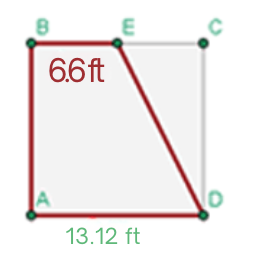

2. We calculate the area of the square.

3. We calculate the area of the triangle.

4. We calculate the area of the trapezoid.

Calculate the amount of paint needed to paint the facade of this building knowing that 1.1 pounds of paint are used per square foot.
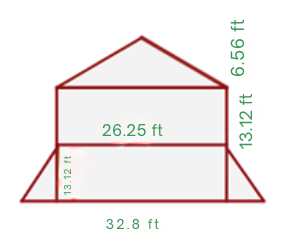
1. We note that the area of the building is formed by a triangle with base 26.25 feet and height 6.56 feet; two rectangles with base 26.25 feet and height 13.12 feet; and two right triangles with base 3.28 feet and height 13.12 feet.

2. We calculate the area of the triangle.

3. We calculate the area of the rectangle.

4. We calculate the area of the right triangle.

5. We calculate the area of the building.

6. We calculate the pounds of paint required to paint the building.

Find the perimeter and area of the figure.
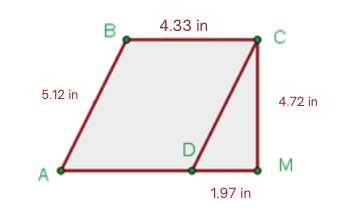
1. We note that the figure is formed by a parallelogram with a base of 4.33 inches and height of 4.72 inches; and a right triangle with a base of 1.97 inches and height of 4.72 inches.

2. We calculate the area of the triangle.

3. We calculate the area of the parallelogram.

4. We calculate the area of the figure.

5. We calculate the perimeter (converting: 13 cm = 5.12 in, 11 cm = 4.33 in, 12 cm = 4.72 in, 5 cm = 1.97 in).

Summarize with AI:
Did you like this article? Rate it!

 Loading...