If you have a problem with a model that has boundary conditions defined, but you also want the model to have certain flexibility so it can be solved more easily by different methods, you should know what a dot product is.
You may not always understand what a dot product is, since the definition often involves complex mathematical equations, but they remain important for understanding other concepts in physics. In particular, when studying boundary conditions in the atmosphere, such as low-level clouds or wind shear, the inclusion of a dot product in the formulation will facilitate solving the problem.
A dot product is a scalar quantity that has a well-defined positive value, but which is not necessarily zero. In other words, it represents a change in any measurable quantity, such as a vector, and not necessarily the actual position or direction to which the vector points. The dot products of two or more vectors are usually defined as the sum of all corresponding vector quantities, although this is not necessary.
The dot product of two vectors is an operation that takes two vectors and produces a real number:

Note that the dot product is usually denoted by means of a dot  . Another notation often used is
  . However, at Superprof we will always denote the dot product using a dot.
Furthermore, the dot product should not be confused with the multiplication of a vector by a scalar.


Ways to Calculate the Dot Product
There are two equivalent ways to obtain the dot product of two vectors  and
and  . These are described below:
1. If we know the magnitude of both vectors and the angle  between them, then the dot product is obtained by:

2. If we know the components of the vectors  and
and  , then the dot product is given by:

Examples
Example 1:
Consider the vectors  and
and  . The angle between the vectors is
  .
.
To calculate the dot product, we must first find the magnitude of and :

Thus, the dot product is given by:

Example 2:
We will repeat the previous example with and . However, now we will use the other formula:

Note that the result was the same regardless of which formula we used.
Calculating Magnitude and Angles of Vectors
As we saw previously, there are two equivalent formulas for calculating the dot product of two vectors. Therefore, the dot product can be used to calculate the magnitude of a vector or the angle between two vectors.
Calculating the Magnitude of a Vector Using the Dot Product
Note that if is a vector, then:

Therefore:

This formula can be used to calculate the magnitude of a vector using the dot product of with itself.
Calculating the Angle Between Two Vectors Using the Dot Product
Suppose we have vectors and . Then:
Solving for  :
:

Thus, if we substitute the other dot product formula, we have:
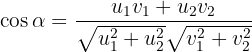
This formula is used to calculate using the arc-cosine function.
Examples
Example 1:
Again consider the vectors and . The magnitude of these vectors is:


Example 2:
Now we will calculate the angle between and . We have:

Thus:

Therefore, we must have:

Orthogonality of Two Vectors
We know that two vectors are orthogonal (or perpendicular) if the angle between them is  or
or  . In either case, we have
  . Therefore, if two vectors are orthogonal, we have:

That is, two vectors  and
and  will be orthogonal whenever:

Example
We will verify the orthogonality of the vectors and that we used in the previous examples. Note that:

Therefore, vectors and are not perpendicular.
Geometric Interpretation of the Dot Product
Note that  can be seen as the magnitude of the projection of vector onto —as long as
  —as shown in the following figure. The projection would be the vector with origin
  and endpoint
  .
.

This follows from observing the right triangle that formed in the previous figure. We know that:
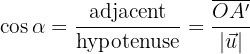
Thus, solving for  :
:

To visualize the projection, imagine there is a light source and the projection is the shadow of vector onto vector . Furthermore, this light source must be positioned such that a vector perpendicular to casts no shadow.
Thus, the product  can be seen as the magnitude of one vector multiplied by the magnitude of the projection of the other vector. That is, substituting
  into the dot product formula, we have:

Therefore, we can calculate the magnitude of the projection of vector onto vector using:
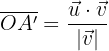
Note: If we have and it is negative, then this means the projection has the opposite direction to vector . This occurs when  or
or  . In this case, the magnitude of the projection is given by
  .
.
Example
We will find the projection of  onto the vector
  . To do this, let's calculate:

Note that  has a negative sign. Therefore, the projection has the opposite direction to and its magnitude is 2/5.
Properties of the Dot Product
The dot product satisfies different properties. The most important are the following:
1. The dot product is commutative. In other words, "the order of factors does not change the product." Thus, it doesn't matter in which order the vectors are multiplied.

2. Associativity with respect to scalar multiplication. That is, if we multiply by and then by a scalar  , the result is the same as first performing
  and then the dot product with . This is:

3. Distributivity with respect to addition. That is:

Note: Properties 2 and 3 together are known as linearity of the dot product with respect to the first operand.
Note: Because the dot product is commutative, linearity also holds with respect to the second operand. That is:


4. The dot product is positive definite. That is, the dot product of a nonzero vector with itself is always positive.

Summarize with AI:
Did you like this article? Rate it!

 Loading...