Sine Theorem
Each side of a triangle is directly proportional to the sine of the opposite angle.
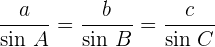
Applications
This theorem is useful for solving problems if the given data falls into any of the following cases:
1. If we have the measures of 2 sides of a triangle and the angle opposite to one of them.
Applying the theorem, we can immediately obtain the angle opposite to the other side we know.
2. If we have the measures of 2 angles of a triangle and the side opposite to one of them.
Applying the theorem, we can immediately obtain the side opposite to the other angle we know.
3. It can also be applied when 2 angles of the triangle and a side that is not opposite to either of them are known, only it requires an extra step, which is to obtain the other angle of the triangle.
This is possible because we know that the sum of the angles of a triangle is 180°. For example, in the image above, angle B is obtained by subtracting the other 2 angles from 180:

Ignoring one of the originally given angles, we now have the data of 2 angles and the side opposite to one of them, as in the second case mentioned in the applications.

Cosine Theorem
In a triangle, the square of each side is equal to the sum of the squares of the other two minus twice the product of both times the cosine of the angle they form.

Applications
This theorem is useful for solving problems:
1. If we have the measure of an angle and the sides adjacent to it.
Applying the theorem, we can obtain the third side, that is, the side opposite to the angle we have, since:

2. If we have the measure of all 3 sides of a triangle.
Applying the theorem, we can obtain any angle, since:

Tangent Theorem
The tangent theorem relates a pair of sides of a triangle and their respective opposite angles:

Applications:
This theorem is just as useful as the sine and cosine theorems, but is less popular. It can be used in any of the cases where:
1. Two sides and an opposite angle are known.
2. Two angles and an opposite side are known.
Area of a Triangle
1. The area  of a triangle is half the product of a base times the corresponding height.

By definition:

Substituting  in the previous area formula, we obtain the following result.
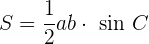
2. The area of a triangle is the semi-product of two of its sides times the sine of the angle they form.
3. The area of a triangle is the quotient between the product of its sides and four times the radius of its circumscribed circle.

4. The area of a triangle is equal to the product of the radius  of the inscribed circle times its semi-perimeter
  .
.

5. Heron's Formula: Let be the semi-perimeter of the triangle, then:

Summarize with AI:
Did you like this article? Rate it!

 Loading...