


While mathematics often comes under criticism from students for its inability to be applied in daily life, the discipline was actually founded on the goal of making life simpler. Division, multiplication, addition, subtraction – math should help students obtain a better quality of life. One example of this can be found by reviewing the history of mathematics and examining the life of Archimedes of Syracuse. A great scientist, physician, mathematician, and engineer of ancient Greece, Archimedes utilized math to explain the mechanics of daily life.¹ He contributed a number of revolutionary tools, like the lever and the screw, through his mathematical works and explorations.


The Early Life and Background of Archimedes of Syracuse
Like many scientists of antiquity like Thales, the life of Archimedes of Syracuse was not well documented. There is no biography that was written by him, and, in fact, only a couple of written texts have been found about the mathematician - a common problem for historians studying this era. What we do know comes mainly from the writings of Isadore of Miletus, who discussed him in approximately 530 BCE.
Some other scholars who mentioned the life of Archimedes range from Polybius (202-126 BCE), Plutarch (46-125BCE), and Livy (59-17BCE). It is estimated that Archimedes was born in Syracuse in 287 BCE. With an astronomer for a father, Archimedes began to take an interest in and study sciences from a young age. According to texts documenting exchanges Archimedes had with certain professors, historians inferred that he continued his studies at the reputable School of Alexandria.²
It was there that he rubbed shoulders with the most well-known sages of the era, most notably Dositheus, Conon of Samos, and also the director of the library of Alexandria, Eratosthenes. It was to this audience of distinguished academics, and to the academics later inspired by these works, that Archimedes intended his scientific books. Later in life, Archimedes became an engineer for the king of Syracuse, Hiero II.
He participated, therefore, in the defense of the city during the Second Punic War. Legend has it that Archimedes was killed in 212 BCE by a Roman soldier who had specifically been ordered not to execute him. The documents gathered on Archimedes’ life are not sufficient to establish whether the scientist had a wife or children. On the other hand, the documents found concern only the mathematician's work and publications. Nothing else has been found over the period he was an engineer of the king. It is necessary, then, to trust the witness accounts found many years after his death.
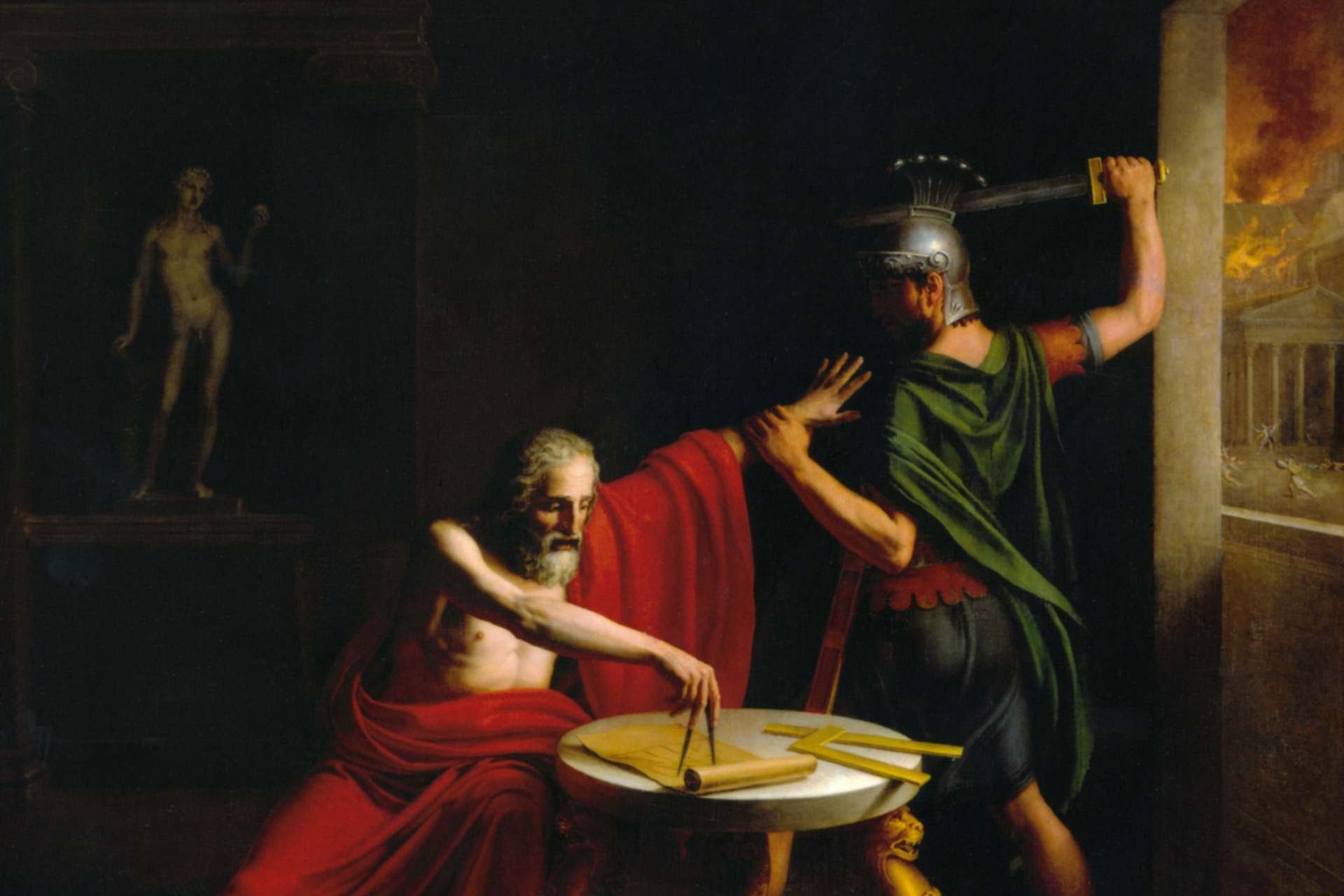
Archimedes and his seminal works made an important mark not only on his era but also on the generations to come including Sir Isaac Newton. In other words, it was not only the great sages of his epoch who admired him, but he also inspired many other academics in the future. These great academics include Cicero, Plutarch, and even Leonardo da Vinci. Archimedes’ influence even extends to language.
The word “Eureka” was made popular by Archimedes, who, it is said, cried it out in the street to celebrate one of his major discoveries. The word eureka translates to “I have found,” which explains why so many of us have uttered it after finding an object or idea we thought we had lost. This alone is proof that Archimedes’ influence has traversed the ages. Alongside the likes of Newton, Pythagoras, Thales, Descartes, and Einstein, Archimedes finds a place among some of the great mathematicians and scientists in the history of mathematics.
| Discovery / Work | Field | What Archimedes Demonstrated | Lasting Impact |
|---|---|---|---|
| Method of Exhaustion | Geometry | A mathematical method for calculating the area of curved shapes using progressively smaller polygons | Early foundation for integral calculus and modern mathematical analysis |
| Approximation of Pi | Geometry | Calculated the value of pi by comparing the perimeter of polygons inside and outside a circle | Provided one of the most accurate estimates of pi in the ancient world |
| The Sand Reckoner | Mathematics | Developed a system for expressing extremely large numbers to estimate grains of sand in the universe | Expanded mathematical thinking about large numbers and notation |
| Archimedean Spiral | Geometry | Studied the properties of a spiral curve and relationships between radius, surface, and angle | Influenced later work in geometry and mechanical design |
| Sphere and Cylinder Theorem | Geometry | Demonstrated the relationship between the volume and surface area of a sphere and a cylinder | Considered one of Archimedes’ greatest mathematical discoveries |
| Archimedes’ Principle | Physics | Explained how objects submerged in a fluid experience buoyant force | Foundation of fluid mechanics, shipbuilding, and engineering |
| Law of the Lever | Mechanics | Proved mathematically how a lever system balances weight around a pivot | Essential principle in classical mechanics and engineering |
Major Mathematical Discoveries by Archimedes
What did archimedes contribute to mathematics? Archimedes contributed many advancements in mathematics. This is why he's one of the most important figures in the history of science. Here are some of his major mathematical discoveries.
Method of Exhaustion
The Method of Exhaustion Archimedes built upon the works of Eudoxus of Cnidus, who discussed how the method of exhaustion can be utilized in order to succeed in calculating the area found under a parabola. This permitted him to continue expanding upon his reflections on conic shapes and to calculate areas previously considered impossible.²
Approximation of Pi
Archimedes is particularly known for calculating pi to incredible precision. To perform his calculations, the mathematician utilized regular polygons and combined them to calculate the relationship between the perimeter of a circle and its diameter. It was using this method that he was able to find the number that approached the number pi as we know today (3.14159).⁴
The Sand Reckoner
Archimedes explored extremely large numbers in The Sand Reckoner. This mathematical treatise was used by Archimedes to estimate how many grains of sand would be required to fill the known universe.⁶ Since Greek mathematicians did not yet have a convenient system for expressing very large numbers, calculations of this scale were difficult. Archimedes developed a new numerical system capable of representing extraordinarily large values.⁵ He used powers of tens and structured groupings of numbers, demonstrating that math could be used to describe quantities on cosmic scales.
Archimedean Solids and the Flotation Principle
Archimedes also made important discoveries while studying three-dimensional shapes, particularly the sphere and the cylinder. In his work On the Sphere and Cylinder, he showed that the volume of a sphere is two-thirds the volume of the cylinder that surrounds it when the sphere touches the cylinder’s sides and bases.⁷ He was especially proud of this discovery and reportedly requested that a sphere and a cylinder be engraved on his tombstone to commemorate the theorem.
Archimedes’ investigations into geometry were also connected to his study of physical principles, especially the behavior of objects in water. His work on floating bodies led to what is now known as Archimedes’ principle, which explains how objects submerged in a fluid experience an upward buoyant force equal to the weight of the displaced liquid. This discovery helped explain why ships float and laid the foundations for later developments in fluid mechanics and engineering, an area explored by many great mathematicians.
Archimedes’ principle states that an object submerged in a fluid experiences an upward buoyant force equal to the weight of the fluid it displaces. This principle explains why ships float and why objects appear lighter in water. It remains one of the most important discoveries in fluid mechanics and continues to influence modern engineering and shipbuilding.
Contributions to Geometry
Archimedes made several important contributions to geometry. With much of his work focusing on areas, volumes, and the properties of curves, he significantly changed how mathematicians worked with shapes. These are the key areas of geometry where Archimedes made significant contributions.
Quadrature of the Parabola
Archimedes' work, Quadrature of the Parabola, investigated the area enclosed by a parabola and a straight line. By using geometric reasoning and the method of exhaustion, he demonstrated that the curved segment could be calculated precisely. His proof showed that the area of the parabolic segment is equal to four-thirds of the area of a specific inscribed triangle.⁸
On Spirals
In the treatise On Spirals, Archimedes studied the properties of a spiral curve, which is now known as the Archimedean spiral. He defined this spiral as a path traced by a point moving at a constant speed on a rotating line. Using this, he explored the relationship between the radius of the spiral and the angle of rotation.
He also used this curve to solve geometric problems with tangents and areas. He applied careful reasoning and geometric constructions to show how spirals could be analyzed mathematically like circles and curves. This work expanded geometry and would influence the later developments in math, mechanics, and engineering and be studied by greats like René Descartes.
Applications in Physics and Engineering
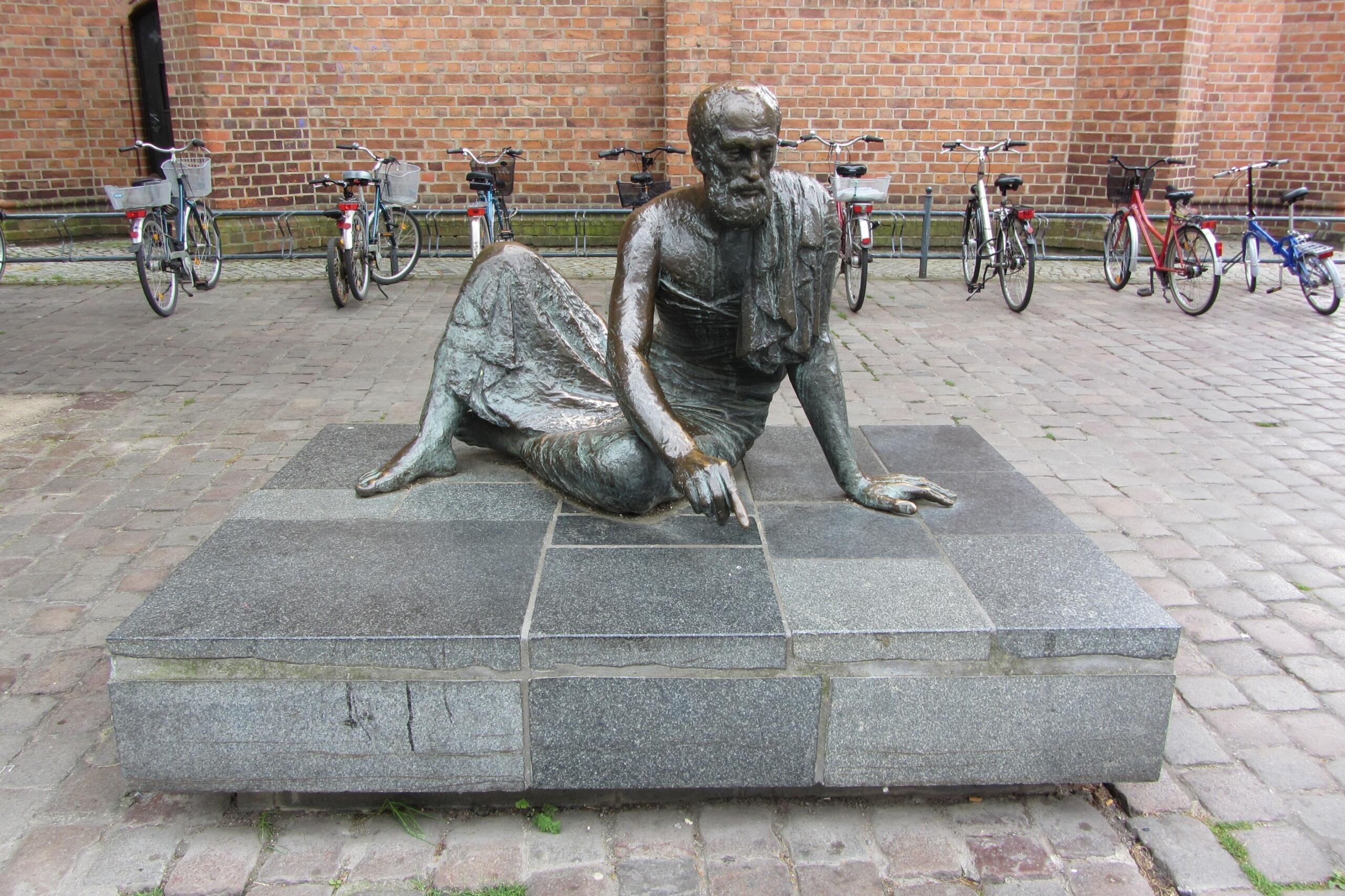
Archimedes didn't just work in math. He also had ideas that could be directly applied to physics, mechanics, and engineering. He studied forces, motion, and fluid behavior, demonstrating how mathematical reasoning can be applied to real-world machines.
Law of the Lever
By examining how weight and distance interact around a pivot point, he demonstrated that objects could be balanced using proportional distances. He showed that a relatively small force could move a much heavier object when applied at the correct distance from the fulcrum. This relationship was explained in his work On the Equilibrium of Planes, where he explored how bodies remain balanced when forces act upon them.⁸ The principle remains central to mechanics and engineering.
Archimedes’ Principle
Archimedes’ principle is defined as:
Any body that is submerged, either completely or partially, in a fluid at rest is subjected to an upward force. The magnitude of this buoyant force is equal to the weight of the fluid that the body has displaced.
Some important distinctions are made by Archimedes’ principle, namely that this push only operates on the object if the fluid and the body area at rest. This principle is proved in his work through his experimentation with cylindrical objects. While this principle continues to have an important impact in today's technological advancements, it was especially important at the time. Archimedes utilized this principle to create the plans for the biggest boat of antiquity for Hiero II: the Syracusia. Today, this principle is still being utilized in the construction of machines.
Archimedes’ Long-Lasting Legacy
As with today, the discipline of mathematics in ancient times was entirely linked to understanding the workings of the world. The people who make up the canon of the great academics of antiquity all studied and utilized math to put their world into context. Astronomy, geography, physics, and mechanics - all scientific subjects need math and Archimedes alongside his fellow Greek mathematicians like Euclid.
Archimedes took a special interest in studying the function of machines and, in fact, is widely recognized as the father of static mechanics. At first, he studied the functioning of both the lever and the center of gravity, investigations which would later play a major role in his work “On the Equilibrium of Planes.” It was because of this work that Archimedes famously: “Give me a place to stand on, and I will move the Earth.” Archimedes wrote many other works relating to the principles of the mechanisms of the lever. Through these, he discovered that the weight should be in equilibrium on each side of an object for the center of gravity to be perfectly balanced. The mathematician is also credited with providing the first investigations on machines using traction.
Give me a place to stand on, and I will move the Earth.
Archimedes
One example is his implementation of the pulley system, which helped the ancient Greeks lift heavier objects. However, it is another, more powerful invention that is credited to the accomplished mathematician: the screw. Inspired by his discoveries in Egypt, Archimedes created the screw in order to help people lift water from rivers. Another of Archimedes’ inventions, the “Antikythera mechanism,” enabled humans to predict the dates and times of eclipses. Some parts of this machineare visible at the National Archaeological Museum in Athens. For Archimedes, all of his mechanical inventions and academic investigations were not just distractions or entertainment. His discoveries were mostly a product of the commands to protect the city of Syracuse and his creative spirit.
References
- “Archimedes.” MacTutor History of Mathematics Archive, University of St Andrews. https://mathshistory.st-andrews.ac.uk/Biographies/Archimedes/ Accessed 6 Mar. 2026.
- “The Rise of Calculus.” MacTutor History of Mathematics Archive, University of St Andrews. https://mathshistory.st-andrews.ac.uk/HistTopics/The_rise_of_calculus/ Accessed 6 Mar. 2026.
- “Method of Exhaustion.” Encyclopaedia Britannica. https://www.britannica.com/science/method-of-exhaustion Accessed 6 Mar. 2026.
- “Chronology of Ancient Mathematics.” MacTutor History of Mathematics Archive, University of St Andrews. https://mathshistory.st-andrews.ac.uk/Chronology/2/ Accessed 6 Mar. 2026.
- Valdivia, Manuel. “Infinity in Mathematics.” MacTutor History of Mathematics Archive, University of St Andrews. https://mathshistory.st-andrews.ac.uk/Extras/Valdivia_Infinity/ Accessed 6 Mar. 2026.
- Archimedes. The Sand Reckoner. Translated by Thomas L. Heath. https://sacred-texts.com/cla/archim/sand/sandreck.htm Accessed 6 Mar. 2026.
- Bruskiewich, Patrick. Archimedes – The Sand Reckoner. https://www.researchgate.net/publication/379894059_Archimedes_-The_Sand_Reckoner Accessed 6 Mar. 2026.
- Archimedes. The Works of Archimedes. Digital Archive Edition. https://www.aproged.pt/biblioteca/worksofarchimede.pdf Accessed 6 Mar. 2026.
Summarize with AI:
Did you like this article? Leave a rating!


 Loading...

Excellent!