
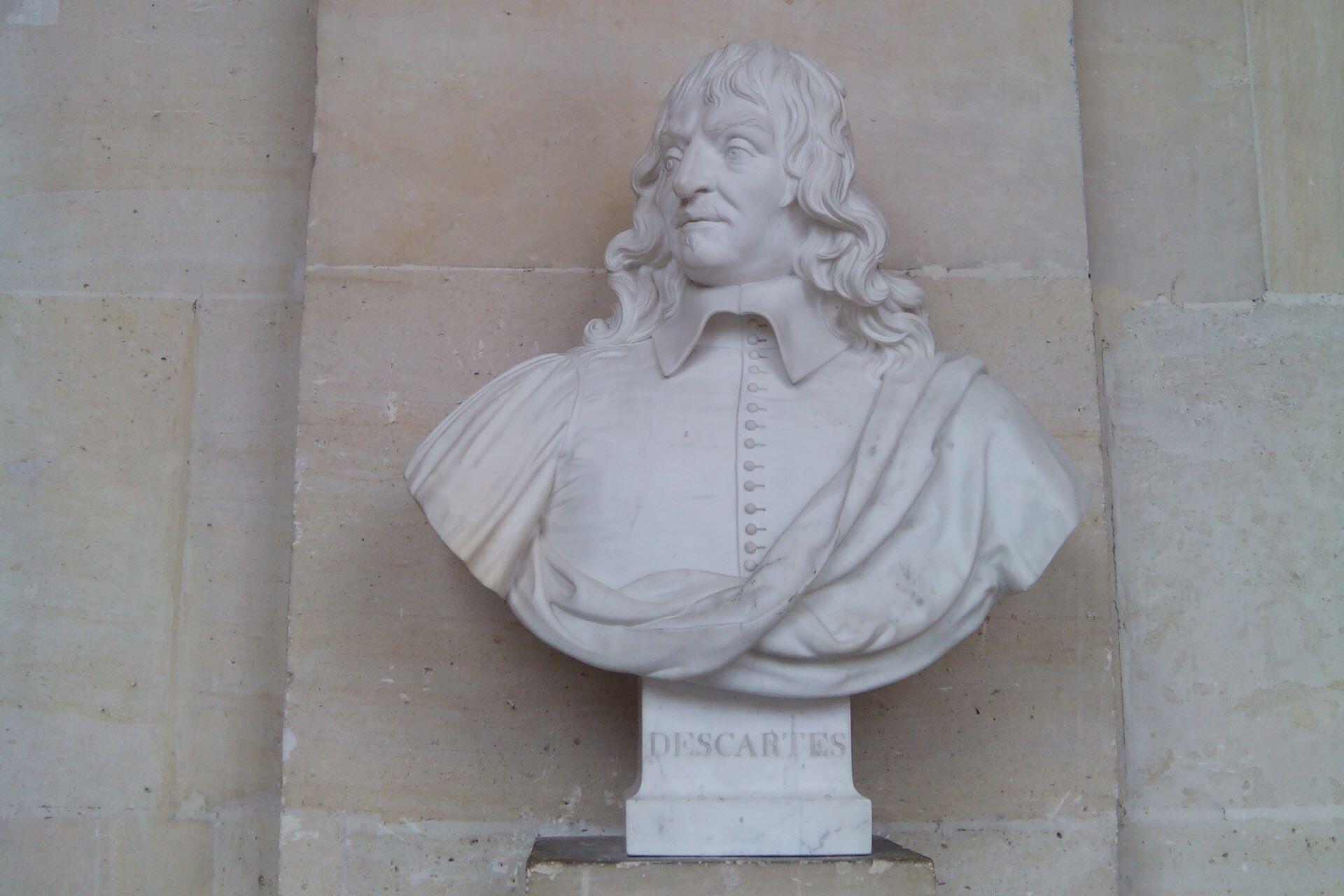

Cogito, ergo sum
René Descartes, Discourse on the Method (1637)
René Descartes is one of the most influential figures in the history of mathematics and philosophy.¹ The French mathematician and thinker reshaped scientific reasoning in the seventeenth century with several groundbreaking discoveries. One of Descartes’ key inventions was analytic geometry, which connected algebra and geometry and transformed how mathematical problems are solved. Let's explore the life and impact of one of history's greatest mathematicians.


The Life of the Mathematician
René Descartes was born in 1596 in La Haye en Touraine, France, a town later renamed Descartes in his honor.² The same was done for the mathematician Pythagoras, who has a town in Greece that bears his name. Descartes became one of the most important French thinkers in the history of mathematics, philosophy, and science. Although widely remembered for his philosophical ideas about doubt, knowledge, mind, and existence, Descartes was also a mathematician whose work shaped modern mathematics.
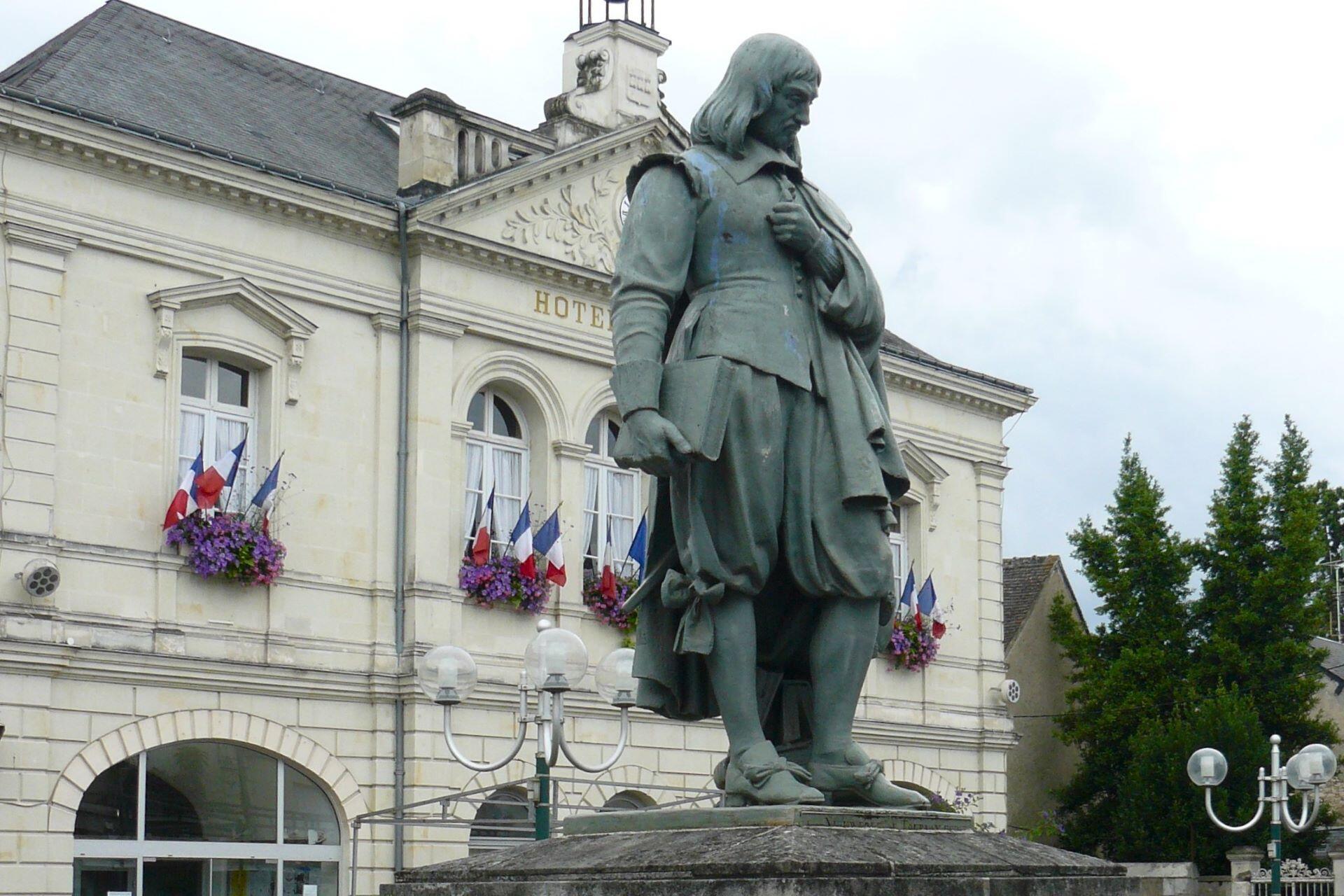
He continued his higher education at the University of Poitiers, where he studied law and obtained a bachelor’s degree. Despite this education, Descartes never worked in law or politics. Instead, he enlisted in the army and used the opportunity to travel across Europe. In 1628, Descartes moved to the Netherlands, where he prepared a scientific work titled “The World” or “Treatise on Light.”
In this work, Descartes described physical phenomena that explained how the world functions. Drawing on the work of Copernicus and Galileo, he supported the idea that the Earth revolves around the sun. However, after Galileo was condemned by the Church in 1633, Descartes postponed publishing the book for several years.
He later wrote Discourse on the Method of Rightly Conducting One’s Reason and of Seeking Truth in the Sciences, commonly known as Discourse on the Method.³ Published in 1637 and still studied worldwide, the book was notable because it was written in French rather than Latin, the usual language of scientific works. It was accompanied by three essays on optics, meteorology, and geometry, like other great mathematicians like Archimedes had studied extensively. In the geometry essay, Descartes explained the relationship between algebra and geometry.⁷
While this relationship is standard in modern mathematics, Descartes was the first to describe it clearly in what became known as analytic geometry. He later published other influential works, including Principles of Philosophy (1644) and The Passions of the Soul (1649). Descartes died of pneumonia in Stockholm in 1650 while serving at the court of Queen Christina of Sweden.
1596
Birth in France
René Descartes is born in La Haye en Touraine, France, a town later renamed Descartes in his honor.
1616
University Education
Descartes completes his studies at the University of Poitiers, earning a law degree before pursuing science and philosophy.
1628–1649
Scientific Work in the Netherlands
Descartes lives in the Netherlands, where he develops many of his ideas in mathematics, physics, and philosophy.
1637
Publication of Discourse on the Method
Descartes publishes Discourse on the Method along with La Géométrie, introducing analytic geometry.
1644
Principles of Philosophy
He publishes Principles of Philosophy, presenting his broader scientific and philosophical system.
1650
Death in Stockholm
Descartes dies of pneumonia while serving at the court of Queen Christina of Sweden.
Development of Analytic Geometry
Linking algebra and geometry was one of the most important mathematical breakthroughs. As the work of the Greek mathematician Thales with triangles, Descartes's work also focused heavily on geometry. He showed that geometric shapes and curves could be expressed with algebraic equations, giving mathematicians a new way to solve problems. This would become known as analytic geometry, and it's still a fundamental part of modern math.⁴
René Descartes made several discoveries that transformed the study of mathematics. He developed analytic geometry, a method that connects algebra and geometry by expressing curves and shapes through equations. Descartes also introduced the Cartesian coordinate system, which represents points on a plane using numerical coordinates along two axes. In addition, he helped standardize algebraic notation by using letters such as x, y, and z for unknown values and a, b, and c for known quantities. He also introduced the term “imaginary numbers,” which later became important in the study of complex numbers.
Algebra in the Context of Descartes
While writing Discourse on the Method in the 17th century, Descartes made several choices that reshaped algebra. Most notably, he expressed unknown values using letters. While this notation seems normal today, it was unusual at the time. François Viète, a contemporary of Descartes, first introduced letters into algebraic formulas.⁵ Descartes expanded this idea in the geometry essay of Discourse on the Method. In this essay, Descartes used the letters x, y, and z to represent unknown values, while a, b, and c represented known quantities.
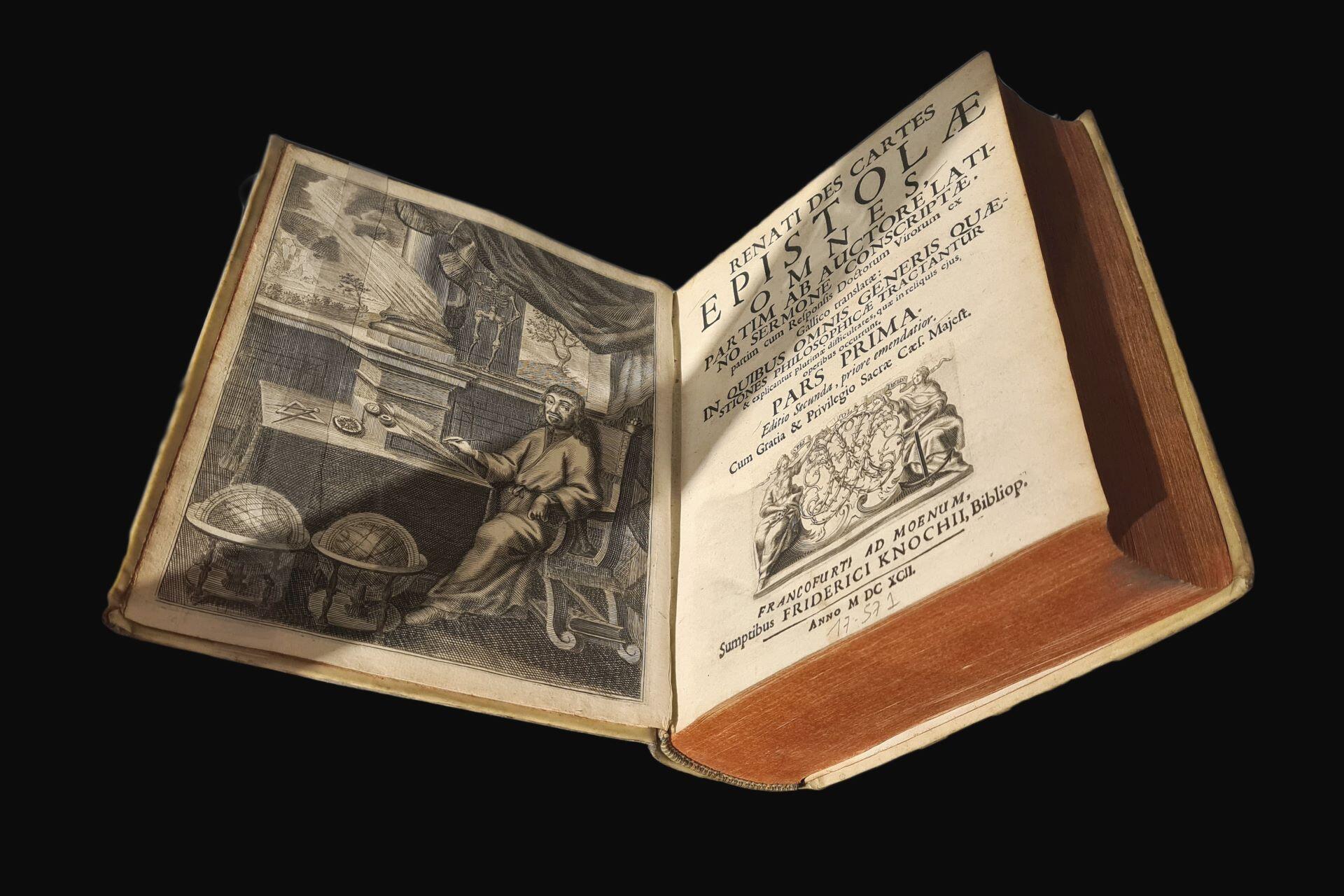
He also introduced a clearer notation for exponents, replacing repeated multiplication such as xxxx with x⁴. The equal sign was not yet standard in Descartes’ time, and subtraction was sometimes expressed using two negative signs. The notation for squares, however, remained unchanged.
Descartes also introduced the term “imaginary numbers” to describe complex numbers. More importantly, he connected algebraic calculations with plane geometry. This approach, known as analytic geometry, allowed geometric shapes to be described using equations, coordinates, and graphs.
Bridging Algebra and Geometry
By describing geometric shapes with algebraic equations, Descartes showed that mathematicians could translate lines and curves into numerical relationships. Mathematicians no longer had to use diagrams to solve geometric problems, which they had been doing since the times of the mathematician Thales. This connection between algebra and geometry was the basis of analytic geometry, and it changed mathematics.
| Mathematician | Key Contribution | Field of Mathematics | Historical Importance |
|---|---|---|---|
| René Descartes | Analytic geometry and Cartesian coordinates | Geometry and algebra | Connected algebra with geometry and transformed mathematical problem solving |
| Pierre de Fermat | Early analytic geometry and number theory | Number theory | Independently developed methods similar to analytic geometry |
| Isaac Newton | Development of calculus | Mathematical physics | Expanded mathematical tools used to describe motion and physics |
| Gottfried Wilhelm Leibniz | Independent invention of calculus | Mathematical analysis | Introduced calculus notation still used today |
Introduction of the Cartesian Coordinate System
While the names of many philosophers, scientists, and mathematicians of the past remain obscure, Descartes is one name we have surely all heard in and outside of class before. There is a reason why mathematics, history, and philosophy courses still study Descartes: he showed how lines and curves could be described using mathematical equations, laying the foundation for analytic geometry.
Analytic geometry is based on a simple principle: points on a curve can be represented by coordinates on two axes that share a common origin.¹⁰ Legend suggests that Descartes imagined this system while watching a fly move across the squares of a window, realizing that its position could be described using coordinates. While Descartes was influenced by many of antiquity's greatest mathematicians, it was his own knowledge that developed what is today known as Cartesian coordinates.⁶ The parabolic curve actually owes its discovery to Descartes.
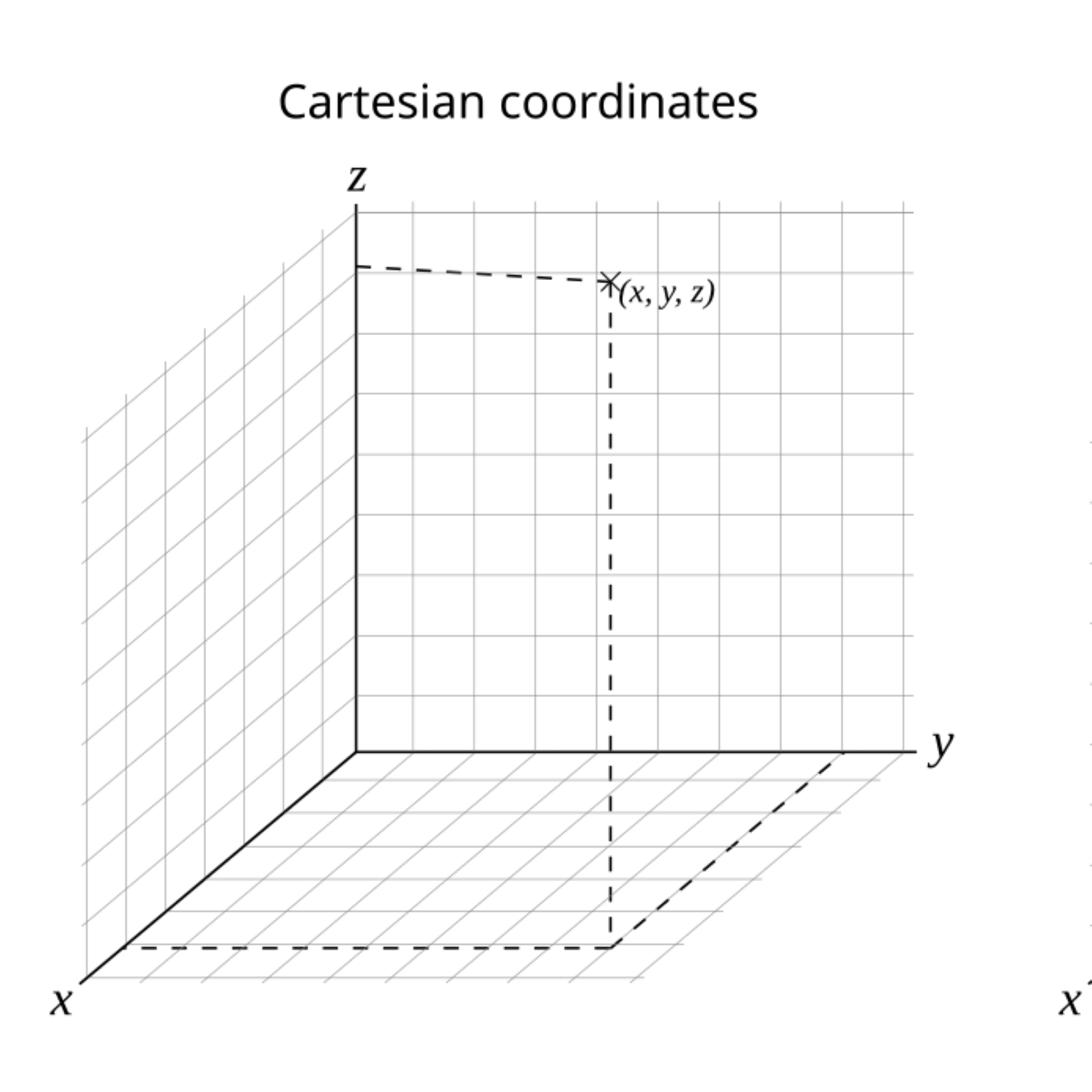
What differs from the system of coordinates we study today is that Descartes considered only positive coordinates. These points represented the segments of geometric shapes where the values were positive. Descartes also gave his name to Cartesian equations, where an equation represents the shape of a curve. The equation, called Cartesian equation, took the form:
ax + by + cz + d = 0 with (a,b,c) = / = (0,0,0)
For example: For one line passing through A (1,3), originating at -4, the Cartesian equation would be y= 7x – 4. For a plane passing through A(1,1,2), B(1,0,1) and C(0,2,1), the Cartesian equation would be: 2x +y – z = 1.
Descartes’ Legacy in Mathematics
Trigonometry, algebraic reasoning, equations, fractions, and logarithms are all influenced by the discoveries of René Descartes. It is impossible to discuss the history of mathematics without mentioning Descartes in the same way you'd talk about the other great mathematicians. Today, equations use letters to denote known and unknown values, forming the basis of mathematical learning from elementary school through high school education.
This notation becomes more complex for students who continue studying mathematics at college. Without Descartes, many modern symbols would look very different, and powers might still be written using terms like “quadratus” and “cubus” instead of x² and x³. Beyond notation, Descartes also showed that geometric problems could be translated into numerical equations.
René Descartes’ influence extends far beyond the seventeenth century. By connecting algebra with geometry through analytic geometry, he introduced a powerful way of solving mathematical problems using equations and coordinates. His work also helped standardize algebraic notation and encouraged a new scientific method based on logic, doubt, and clear reasoning. These ideas shaped the development of modern mathematics and influenced later thinkers such as Isaac Newton and Gottfried Wilhelm Leibniz, whose work on calculus built upon the foundations Descartes helped establish.⁸
Analytic geometry now plays a central role in modern mathematics education. Descartes is also associated with Cartesian thought, a philosophical approach based on rationalism and the distinction between mind and matter.⁸ His ideas influenced many later thinkers, including Isaac Newton and Gottfried Wilhelm Leibniz, who went on to develop calculus.
References
- Descartes, René. Discourse on the Method of Rightly Conducting One’s Reason and of Seeking Truth in the Sciences. Project Gutenberg, https://www.gutenberg.org/ebooks/59. Accessed 6 Mar. 2026.
- Dika, Tarek R. “Descartes’ Method.” The Stanford Encyclopedia of Philosophy, 3 June 2020, https://plato.stanford.edu/entries/descartes-method/. Accessed 6 Mar. 2026.
- Domski, Mary. “Descartes’ Mathematics.” The Stanford Encyclopedia of Philosophy, 28 Apr. 2011, https://plato.stanford.edu/entries/descartes-mathematics/. Accessed 6 Mar. 2026.
- Encyclopaedia Britannica, The Editors of. “Analytic Geometry.” Encyclopaedia Britannica, https://www.britannica.com/science/analytic-geometry. Accessed 6 Mar. 2026.
- Encyclopaedia Britannica, The Editors of. “Cartesian Coordinates.” Encyclopaedia Britannica, https://www.britannica.com/science/Cartesian-coordinates. Accessed 6 Mar. 2026.
- Encyclopaedia Britannica, The Editors of. “Coordinate System.” Encyclopaedia Britannica, https://www.britannica.com/science/coordinate-system. Accessed 6 Mar. 2026.
- Encyclopaedia Britannica, The Editors of. “Geometry.” Encyclopaedia Britannica, https://www.britannica.com/science/geometry. Accessed 6 Mar. 2026.
- Encyclopaedia Britannica, The Editors of. “La Géométrie.” Encyclopaedia Britannica, https://www.britannica.com/topic/La-Geometrie. Accessed 6 Mar. 2026.
- Encyclopaedia Britannica, The Editors of. “René Descartes.” Encyclopaedia Britannica, https://www.britannica.com/biography/Rene-Descartes. Accessed 6 Mar. 2026.
- O’Connor, John J., and Edmund F. Robertson. “René Descartes.” MacTutor History of Mathematics Archive, University of St Andrews, https://mathshistory.st-andrews.ac.uk/Biographies/Descartes/. Accessed 6 Mar. 2026.
Summarize with AI:
Did you like this article? Leave a rating!


 Loading...

Learnt a lot abou ancient culture just reading it. Thank you very much 🙏😊
You’re welcome, Sadeppa! We’re happy you enjoyed reading the article!