Welcome to the exciting world of the ellipse, a geometric figure that has captivated mathematicians and scientists for centuries. In this collection of exercises and problems, you will explore the secrets and properties of the ellipse.
The ellipse is much more than a simple oval shape. It is a curve with unique properties that make it indispensable in various areas of knowledge. Through these challenges, you will delve into the study of its equation, its characteristic elements such as foci and vertices, and the relationships between its different parameters.
Whether you are a student just being introduced to the world of the ellipse or a mathematics enthusiast seeking more complex challenges, this collection will provide you with a solid foundation for understanding and applying the principles of the ellipse in various situations. Get ready to sharpen your analytical thinking!





Elements of the Ellipse
Graph and determine the coordinates of the foci, vertices, and eccentricity of the following ellipses.
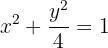
1. Major axis
The equation of the ellipse is already in canonical form, so we proceed to obtain the value of the semi-major axis:

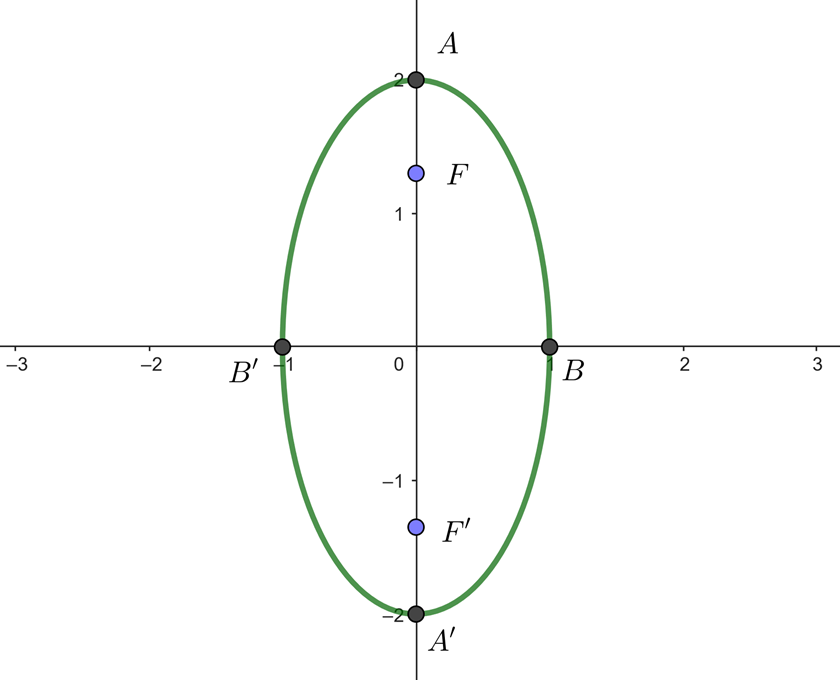
And thus find the vertices that form the major axis:

2. Minor axis
Then the value of the semi-minor axis is:

Therefore, the vertices located on the minor axis are:

3. Foci
Finally, we calculate the value of the semi-focal distance:

And with this, we locate the foci:

4. Eccentricity
The eccentricity is equal to the quotient of the semi-focal distance and the semi-major axis:
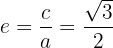
5. Graph

1. Major axis
The equation of the ellipse is already in canonical form, so we proceed to obtain the value of the semi-major axis:

And thus find the vertices that form the major axis:

2. Minor axis
Then the value of the semi-minor axis is:

Therefore, the vertices located on the minor axis are:

3. Foci
Finally, we calculate the value of the semi-focal distance:

And with this, we locate the foci:

4. Eccentricity
The eccentricity is equal to the quotient of the semi-focal distance and the semi-major axis:

5. Graph

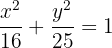
1. Major axis
The equation of the ellipse is already in canonical form, so we proceed to obtain the value of the semi-major axis:

And thus find the vertices that form the major axis:

2. Minor axis
Then the value of the semi-minor axis is:

Therefore, the vertices located on the minor axis are:

3. Foci
Finally, we calculate the value of the semi-focal distance:

And with this, we locate the foci:

4. Eccentricity
The eccentricity is equal to the quotient of the semi-focal distance and the semi-major axis:

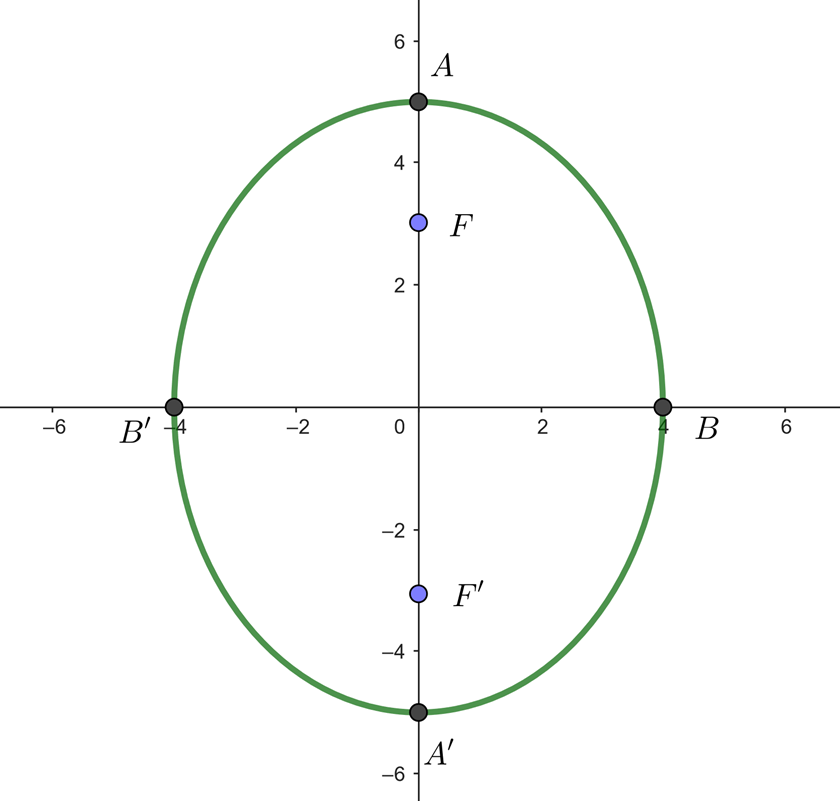
5. Graph

1. Obtain canonical equation

2. Major axis
We obtain the value of the semi-major axis:
And thus find the vertices that form the major axis:
3. Minor axis
Then the value of the semi-minor axis is:

Therefore, the vertices located on the minor axis are:

4. Foci
Finally, we calculate the value of the semi-focal distance:

And with this, we locate the foci:

5. Eccentricity
The eccentricity is equal to the quotient of the semi-focal distance and the semi-major axis:

6. Graph
1. Major axis
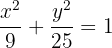
The equation of the ellipse is already in canonical form, so we proceed to obtain the value of the semi-major axis:
And thus find the vertices that form the major axis:
2. Minor axis
Then the value of the semi-minor axis is:

Therefore, the vertices located on the minor axis are:

3. Foci
Finally, we calculate the value of the semi-focal distance:

And with this, we locate the foci:

4. Eccentricity
The eccentricity is equal to the quotient of the semi-focal distance and the semi-major axis:

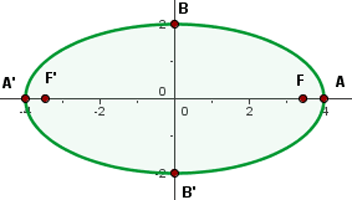
5. Graph


1. Obtain canonical equation

2. Major axis
The equation of the ellipse is already in canonical form, so we proceed to obtain the value of the semi-major axis:

And thus find the vertices that form the major axis:

3. Minor axis
Then the value of the semi-minor axis is:

Therefore, the vertices located on the minor axis are:

4. Foci
Finally, we calculate the value of the semi-focal distance:

And with this, we locate the foci:

5. Eccentricity
The eccentricity is equal to the quotient of the semi-focal distance and the semi-major axis:

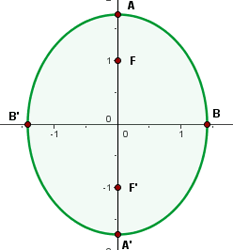
6. Graph

1. Obtain canonical equation

We complete the perfect square trinomial:

We change the trinomials for the squared binomials:

We divide everything by 4:
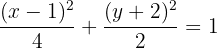
2. Center
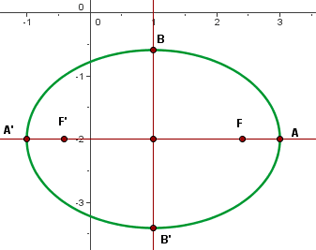
From the canonical ellipse equation we find the center:

3. Major axis
The equation of the ellipse is already in canonical form, so we proceed to obtain the value of the semi-major axis:

And thus find the vertices that form the major axis:

4. Minor axis
The value of the semi-minor axis is:

Therefore, the vertices located on the minor axis are:

5. Foci
Finally, we calculate the value of the semi-focal distance:

And with this, we locate the foci:

6. Graph

1. Obtain canonical equation

We complete the perfect square trinomial:

We change the trinomials for the squared binomials:

We divide everything by 225:
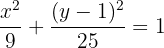
2. Center
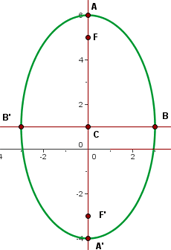
From the canonical ellipse equation we find the center:

3. Major axis
The equation of the ellipse is already in canonical form, so we proceed to obtain the value of the semi-major axis:

And thus find the vertices that form the major axis:

4. Minor axis
The value of the semi-minor axis is:

Therefore, the vertices located on the minor axis are:

5. Foci
Finally, we calculate the value of the semi-focal distance:

And with this, we locate the foci:

6. Graph

1. Obtain canonical equation

We complete the perfect square trinomial:

We change the trinomials for the squared binomials:

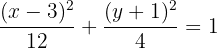
We divide everything by 12:
2. Center
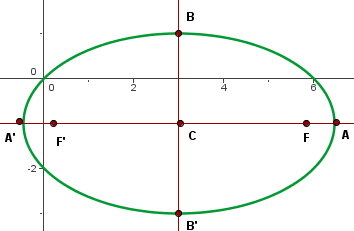
From the canonical ellipse equation we find the center:

3. Major axis
The equation of the ellipse is already in canonical form, so we proceed to obtain the value of the semi-major axis:

And thus find the vertices that form the major axis:

4. Minor axis
The value of the semi-minor axis is:

Therefore, the vertices located on the minor axis are:

5. Foci
Finally, we calculate the value of the semi-focal distance:

And with this, we locate the foci:

6. Graph

1. Obtain canonical equation

We complete the perfect square trinomial:

We change the trinomials for the squared binomials:

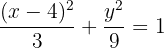
We divide everything by 9:
2. Center
From the canonical ellipse equation we find the center:

3. Major axis
The equation of the ellipse is already in canonical form, so we proceed to obtain the value of the semi-major axis:

And thus find the vertices that form the major axis:

4. Minor axis
The value of the semi-minor axis is:

Therefore, the vertices located on the minor axis are:

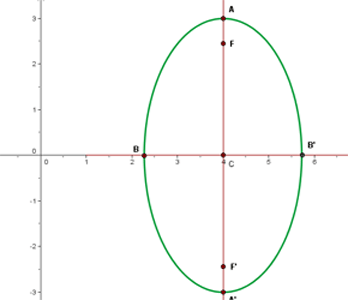
5. Foci
Finally, we calculate the value of the semi-focal distance:

And with this, we locate the foci:

6. Graph
Equation of the Ellipse
Find the equation of the ellipse given:
a 
b 
c 
d 
a.
The value of  is the distance from the center to vertex A, while the value of
  is the distance from the center to the focus, therefore:

The values ,  , and maintain a Pythagorean relationship, that is:

We solve for the value of :


We conclude that:
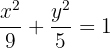
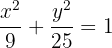
b.
The value of is the distance from the center to vertex A, while the value of is the distance from the center to the focus, therefore:

The values , , and maintain a Pythagorean relationship, that is:
We solve for the value of :

We conclude that:
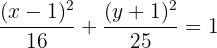
c.
The value of is the distance from the center to vertex A, while the value of is the distance from the center to the focus, therefore:

The values , , and maintain a Pythagorean relationship, that is:
We solve for the value of :

We conclude that:
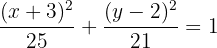
d.
The value of is the distance from the center to vertex A, while the value of is the distance from the center to the focus, therefore:

The values , , and maintain a Pythagorean relationship, that is:
We solve for the value of :

We conclude that:
Write the canonical equation of the ellipse with center at the origin that passes through the point  and whose minor axis measures
  and lies on the Y-axis.
The minor axis measures  :
:

It has its center at the origin and the minor axis is on the Y-axis, so the canonical equation is of the type:
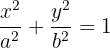
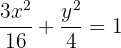
Since the point (2,1) belongs to the ellipse, its coordinates satisfy the canonical equation:

We solve to obtain the value of :

Knowing the values of and , we conclude that:
The focal distance of an ellipse with center at the origin is . A point on the ellipse is at distances  and
and  from its foci, respectively. Calculate the canonical equation of said ellipse if the major axis is on the X-axis.
The focal distance is equal to the value of  :
:

Recall that the sum of the distances from a point on the ellipse to the foci is equal to  :
:

The values , , and maintain a Pythagorean relationship, that is:
We solve for the value of :

Knowing the values of and , we conclude that:
Write the canonical equation of the ellipse that passes through the points:

Since it passes through the points 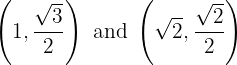 , their coordinates satisfy the canonical equation of the ellipse. This is:

We solve the system:

Then:

We solve for :

Finally:
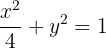
Determine the canonical equation of an ellipse with center at the origin and major axis on the X-axis, whose focal distance is  and the area of the rectangle with sides measuring the same as the axes (major and minor) is
  .
.
Since the sides of the rectangle are the axes, and these measure and , then:

The focal distance is equal to :

The values , , and maintain a Pythagorean relationship, that is:

This leads us to have a system of two equations:

From the first equation we solve for  and from the second for :
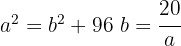
We use from the second equation to substitute in the first:
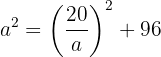
We develop:

We solve with the quadratic formula and obtain the value of :

Knowing the values of and , we conclude that:

Coordinates of Chords of the Ellipse
Find the coordinates of the chord that the line  intercepts on the ellipse with equation
  .
.
1. Find points of intersection
The points of intersection are those that solve the system of the equations of the line and the ellipse.

To solve, we can isolate  from the first equation and square it. We also isolate
  from the second equation:

We set both equations equal:



We use the quadratic formula to find the solutions:


The solutions for the y-coordinate are:
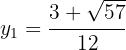
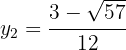
The x-coordinates are calculated using one of the equations in the system; in this case we will use:

So the points of intersection are given by:
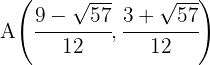

Find the coordinates of the chord that the line intercepts on the ellipse with equation  .
.
1. Find points of intersection
The points of intersection are those that solve the system of the equations of the line and the ellipse.

To solve, we can isolate from the first equation and square it. We also isolate from the second equation:

We set both equations equal:
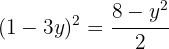


We use the quadratic formula to find the solutions:

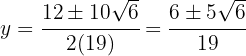
The solutions for the y-coordinate are:
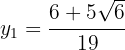
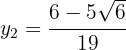
The x-coordinates are calculated using one of the equations in the system; in this case we will use:
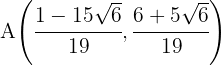
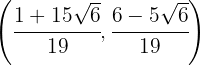
So the points of intersection are given by:
Find the coordinates of the chord that the line  intercepts on the ellipse with equation
  .
.
1. Find points of intersection
The points of intersection are those that solve the system of the equations of the line and the ellipse.

To solve, we can isolate from the first equation and square it. We also isolate from the second equation:

We set both equations equal:



We use the quadratic formula to find the solutions:

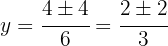
The solutions for the y-coordinate are:
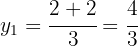
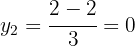
The x-coordinates are calculated using one of the equations in the system; in this case we will use:

So the points of intersection are given by:


Find the coordinates of the chord that the line  intercepts on the ellipse with equation
  .
.
1. Find points of intersection
The points of intersection are those that solve the system of the equations of the line and the ellipse.

To solve, we simply isolate  from the first equation and substitute in the second equation:

And we obtain 
So the points of intersection are given by:


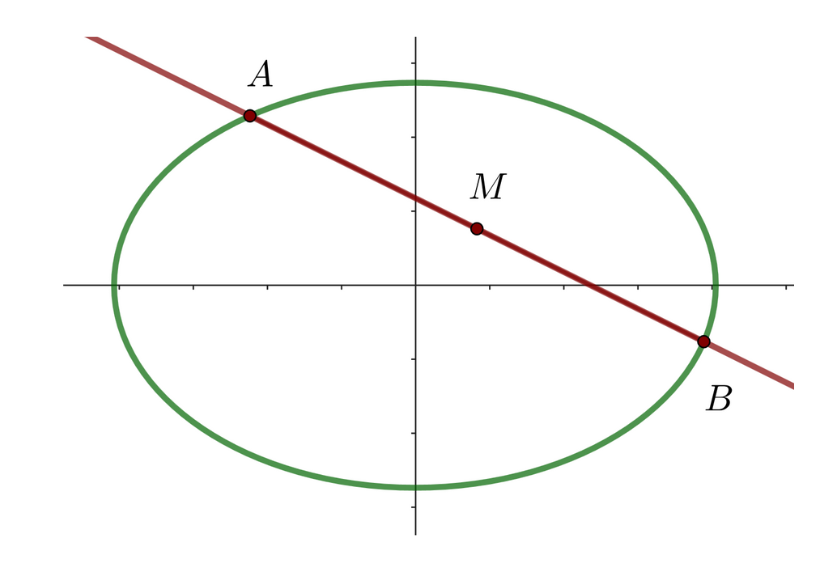
Find the coordinates of the midpoint of the chord that the line  intercepts on the ellipse with equation
 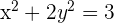 .
.
1. Find points of intersection
The points of intersection are those that solve the system of the equations of the line and the ellipse.

To solve, we can isolate from the first equation and square it. We also isolate from the second equation:

We set both equations equal:



We use the quadratic formula to find the solutions:


The solutions for the y-coordinate are:


The x-coordinates are calculated using one of the equations in the system; in this case we will use:

So the points of intersection are given by:


2. Find midpoint
The midpoint between points A and B is given by:

Do you still have doubts about how to solve ellipses? Contact one of our teachers for private math lessons.
Summarize with AI:
Did you like this article? Rate it!

 Loading...