Graphing a circle
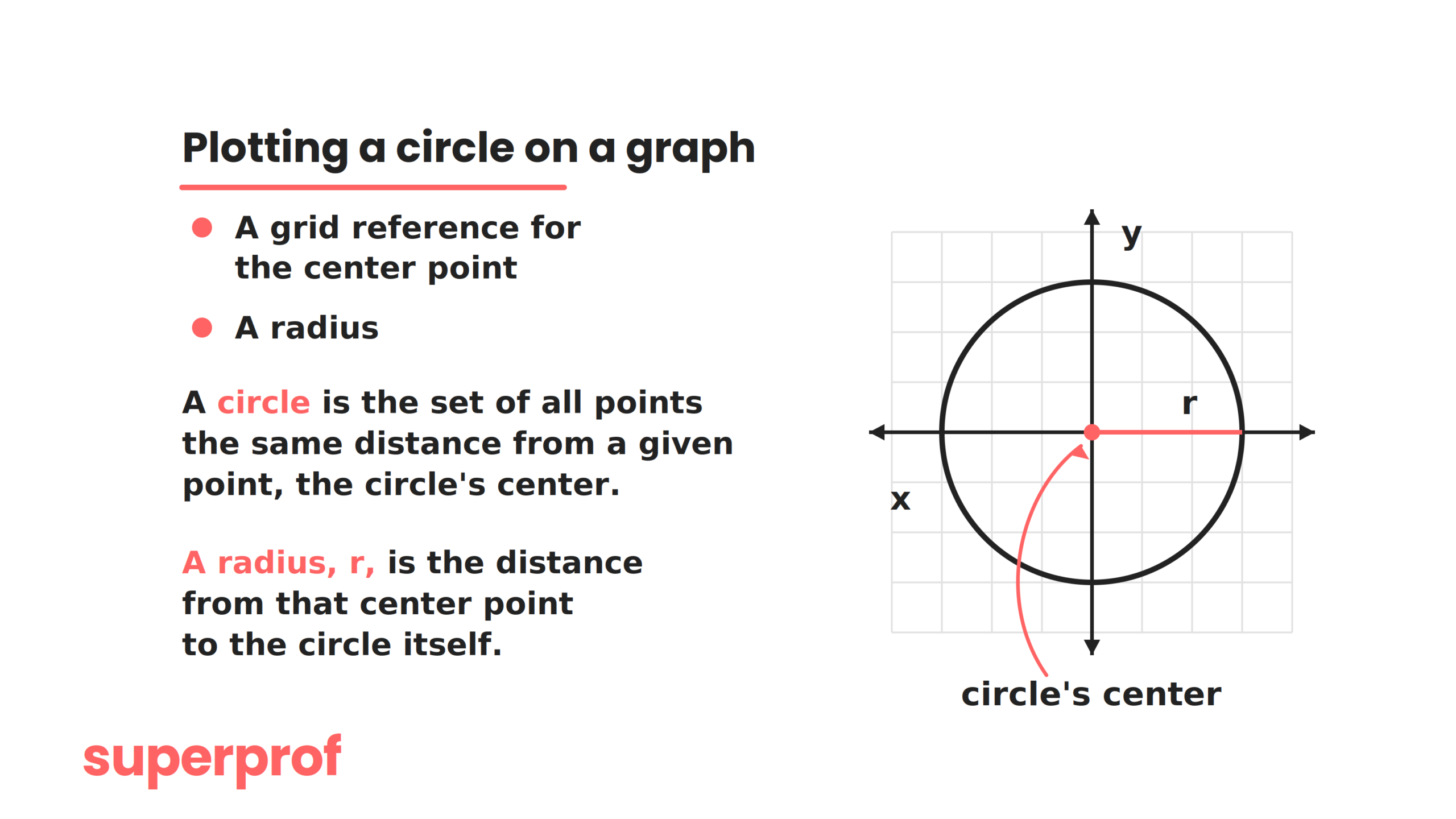
Graphing circles requires two things: the coordinates of the center point, and the radius of a circle. A circle is the set of all points the same distance from a given point, the center of the circle. A radius, r, is the distance from that center point to the circle itself.
Circle Equations
Two expressions show how to plot a circle: the center-radius form and the standard form. Where x and y are the coordinates for all the circle's points, h and k represent the center point's x and y values, with r as the radius of the circle
Center-radius Form
The center-radius form looks like this:
(x−h)2+(y−k)2=r2
Standard Equation of a Circle
The standard, or general, form requires a bit more work than the center-radius form to derive and graph. The standard form equation looks like this:
x2+y2+Dx+Ey+F=0
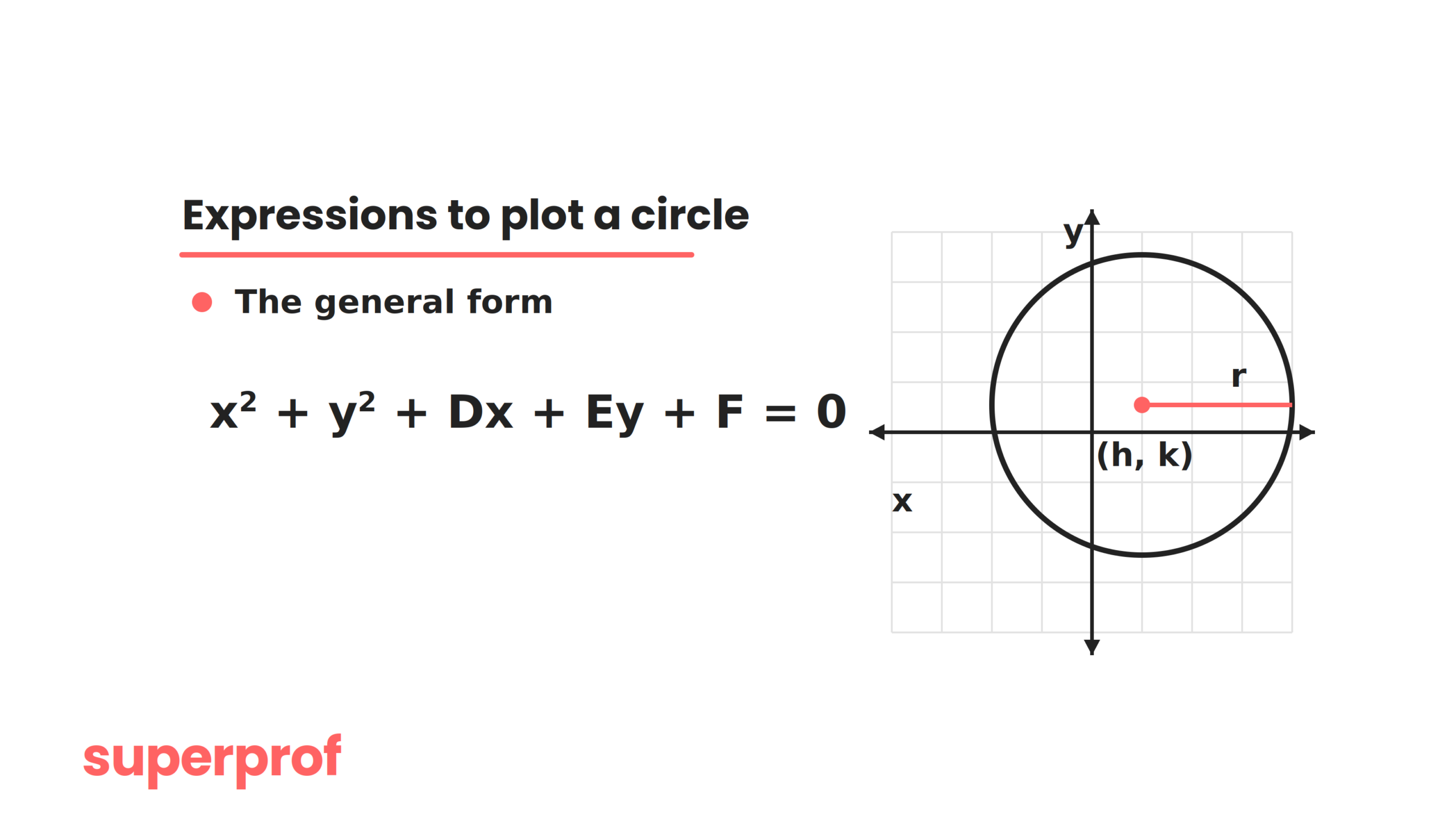
In the general form, D, E, and F are given values, like integers, that are coefficients of the x and y values.
Using the Center-radius Form {use-crf}
If you are unsure that a suspected formula is the equation needed to graph a circle, you can test it. It must have four attributes:
- The x and y terms must be squared.
- All terms in the expression must be positive (which squaring the values in parentheses will accomplish).
- The center point is given as (h,k), the x and y coordinates.
- The value for r, radius, must be given and must be a positive number (which makes common sense; you cannot have a negative radius measure).
The center-radius form gives away a lot of information to the trained eye. By grouping the h value with the x(x−h)2, the form tells you the x coordinate of the circle's center. The same holds for the kk value; it must be the y coordinate for the center of your circle.
Once you ferret out the circle's center point coordinates, you can then determine the circle's radius, r. In the equation, you may not see r2, but a number, the square root of which is the actual radius.
With luck, the squared r value will be a whole number, but you can still find the square root of decimals using a calculator.
Which are center-radius form?
Try these seven equations to see if you can recognize the center-radius form. Which ones are center-radius, and which are just line or curve equations?
- (x−2)2+(y−3)2=16
- 5x+3y=6
- (x+1)2+(y+1)2=25
- y=6x+2
- (x+4)2+(y−6)2=49
- (x−5)2+(y+9)2=8.1
- y=x2+−6x+3
Only equations 1, 3, 5 and 6 are center-radius forms. The second equation graphs a straight line; the fourth equation is the familiar slope-intercept form; the last equation graphs a parabola.
How to Graph a Circle Equation
A circle can be thought of as a graphed line that curves in both its x and y values. This may sound obvious, but consider this equation:
y=x2+4
Here the x value alone is squared, which means we will get a curve, but only a curve going up and down, not closing back on itself. We get a parabolic curve, so it heads off past the top of our grid, its two ends never to meet or be seen again.
Introduce a second x-value exponent, and we get more lively curves, but they are, again, not turning back on themselves.
The curves may snake up and down the y-axis as the line moves across the x-axis, but the graphed line is still not returning on itself like a snake biting its tail.
To get a curve to graph as a circle, you need to change both the x exponent and the y exponent. As soon as you take the square of both x and y values, you get a circle coming back unto itself!
Often the center-radius form does not include any reference to measurement units like mm, m, inches, feet, or yards. In that case, just use single grid boxes when counting your radius units.
Center at the Origin
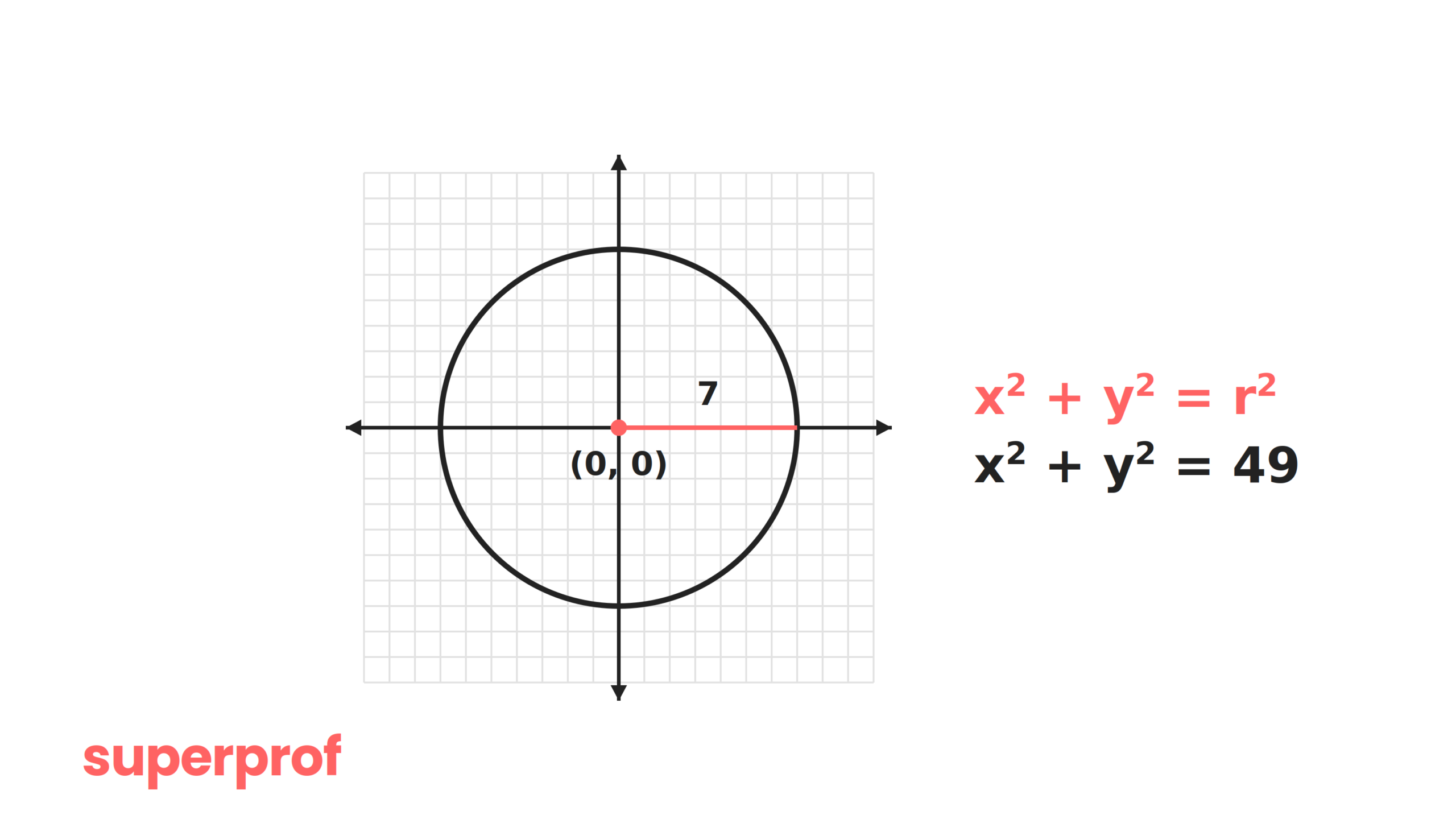
When the center point is the origin (0, 0) of the graph, the center-radius form is greatly simplified:
x2+y2=r2
For example, a circle with a radius of 7 units and a center at (0, 0) looks like this as a formula and a graph:
x2+y2=49
How to Graph a Circle Using Standard Form
If your circle equation is in standard or general form, you must first complete the square and then work it into center-radius form. Suppose you have this equation:
x2+y2−8x+6y−4=0
Rewrite the equation so that all your x-terms are in the first parentheses and y-terms are in the second:
(x2−8x+?1)+(y2+6y+?2)=4+?1+?2
You have isolated the constant to the right and added the values ?1 and ?2 to both sides. The values ?1 and ?2 are each the number you need in each group to complete the square.
Take the coefficient of x and divide by 2. Square it. That is your new value for ?1:
2−8=−4
(−4)2=16
?1=16
Repeat this for the value to be found with the y-terms:
26=3
32=9
?2=9
Replace the unknown values ?1 and ?2 in the equation with the newly calculated values:
(x2−8x+16)+(y2+6y+9)=4+16+9
Simplify:
(x2−8x+16)+(y2+6y+9)=29
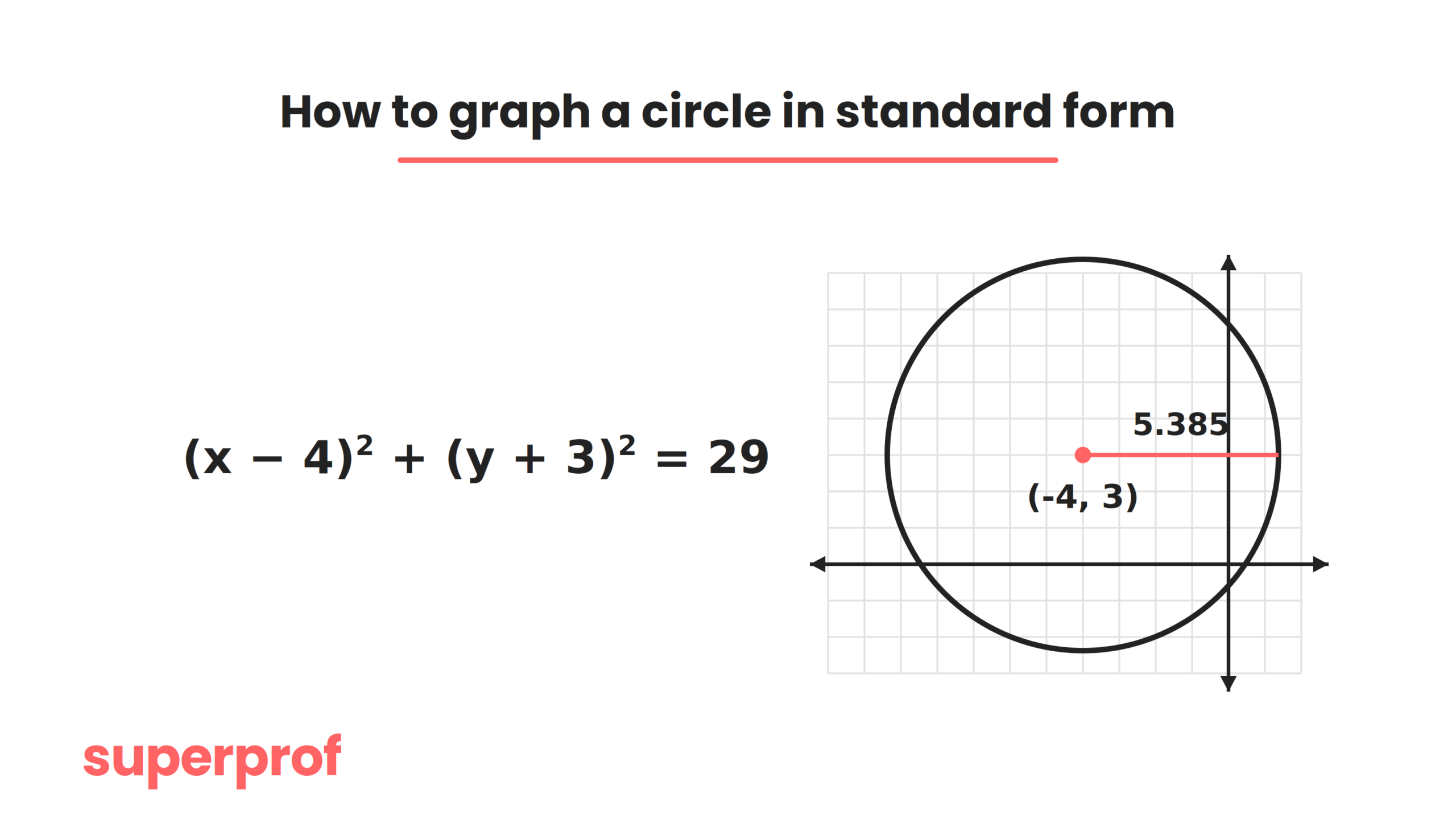
(x−4)2+(y+3)2=29
You now have the center-radius form for the graph. You can plug the values in to find this circle with center point (-4, 3) and a radius of 5.385 units (the square root of 29).
In practical terms, remember that the center point, while needed, is not actually part of the circle. So, when actually graphing your circle, mark your center point very lightly. Place the easily counted values along the x and y axes, by simply counting the radius length along the horizontal and vertical lines.
If precision is not vital, you can sketch in the rest of the circle. If precision matters, use a ruler to make additional marks, or a drawing compass to swing the complete circle.
You also want to mind your negatives. Keep careful track of your negative values, remembering that, ultimately, the expressions must all be positive (because your x-values and y-values are squared).
The Circle and Its Equation
The circle is defined as the locus of points in the plane that are equidistant from a fixed point  that we call the center.
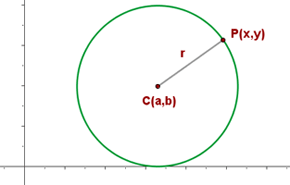
Therefore, each point  of the circle satisfies:

where the distance  is called the radius. Thus, we have the following:

Squaring the previous equation, we obtain:

The previous equation is known as the ordinary equation of the circle. To obtain the general equation, we must expand the squared binomials:

Then we regroup the terms as follows:

We consider the following changes:

Therefore, the equation of the circle can be written as follows:

which is known as the general equation of the circle. Here, the center is given by:

and the radius satisfies:

It is important to note that the equation:
must satisfy the following for it to describe a circle:
1. The following inequality is satisfied:

2. There is no  term (that is,
  and
and  are not multiplied).
3. The coefficients of  and
and  are both 1.
Note: If and have a coefficient different from 1, then both must have the same coefficient. In this way, we can divide the equation by this coefficient to obtain the general equation of the circle.
Note: If the center of the circle coincides with the origin of the coordinates, then the equation of the circle (whether ordinary or general) is reduced to:

which is known as the canonical equation of the circle.
Exercises on Circle Equations
Write the equation of a circle with a center at  and radius 2.
The ordinary equation of the circle is:

while the general equation of the circle is obtained by expanding the squared binomials:

which, when we group the constants, gives us:

Given the circle whose equation is  , find its center and radius.
The center is given by:

On the other hand, the radius satisfies:

therefore, the radius is  .
.
Find the equation of a circle that passes through the points  ,
,  and
and  .
.
To find the circle that passes through three points, we should always use the general equation of the circle, since this will make the work easier.
Thus, we substitute the values of and into the equation:
When we substitute (that is,  and
and  ), we get
  , that is:

Similarly, when we substitute we get  ; and when we substitute we have
  . Therefore, we have the following system of equations:

We solve this system in any way we wish (it is simpler if we start by subtracting the third equation from the second equation); once we solve the system we get:

Thus, the general equation of the circle is:

Indicate whether the equation  corresponds to a circle. If so, determine the center and radius.
1. Note that the coefficients of and are equal (although they are not 1); therefore, we divide the entire equation by 4:

2. Also, note that it has no term.
3. Finally, let us verify that the inequality is satisfied with the terms  ,
,  and
and  :
:

Therefore, because all three conditions are satisfied, the equation does describe a circle.
To find the center, we have:

Similarly, the radius satisfies:

so  .
.
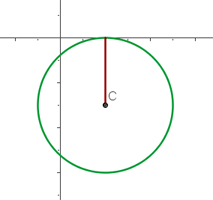
Calculate the equation of a circle with its center at and its tangent to the x-axis.
We are asked to find a circle that is tangent to a line. When we are asked this, the radius will always be the distance between the point and the line (to which we want the circle to be tangent). Therefore, we must find the distance between the line and the center.
First, recall that the x-axis is the line . Also, the distance between a point  and a line
  is given by the formula:

Therefore, the distance between and the line  is:
is:

Therefore, the ordinary equation of the circle is:

The graphical representation of the circle is:
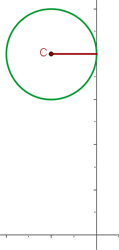
Calculate the equation of a circle with its center at  and its tangent to the y-axis.
Similar to the previous exercise, we must find the distance between the point and the y-axis. Recall that the y-axis is given by the equation  . Thus, the distance is:

Therefore, the equation of the circle is:

The graphical representation of the circle is:
Calculate the equation of a circle with its center at the point of intersection of the lines  and
and  , and whose radius equals 5.
To find the equation of the circle, we only need to find the intersection of the two lines (we already have the radius). To do this, we equate the equations:

from which it follows that  ; that is,
  . Substituting into any equation, we get
  . Therefore, the center is
  and the equation of the circle is:

or, in general form:

The graphical representation of the circle is:

Find the equation of a circle that passes through the point  and is concentric with the circle
  .
.
This problem can be solved in two different ways:
The simplest way is to realize that all circles concentric with will have an equation of the form:

Therefore, we must substitute the point in order to find the value of , which gives us:

that is,  . Therefore,
  . In this way, the equation of the circle would be:

Note: The other way is to determine the center of and use the ordinary equation to determine the radius.
The graphical representation of the circle is:

The endpoints of the diameter of a circle are the points  and
and  . What is the equation of this circle?
To solve this problem, we must find the radius and the center.
The radius is half the diameter, therefore, it will be half the distance between and :

On the other hand, the center is the midpoint between and :

In this way, the ordinary equation of the circle is:

while the general equation is:

The graphical representation of the circle is:

Find the equation of a circle concentric with the circle  and tangent to the line
  .
.
To solve this equation, we need to find the center of the circle. Therefore, we will work with the ordinary form. The center is given by:

once we find the center, we must find the distance between the center and the given line; this distance will be the radius:

Therefore, the equation of the circle is:

The graphical representation of the circle is:

Find the equation of a circle that passes through the points  and
and  , and has its center on the line
  .
.
Since we need to use the center, we should use the ordinary equation (and not the general) of the circle. Let be the center of the circle and be its radius, then we know that the center satisfies:

On the other hand, the equation of the circle is:
if we substitute the point , we have:

similarly, if we substitute , then we have:

In this way, we have the following system of equations (nonlinear):

To solve it, we equate the first two equations (since both equal  ):
):

If we expand the binomials and cancel appropriate terms, we get:

Then, from the third equation we solve for  to get
  . Substituting it into the previous equation gives us:

From this it follows that  . Finally, substituting and
  into the first equation of the system of equations we get
  . Therefore, the ordinary equation of the circle is:

The graphical representation of the circle is:

Calculate the equation of a circle that passes through the point  , whose radius is
  and whose center lies on the bisector of the first and third quadrants.
First, we should note that the bisector of the first and third quadrants is the line  or
or  . That is, the center must satisfy that
  ; therefore, we write the center as
  .
.
We know it passes through the point and that the radius is  , substituting into the ordinary form of the circle we get:

We only have as an unknown, so that equation is sufficient. We expand the binomials:

So we have a quadratic equation. Using the general formula (or any other method), we find that  and
and  .
.
Therefore, there are two circles that satisfy the conditions of the problem. The first has its center at  , so its equation is (first in ordinary form and then in general form):

and the second circle has its center at  , so its equation is:

The graphical representation of the circle is:

Summarize with AI:
Did you like this article? Rate it!

 Loading...