A parabola is an infinite collection of points that are equidistant from a fixed line and a fixed point in the plane. The definition above is also known as the locus of a parabola.
The parabola contains characteristic elements such as the directrix and the focus, which are the line and point, both fixed, mentioned in the definition. It also has a vertex, which is the point closest to the directrix and focus.
In the following problems and exercises, we work with two modalities: we obtain the elements of the parabola from knowing its equation, and if we know the elements of the parabola, we obtain its equation.


Obtaining the Elements of the Parabola
Given the parabola  , calculate its vertex, focus, and directrix.
The parameter is:

This is a reduced equation, so the vertex is at the origin:

The squared term in the equation is  , so the axis of the parabola coincides with the x-axis. Moreover, the parabola is on the positive side of the x-axis because the coefficient accompanying the non-squared term (in this case
  ) is 8, which is positive:


The graphical representation of the parabola  is
is
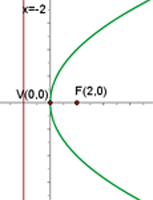
Given the parabola  , calculate its vertex, focus, and directrix.
The parameter is:

This is a reduced equation, so the vertex is at the origin:
The squared term in the equation is , so the axis of the parabola coincides with the x-axis. Moreover, the parabola is on the negative side of the x-axis because the coefficient accompanying the non-squared term (in this case ) is −8, which is negative:


The graphical representation of the parabola  is
is
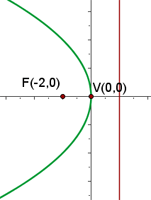
Given the parabola  , calculate its vertex, focus, and directrix.
The parameter is:
This is a reduced equation, so the vertex is at the origin:
The squared term in the equation is , so the axis of the parabola coincides with the y-axis. Moreover, the parabola is on the positive side of the y-axis because the coefficient accompanying the non-squared term (in this case ) is 8, which is positive:


The graphical representation of the parabola  is
is

Given the parabola  , calculate its vertex, focus, and directrix.
The parameter is:
This is a reduced equation, so the vertex is at the origin:
The squared term in the equation is , so the axis of the parabola coincides with the y-axis. Moreover, the parabola is on the negative side of the y-axis because the coefficient accompanying the non-squared term (in this case ) is −8, which is negative:


The graphical representation of the parabola  is
is
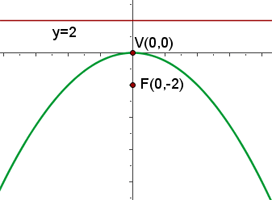
Given the parabola  , calculate its vertex, focus, and directrix.
The parameter is:
This is not a reduced equation, so the vertex is at:

The squared term in the equation is , so the axis of the parabola is parallel to the x-axis. Moreover, the coefficient accompanying the non-squared term (in this case ) is 8, which is positive, so the focus is to the right of the vertex:


The graphical representation of the parabola is
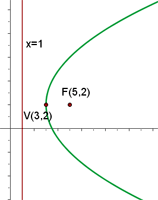
Given the parabola  , calculate its vertex, focus, and directrix.
The parameter is:
This is not a reduced equation, so the vertex is at:
The squared term in the equation is , so the axis of the parabola is parallel to the y-axis. Moreover, the coefficient accompanying the non-squared term (in this case ) is 8, which is positive, so the focus is above the vertex:


The graphical representation of the parabola is

Determine, in reduced form, the equations of the following parabolas, indicating the value of the parameter, the coordinates of the focus, and the equation of the directrix:
1 
We solve for the term  :
:


The equation of the parabola: 
The parameter is:

This is a reduced equation, so the vertex is at the origin:

The squared term in the equation is , so the axis of the parabola coincides with the x-axis. Moreover, the coefficient accompanying the non-squared term (in this case ) is 2, which is positive, so the focus is to the right of the vertex:

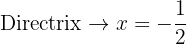
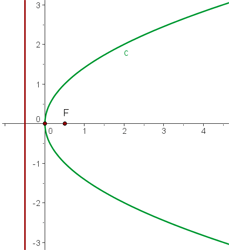
The graphical representation of the parabola  is
is
2 
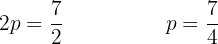
We solve for the term :

The parameter is:
This is a reduced equation, so the vertex is at the origin:
The squared term in the equation is , so the axis of the parabola coincides with the x-axis. Moreover, the coefficient accompanying the non-squared term (in this case ) is  , which is negative, so the focus is to the left of the vertex:

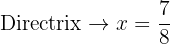
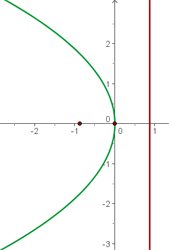
The graphical representation of the parabola  is
is
3 
We solve for the term  :
:


The parameter is:

This is a reduced equation, so the vertex is at the origin:
The squared term in the equation is , so the axis of the parabola coincides with the y-axis. Moreover, the coefficient accompanying the non-squared term (in this case ) is  , which is negative, so the focus is below the vertex:

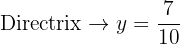
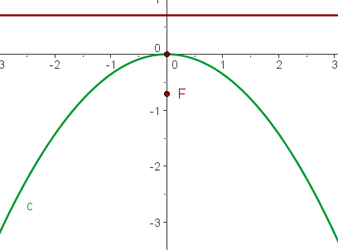
The graphical representation of the parabola 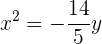 is
is
Calculate the coordinates of the vertex and focus, and the equations of the directrices of the parabolas:
1 
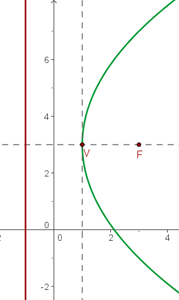
We complete the square:

We simplify:

We solve:



The parameter is:
The squared term in the equation is , so the axis of the parabola is parallel to the x-axis. Moreover, the coefficient accompanying the non-squared term (in this case ) is 8, which is positive, so the focus is to the right of the vertex:


2 

We complete the square:

We simplify:

We solve:


Therefore:

The parameter is:
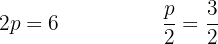
The squared term in the equation is , so the axis of the parabola is parallel to the y-axis. Moreover, the coefficient accompanying the non-squared term (in this case ) is 6, which is positive, so the focus is above the vertex:


3 

We complete the square:

We simplify:

We solve:

The parameter is:
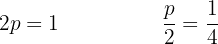
The squared term in the equation is , so the axis of the parabola is parallel to the y-axis. Moreover, the coefficient accompanying the non-squared term (in this case ) is 1, which is positive, so the focus is above the vertex:


Obtaining the Equation of the Parabola
Determine the equations of the parabolas that have:
- Directrix
 , focus
- Directrix
 , vertex
- Directrix
 , focus
- Directrix
 , focus
- Focus
 , vertex
 - Focus
 , vertex
- Focus
 , vertex
 - Focus
 , vertex
1 Directrix , focus
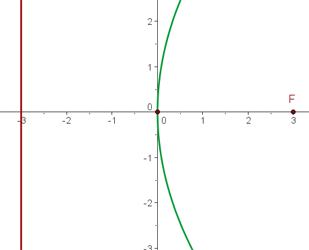
First we calculate the distance between the focus and the directrix to obtain the parameter  :
:

Since the focus is on the x-axis, the directrix is parallel to the y-axis, and they are equidistant from the origin, this is a reduced equation:
Since the axis coincides with the x-axis and the focus is to the right of the vertex, the equation is:

2 Directrix , vertex
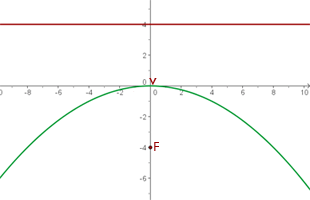
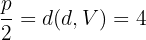
First we calculate the distance between the vertex and the directrix to obtain  :
:
We note that the vertex is at the origin and the directrix is parallel to the x-axis, so this is a reduced equation.
Since the axis coincides with the y-axis and the focus is below the vertex, the equation is:

3 Directrix , focus
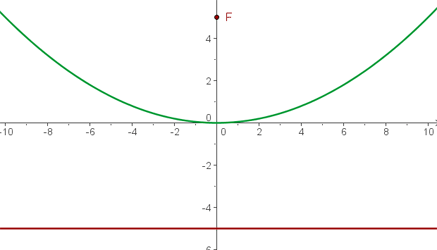
First we calculate the distance between the focus and the directrix to obtain the parameter :

We note that the directrix is parallel to the x-axis, the focus is on the y-axis, and they are equidistant from the origin, so this is a reduced equation.
Since the focus is above the directrix, the equation is:

4 Directrix , focus
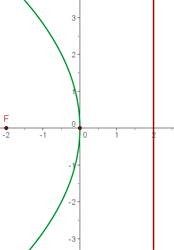
First we calculate the distance between the focus and the directrix to obtain the parameter :

We note that the directrix is parallel to the y-axis, the focus is on the x-axis, and they are equidistant from the origin, so this is a reduced equation.
Since the focus is to the left of the directrix, the equation is:
5 Focus , vertex
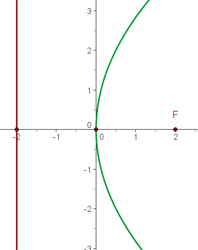
First we calculate the distance between the focus and the vertex to obtain the parameter :

We note that the directrix is parallel to the y-axis, the focus is on the x-axis, and they are equidistant from the origin, so this is a reduced equation.
Since the focus is to the right of the directrix, the equation is:
6 Focus , vertex
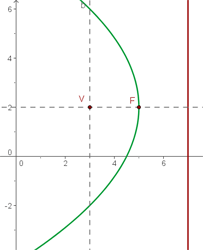
First we calculate the distance between the focus and the vertex to obtain :
We note that the directrix is parallel to the y-axis.
Since the focus is to the left of the vertex, the equation is:

7 Focus , vertex
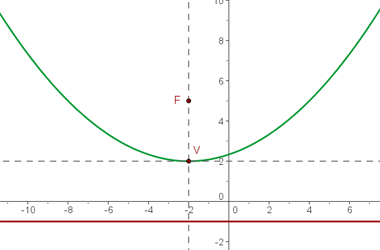
First we calculate the distance between the focus and the vertex to obtain :

We note that the directrix is  and is parallel to the x-axis.
Since the focus is above the vertex, the equation is:

8 Focus , vertex
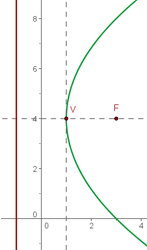
First we calculate the distance between the focus and the vertex to obtain the parameter :
We note that the directrix is parallel to the y-axis.
Since the focus is to the right of the vertex, the equation is:

Find the equation of the parabola whose vertex coincides with the origin of coordinates and passes through the point , with axis on the x-axis.
Since the vertex is at the origin and the axis coincides with the x-axis of the plane, its equation is in reduced form, specifically:

It passes through the point (3, 4), so its coordinates satisfy the previous equation:
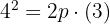

We divide by 3:

Thus, the equation is:

Write the equation of the parabola with axis parallel to the y-axis, vertex on the x-axis, and passing through the points  and
and  .
.
From the problem we know that:


Since the curve passes through points A and B, their coordinates must satisfy the equation of the parabola:

We take the first equation and multiply it by 4:

We subtract the second equation (or add its negative):

And thus obtain:

We simplify by dividing everything by 3:




The two solutions for give us two distinct parabola equations:

Determine the equation of the parabola that has directrix  and focus at the origin.


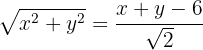
We square both sides to eliminate the square root:


Find the equation of the parabola with vertical axis passing through the points:  ,
,  ,
,  .
.
The equation must be of the form:

If it passes through points A, B, and C, their coordinates satisfy the previous equation:
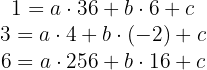
Solving the system of 3 unknowns we obtain:

Finally:
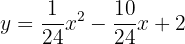
Determine the equation of the parabola that has directrix  and focus at point
  .
.




Finally, the parabola equation is:

Calculate the relative position of the line  with respect to the parabola
  .
.
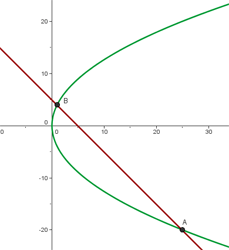

We expand:



We solve:


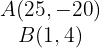
Points of intersection:
Do not hesitate to contact Superprof to help you find the perfect mathematics course.
Summarize with AI:
Did you like this article? Rate it!

 Loading...