What Are Trigonometric Equations?
Trigonometric equations involve trigonometric functions, which are periodic. Therefore, their solutions can appear in one or two quadrants and repeat in all rotations (all full cycles).
To solve a trigonometric equation, we perform the necessary transformations to work with a single trigonometric function. To do this, we use the fundamental trigonometric identities.
Examples of Resolving Trigonometric Equations
Solve the following trigonometric equations:
1
Using trigonometric identities, convert tangent to sine and cosine.
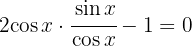



In general form:


with 
2 for
for 
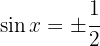
From the Pythagorean identity of sine and cosine  , we can deduce that
  . Thus the equation is rewritten as:

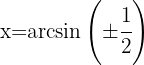
Group like terms and solve for  .
.




3
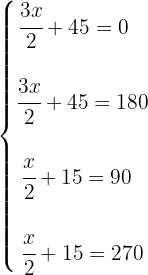
Transform the sum into a product.

Divide both sides by 2 and set each factor equal to 0.
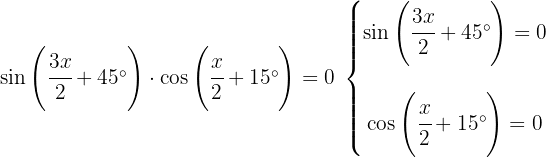

with
4 
Multiply both sides of the equation by  .
.


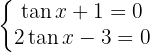
Factor the first member as a quadratic trinomial of the form  and set each factor equal to zero.


with
5 
Use  to write the equation as a function of sine:


Factor out the common factor.

From the first factor:

with
From the second factor no solution is obtained since  .
.
6
Use the double angle identity for tangent: 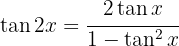

Simplifying the expression we obtain:



with
7 
We can apply the identity 



with
8 
Applying the double angle sine identity we obtain:


Set each factor equal to zero.
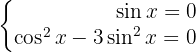
From the first equation we deduce that:

with
From equation 2:


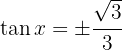

with
9 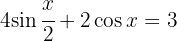
Using the identity 
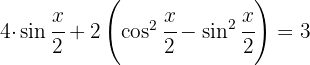

Use the Pythagorean identity of sines and cosines:


Factor the perfect square trinomial:
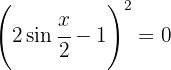


with
Summarize with AI:
Did you like this article? Rate it!

 Loading...