Trigonometric Ratios
Let us observe the following right triangle:
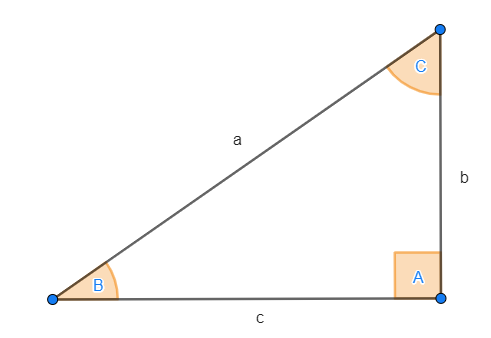
The trigonometric ratios or functions for angle  are defined as follows:
1. Sine:
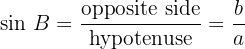
Note that, sometimes, sine is denoted as  .
.
2. Cosine:
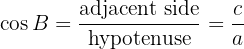
3. Tangent:

Tangent is sometimes denoted as  .
.
4. Cotangent:

Cotangent is sometimes denoted as  .
.
5. Secant:

6. Cosecant:

Sometimes, cosecant is denoted as  .
.
In the successive identities, we will use  and
and  to denote angles (instead of
  , or
, or  ).
).


Pythagorean Identities
Recall that a trigonometric identity is a relationship that involves trigonometric functions and is satisfied for all angles in the domain. These identities are very useful when solving integrals, differential equations, and other mathematical problems.
Since trigonometric functions are defined from right triangles, the following identities are satisfied:
1.
2.
3.
Identities for the Sum and Difference of Angles
1.
2.
3.
4.
5.
6.
Double Angle and Half Angle Identities
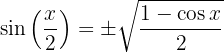
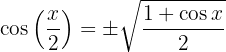
We can obtain the double angle identities from the sum of angle identities (with  ). On the other hand, we obtain the half angle identities from the double angle identity of
  .
.
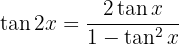
Double Angle
1.
2.
3.
Half Angle
1.
2.
3.
Note that the tangent of the half angle also satisfies the following identities:

and
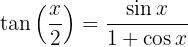
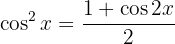
Identities for Power Reduction
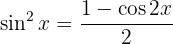
1.
2.
Transformation of Sum to Product and Vice Versa
Transformation of Sum to Product
1.
2.
3.
4.
5.
Transformation of Product to Sum
1.
2.
3.
4.
Law of Sines, Cosines, and Tangents
The law of sines, cosines, and tangents allow us to calculate remaining sides or angles when our triangle is not a right triangle. Observe the following figure:
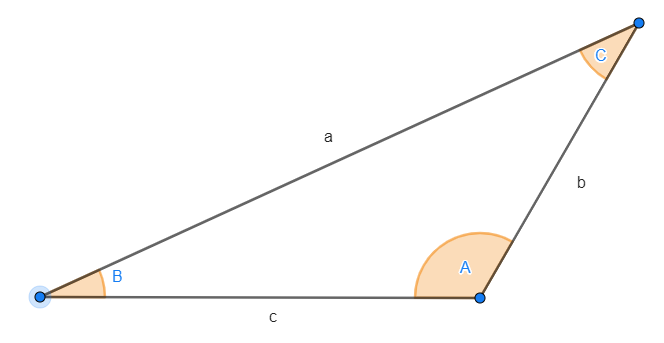
1. Law of Sines: Given a triangle (not necessarily a right triangle) with sides  ,
,  and
and  , with their respective opposite angles , and , the following is satisfied:

Note: if we have two angles and one side, then we use the law of sines to calculate the two remaining sides (we calculate the remaining angle by recalling that the sum of the angles is  ).
).
2. Law of Cosines: Given a triangle (not necessarily a right triangle) with sides , and , with their respective opposite angles , and , the following is satisfied:

Similarly, it is satisfied that:

and

Note: if we have the length of all three sides, then we use the law of cosines to calculate the angles. Similarly, if we have two sides and the angle between them, then we use the law of cosines to calculate the two remaining angles and the remaining side.
3. Law of Tangents: Given a triangle (not necessarily a right triangle) with sides , and , with their respective opposite angles , and , the following is satisfied:

Formulas for Calculating the Area of a Triangle
Finally, we will provide some formulas for calculating the area of a triangle. In these formulas, the area is denoted by  :
:
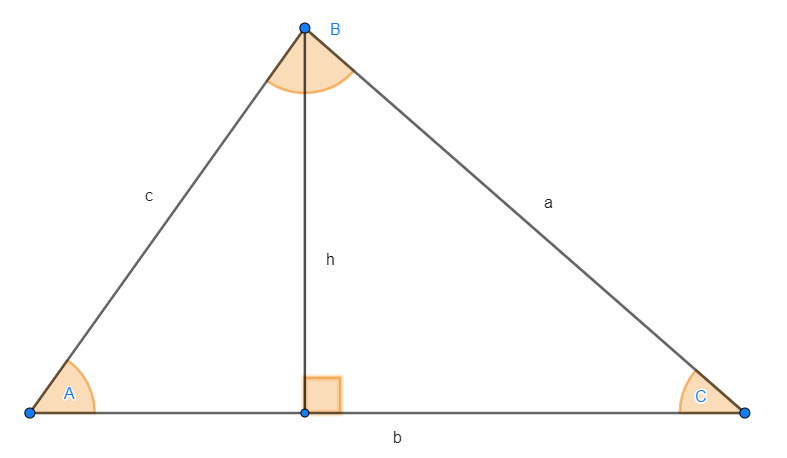
1. If denotes the base and  the height (which is perpendicular to the base ), then the area is calculated using:

2. Consider the triangle with sides , and , with their respective opposite angles , and . The area is calculated using:
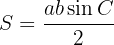
In the following figure we can see the height that is perpendicular to , from which it is clear that  , which is where the formula is derived.
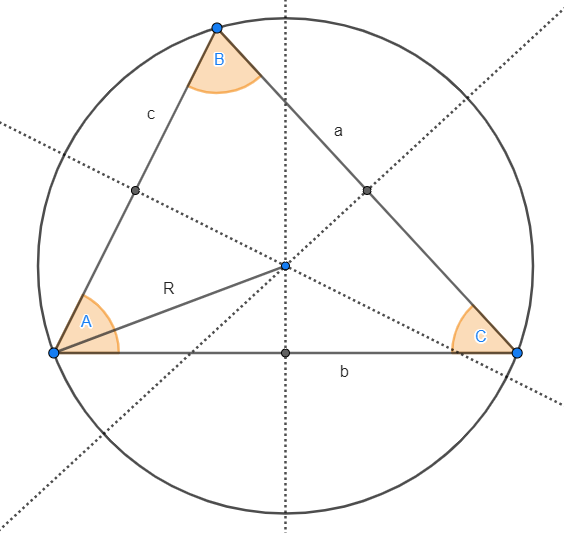
3. If  denotes the radius of the circumscribed circle (or circumradius), then the area is calculated using:

In the following figure we can see the circumscribed circle, and we denote its radius with .
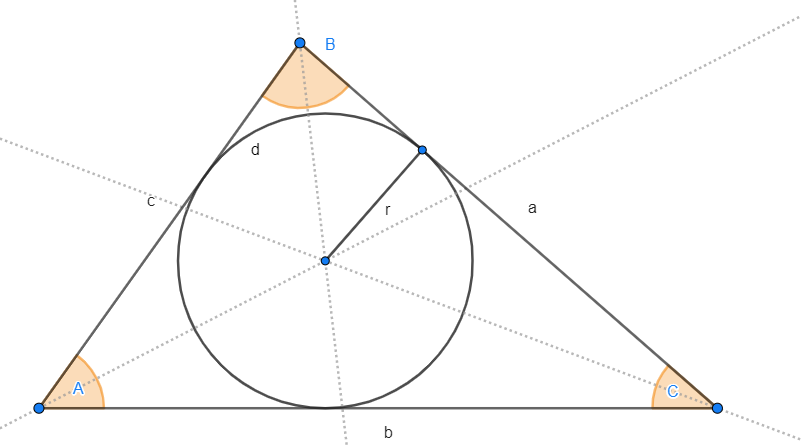
4. If  denotes the radius of the inscribed circle (or inradius), then the area is calculated using:
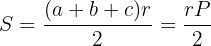
where we denote the perimeter of the triangle as  .
.
The inscribed circle can be seen in the following figure. We denote its radius with .
5. Heron's Formula: Let  be the semiperimeter of the triangle with sides , and , that is:
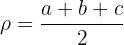
then the area is calculated using:

Summarize with AI:
Did you like this article? Rate it!

 Loading...