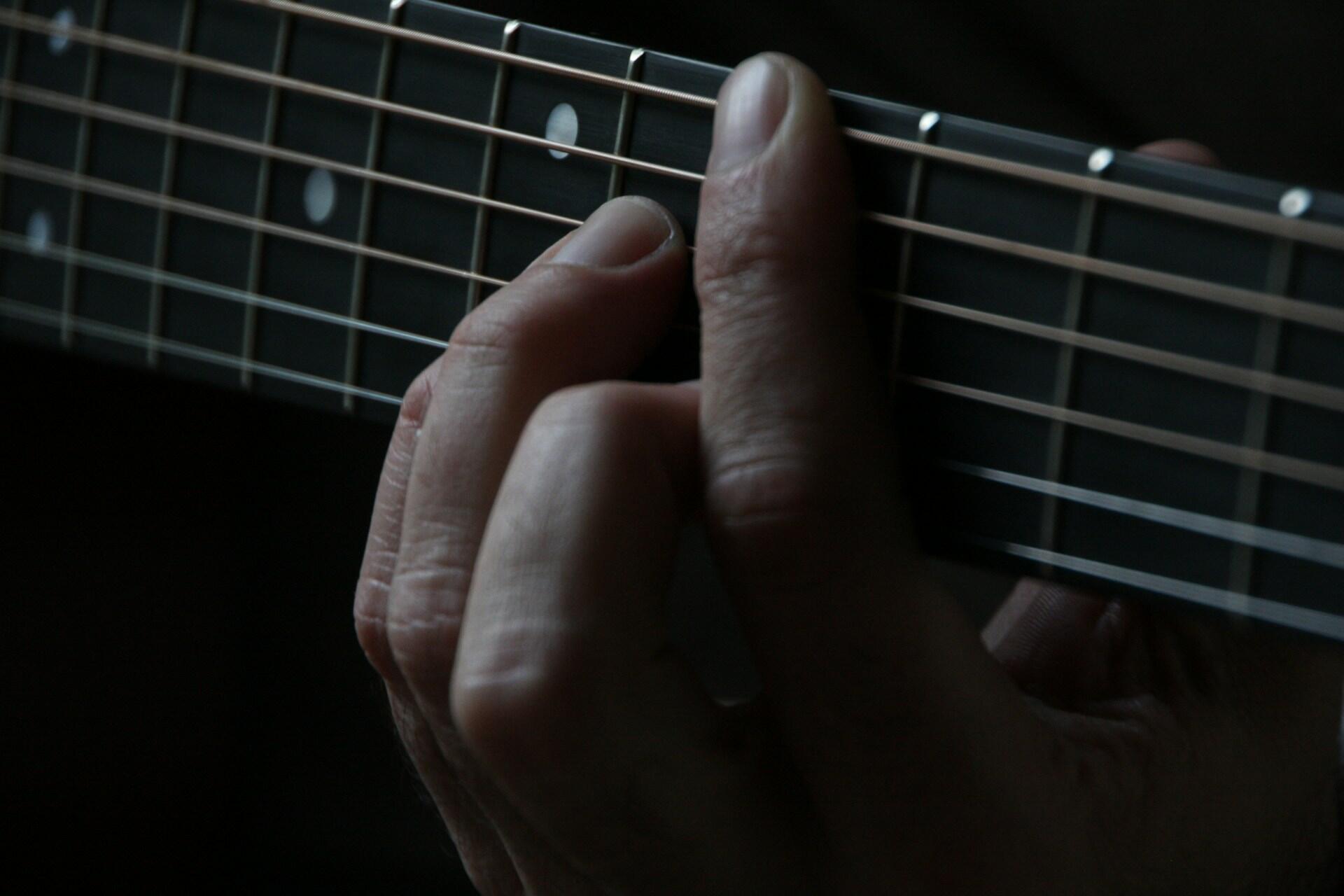

The standard B chord on guitar is a barre at the 2nd fret. Lay your index finger across strings 1 to 5 at fret 2. Then place your middle, ring, and pinky fingers on the 4th fret of the D, G, and B strings. Skip the low E string, and the chord rings out with three notes: B, D#, and F#.
That barre stops many beginners, but you have options. This guide covers four diagrammed shapes, a six-string barre, and easier stand-ins.
Notes in a B major chord
3B, D#, and F#: the root, major third, and perfect fifth





What Notes Are in a B Major Chord?
A B major chord is a triad built from B, D#, and F#. A major triad stacks a root, a major third, and a perfect fifth. Here, D# sits four half steps above B, and F# sits seven half steps above it. The same pitches go by other names: D# is also Eb, and F# is also Gb.
Those sharps come from the key itself. The B major scale carries five sharps: F#, C#, G#, D#, and A#.
Why Is the B Chord Hard for Beginners?
The B chord is hard because it has no comfortable open shape. A guitar in standard tuning has open strings E, A, D, G, B, and E. Only the B string belongs to the chord, so the other strings need fretting or muting. That means a barre, a stretch, or careful muting in every full version.
The Easy Four-String B Chord
The first version many guitarists learn uses only the top four strings. It leaves out the two bass strings entirely:
- Place your 1st finger on the 1st string at the 2nd fret.
- Place your 2nd finger on the 4th string at the 4th fret.
- Place your 3rd finger on the 3rd string at the 4th fret.
- Place your 4th finger on the 2nd string at the 4th fret.
- Mute strings 5 and 6, and strum only the top four.
From low to high, you play F#, B, D#, and F#. With F# in the bass, the chord sounds light, which suits strumming alongside a bass player.
The Low B Shape: A B Major 7 Voicing
This next diagram puts a B in the bass on the 5th string, which gives the chord more weight. Check finger 3, though: the 3rd fret of the G string is A#. That turns the shape into B major 7 (B, D#, F#, and A#), a softer, jazzier color than plain B major:
- Place your 1st finger on the 5th string at the 2nd fret.
- Place your 2nd finger on the 4th string at the 4th fret.
- Place your 3rd finger on the 3rd string at the 3rd fret.
- Place your 4th finger on the 2nd string at the 4th fret.
- Mute strings 1 and 6.
Move your 3rd finger up one fret, to the 4th fret of the G string. Now you play B, F#, B, and D# on strings 5 to 2, with strings 1 and 6 muted. It’s a full B major chord with no barre at all.
The B Barre Chord at the 2nd Fret
Muting the outside strings can be a challenge, so many players move on to the full barre. This is the version you’ll hear most often:
- Use your 1st finger to barre the strings at the 2nd fret.
- Place your 2nd finger on the 4th string at the 4th fret.
- Place your 3rd finger on the 3rd string at the 4th fret.
- Place your 4th finger on the 2nd string at the 4th fret.
- Mute string 6, and strum from the 5th string down.
This is the open A major shape moved up two frets, often called the A-shape barre. The diagram shows the barre across all six strings, but the X means the low E stays silent. Your index finger only has to sound strings 5 and 1.
When we invest our time in learning new chord shapes on the guitar, we broaden our musical vocabulary.
Robbie Calvo, Nashville guitarist and educator
The E-Shape B Barre Chord at the 7th Fret
For a fuller sound with B on the lowest string, slide up to the 7th fret. This is the open E major shape moved up seven frets, and it uses all six strings.
- Barre all six strings at the 7th fret with your 1st finger.
- Place your 2nd finger on the 3rd string at the 8th fret.
- Place your 3rd finger on the 5th string at the 9th fret.
- Place your 4th finger on the 4th string at the 9th fret.
From low to high, the notes are B, F#, B, D#, F#, and B. The frets sit closer together up here, so the stretch between fingers is shorter than at the 2nd fret.
B Major #2: A Spread Voicing at the 6th Fret
The barre is the go-to when you need something quick. Further up the neck, B major takes on trickier shapes, like this spread voicing starting at the 6th fret:
- Place your 1st finger on the 5th string at the 6th fret.
- Place your 2nd finger on the 6th string at the 7th fret.
- Place your 3rd finger on the 2nd string at the 7th fret.
- Mute strings 1, 3, and 4.
Only three notes sound here: B, D#, and F#, with B on the bottom. The wide gaps between them give an open, airy sound that works well for fingerpicking.
What Keys and Progressions Use the B Chord?
B major shows up most in three keys. In every major key, the chords on the 1st, 4th, and 5th scale degrees are major. So B is the I chord in B major, the IV chord in F# major, and the V chord in E major.
The key of E is where most guitarists meet it first. Try these progressions to practice your changes:
- E, A, B: the I, IV, and V chords in the key of E
- E, B, C#m, A: the I, V, vi, and IV chords in the key of E
- B, E, F#: the I, IV, and V chords in the key of B
How to Practice the B Chord
Short, regular sessions build barre strength better than one long push. Start with the four-string version, then add the root, then the full barre.
- Press next to the fret: Yamaha advises pressing just behind the fret, toward the nut, rather than on top of it.
- Check each string: Pick the strings one at a time and adjust any finger that mutes a neighbor.
- Go easy on your hand: Lighter-gauge strings reduce the pressure a barre needs while you build strength.
- Drill the change: Switch slowly between E and B for one minute before you add strumming.
Practice the barre in the middle of the neck first, around the 7th fret, where frets are closer together. Then work it back down toward the 2nd fret as your hand gets stronger.
Common Mistakes With the B Chord
Most buzzing B chords come down to a few habits. Fix them early, and the chord cleans up quickly.
- Letting the low E ring: In the A-shape barre, the 6th string isn’t part of the chord and sounds muddy.
- Pressing on the fret wire: Your fingertip damps the string and the note turns murky.
- Rushing the change: Speed comes from clean, slow repetitions, not from forcing tempo.
If a barre still buzzes after a few weeks, a guitar teacher can usually spot the cause quickly. The fix is often a small change in thumb position.
Chords Related to B Major
Once B major feels steady, these related chords are quick wins. Most reuse shapes you already know.
- B minor (Bm): B, D, and F#. Play the A-shape barre, but drop the B-string note to the 3rd fret.
- B7: B, D#, F#, and A. An open chord with a bluesy pull toward E.
- B major 7 (Bmaj7): B, D#, F#, and A#. The low B shape above is one way to play it.
- B5 power chord: Just B and F#. Play the 2nd fret of the A string and the 4th fret of the D string.
Sources
- "Triads," Open Music Theory, edited by Chelsey Hamm et al., VIVA Open Publishing. Available at: https://viva.pressbooks.pub/openmusictheory/chapter/triads/. Accessed 28 Sept. 2026.
- "Major Scales, Scale Degrees, and Key Signatures," Open Music Theory, edited by Chelsey Hamm et al., VIVA Open Publishing. Available at: https://viva.pressbooks.pub/openmusictheory/chapter/major-scales/. Accessed 28 Sept. 2026.
- "Inversion," Open Music Theory, edited by Chelsey Hamm et al., VIVA Open Publishing. Available at: https://viva.pressbooks.pub/openmusictheory/chapter/inversion/. Accessed 28 Sept. 2026.
- "Constructing Basic Guitar Chords, Part 1," Robbie Calvo, Yamaha Music, 2022. Available at: https://hub.yamaha.com/guitars/g-how-to/constructing-chords-part-1/. Accessed 28 Sept. 2026.
- "How to Play the Acoustic Guitar: Playing Hints," Musical Instrument Guide, Yamaha Corporation. Available at: https://www.yamaha.com/en/musical_instrument_guide/acoustic_guitar/play/play003.html. Accessed 28 Sept. 2026.
- "Learn The CAGED System for Guitar," D’Addario, 2026. Available at: https://www.daddario.com/blogs/guitar/guitarists-guide-to-the-caged-system. Accessed 28 Sept. 2026.
- "F Major Chord: How To Play On Guitar," D’Addario. Available at: https://www.daddario.com/blogs/guitar/the-f-major-chord. Accessed 28 Sept. 2026.
- "How to Use Guitar Capos," D’Addario. Available at: https://www.daddario.com/the-lesson-room/guitar/acoustic-guitar/shop/how-to-use-a-capo/. Accessed 28 Sept. 2026.
- "Dominant 7th Open Guitar Chords," D’Addario. Available at: https://www.daddario.com/blogs/guitar/open-dominant-7th-chords. Accessed 28 Sept. 2026.
Summarize with AI:
Did you like this article? Leave a rating!

 Loading...