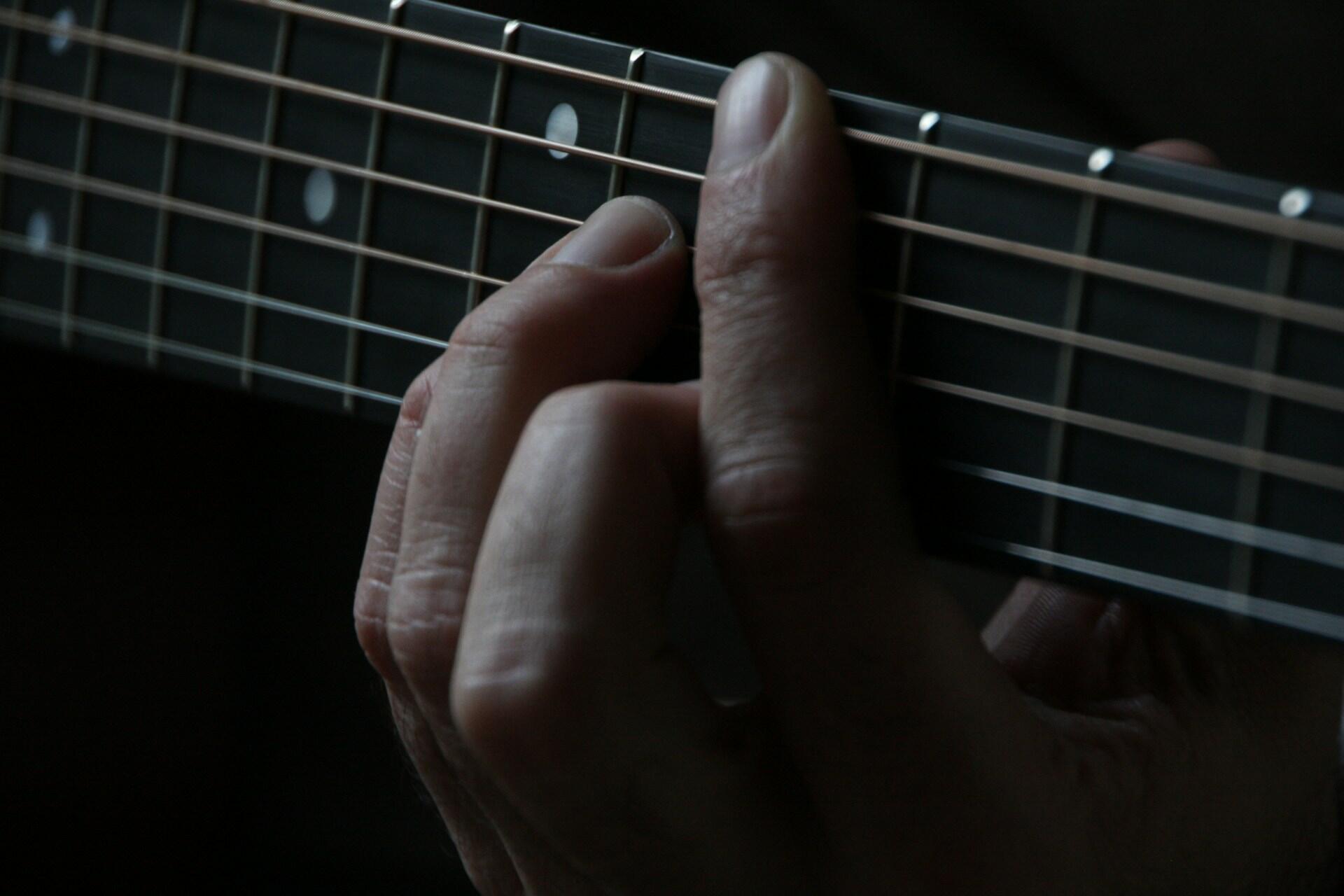

To play the open D chord, put your index finger on the 2nd fret of the G string. Your middle finger goes on the 2nd fret of the high E string, and your ring finger on the 3rd fret of the B string. Strum the top four strings, from the open D string down, and keep the low E and A strings silent.
This guide shows 14 ways to play D major, each with a chord chart and a finger-by-finger guide. It also covers the notes in the chord and the chords in the key of D.
Ways to play D major in this guide
14from the open shape by the nut up to the 15th fret





What Notes Are in a D Chord?
A D major chord has three notes: D, F#, and A. D is the root, F# is the major third, and A is the perfect fifth. Those are steps one, three, and five of the D major scale.
Guitar voicings repeat some of those notes across several strings. The open shape, for example, plays D, A, D, and F# from the D string to the high E.
How to Play the Open D Chord
The standard open D uses three fingers and sits in the first three frets. In chord shorthand, this shape is written xx0232.
- Finger 1: 3rd string, 2nd fret
- Finger 2: 1st string, 2nd fret
- Finger 3: 2nd string, 3rd fret
- Open: string 4
- Muted: strings 5 and 6
D Major With a Fuller Sound
You can beef up the open shape by adding notes on the lower strings. Your index finger lays flat across the top three strings, which frees the other fingers for the bass.
- Finger 1: barre across strings 1, 2, and 3 at the 2nd fret
- Finger 2: 2nd string, 3rd fret
- Finger 3: 4th string, 4th fret
- Finger 4: 5th string, 5th fret
- Muted: string 6
A Wide Three-String D Shape
This version spreads just three notes across the neck. It skips the middle strings, so the fingers on either side must touch them lightly to keep them quiet.
- Finger 1: 4th string, 4th fret
- Finger 2: 5th string, 5th fret
- Finger 3: 1st string, 5th fret
- Muted: strings 2, 3, and 6
D Major Chords Around the 5th Fret
Near the 5th fret, you have two very different options. The first is a barre chord built on the open A shape, one of the five CAGED shapes. The CAGED system moves the open C, A, G, E, and D chords up the neck.
- Finger 1: barre across the strings at the 5th fret
- Finger 2: 4th string, 7th fret
- Finger 3: 3rd string, 7th fret
- Finger 4: 2nd string, 7th fret
- Muted: string 6
The second is a trickier two-finger shape that sounds only three strings. The open D string gives the root, and the two fretted notes add A and F# on top.
- Finger 1: 1st string, 5th fret
- Finger 3: 2nd string, 7th fret
- Open: string 4
- Muted: strings 3, 5, and 6
D Major Chords at the 7th and 9th Frets
Muting matters less once you reach the 7th fret, but the stretches get bigger. This shape follows the open G chord, moved up seven frets. Your index finger holds down three strings while the other fingers reach wide.
- Finger 1: barre across strings 2, 3, and 4 at the 7th fret
- Finger 2: 5th string, 9th fret
- Finger 3: 6th string, 10th fret
- Finger 4: 1st string, 10th fret
D Major at the 9th Fret
Three more shapes share the same anchor on the two lowest strings. The first adds two high notes and lets the open D string ring through the middle.
- Finger 1: 5th string, 9th fret
- Finger 2: 6th string, 10th fret
- Finger 3: 2nd string, 10th fret
- Finger 4: 3rd string, 11th fret
- Open: string 4
- Muted: string 1
The second keeps that bass pair and adds A and D on the top strings. Keep the 3rd and 4th strings quiet with the underside of your fingers.
- Finger 1: 5th string, 9th fret
- Finger 2: 6th string, 10th fret
- Finger 3: 2nd string, 10th fret
- Finger 4: 1st string, 10th fret
- Muted: strings 3 and 4
The third drops the pinky, so you sound only three strings. It gives a lighter, airier D that suits fingerpicking and quiet verses.
- Finger 1: 5th string, 9th fret
- Finger 2: 6th string, 10th fret
- Finger 3: 2nd string, 10th fret
- Muted: strings 1, 3, and 4
D Barre Chords and Shapes at the 10th Fret
At the opposite end of the scale is a bold, full barre chord at the 10th fret. It’s the open E shape moved up the neck, with your index finger acting as the nut. All six strings ring, with D as the lowest note.
- Finger 1: barre across all six strings at the 10th fret
- Finger 2: 3rd string, 11th fret
- Finger 3: 5th string, 12th fret
- Finger 4: 4th string, 12th fret
Non-Barre D Major Shapes
You’ll also find two non-barre options at the 10th fret. The first pairs a low D on the 6th string with F# and A on the middle strings.
- Finger 1: 6th string, 10th fret
- Finger 2: 2nd string, 10th fret
- Finger 3: 3rd string, 11th fret
- Muted: strings 1, 4, and 5
The second is a compact triad on three neighboring strings. It moves easily to other chords, since the same shape works for any major triad.
- Finger 1: 2nd string, 10th fret
- Finger 2: 3rd string, 11th fret
- Finger 3: 4th string, 12th fret
- Muted: strings 1, 5, and 6
How Do You Play D Major Higher up the Neck?
To bring things full circle, you can play the open D shape again, one octave higher. The 12th fret acts as a new nut, so the fingering looks familiar. The first version frets the D on the 4th string with your index finger.
- Finger 1: 4th string, 12th fret
- Finger 2: 3rd string, 14th fret
- Finger 3: 1st string, 14th fret
- Finger 4: 2nd string, 15th fret
- Muted: strings 5 and 6
The second lets the open D string ring below the same shape. Your fingers take the exact positions of the open chord, just 12 frets higher.
- Finger 1: 3rd string, 14th fret
- Finger 2: 1st string, 14th fret
- Finger 3: 2nd string, 15th fret
- Open: string 4
- Muted: strings 5 and 6
What Are the Chords in the Key of D?
The key of D major has seven chords, one built on each note of the D major scale. That scale has two sharps, F# and C#. Chords on the 1st, 4th, and 5th notes are major, those on the 2nd, 3rd, and 6th are minor, and the 7th is diminished.
- I: D (D–F#–A)
- ii: Em (E–G–B)
- iii: F#m (F#–A–C#)
- IV: G (G–B–D)
- V: A (A–C#–E)
- vi: Bm (B–D–F#)
- vii°: C#dim (C#–E–G)
That makes D a friendly key for guitar. D, Em, G, and A are all open chords, so songs in D rarely need a barre.
How to Practice the D Chord
Clean D chords come from slow, regular practice. A few focused minutes every day beat a long session once a week.
beenherePractice tipD major is one of the easier open string chords, the close spacing of the notes making it fall under the fingers relatively comfortably.
Rod Fogg, London-based guitarist, teacher, and author, in Guitar.com
Pick each string of the D chord one at a time, from the D string down. If a note buzzes or dies, adjust that finger and try again. Then strum all four strings together and listen for a clear, even sound.
- Mute the low E: rest your thumb over the edge of the neck so it can’t ring
- Tilt your hand slightly: this keeps your fingertips from touching the high E
- Press just behind the frets: for a clear sound without buzzing
- Practice changes: move slowly between D, G, and A before you speed up
Sources
- "Chord Clinic: Learn to Play 10 Interesting D Major Chord Variations," Rod Fogg, Guitar.com, 2021. Available at: https://guitar.com/lessons/beginner/chord-clinic-d-major-variations/. Accessed 28 Sept. 2026.
- "Learn the CAGED System for Guitar," D’Addario, 2026. Available at: https://www.daddario.com/blogs/guitar/guitarists-guide-to-the-caged-system. Accessed 28 Sept. 2026.
- "Triads," Chelsey Hamm, Open Music Theory, VIVA Pressbooks. Available at: https://viva.pressbooks.pub/openmusictheory/chapter/triads/. Accessed 28 Sept. 2026.
- "Major Scales, Scale Degrees, and Key Signatures," Chelsey Hamm and Bryn Hughes, Open Music Theory, VIVA Pressbooks. Available at: https://viva.pressbooks.pub/openmusictheory/chapter/major-scales/. Accessed 28 Sept. 2026.
- "Roman Numerals," Samuel Brady et al., Open Music Theory, VIVA Pressbooks. Available at: https://viva.pressbooks.pub/openmusictheory/chapter/roman-numerals/. Accessed 28 Sept. 2026.
Summarize with AI:
Did you like this article? Leave a rating!

 Loading...