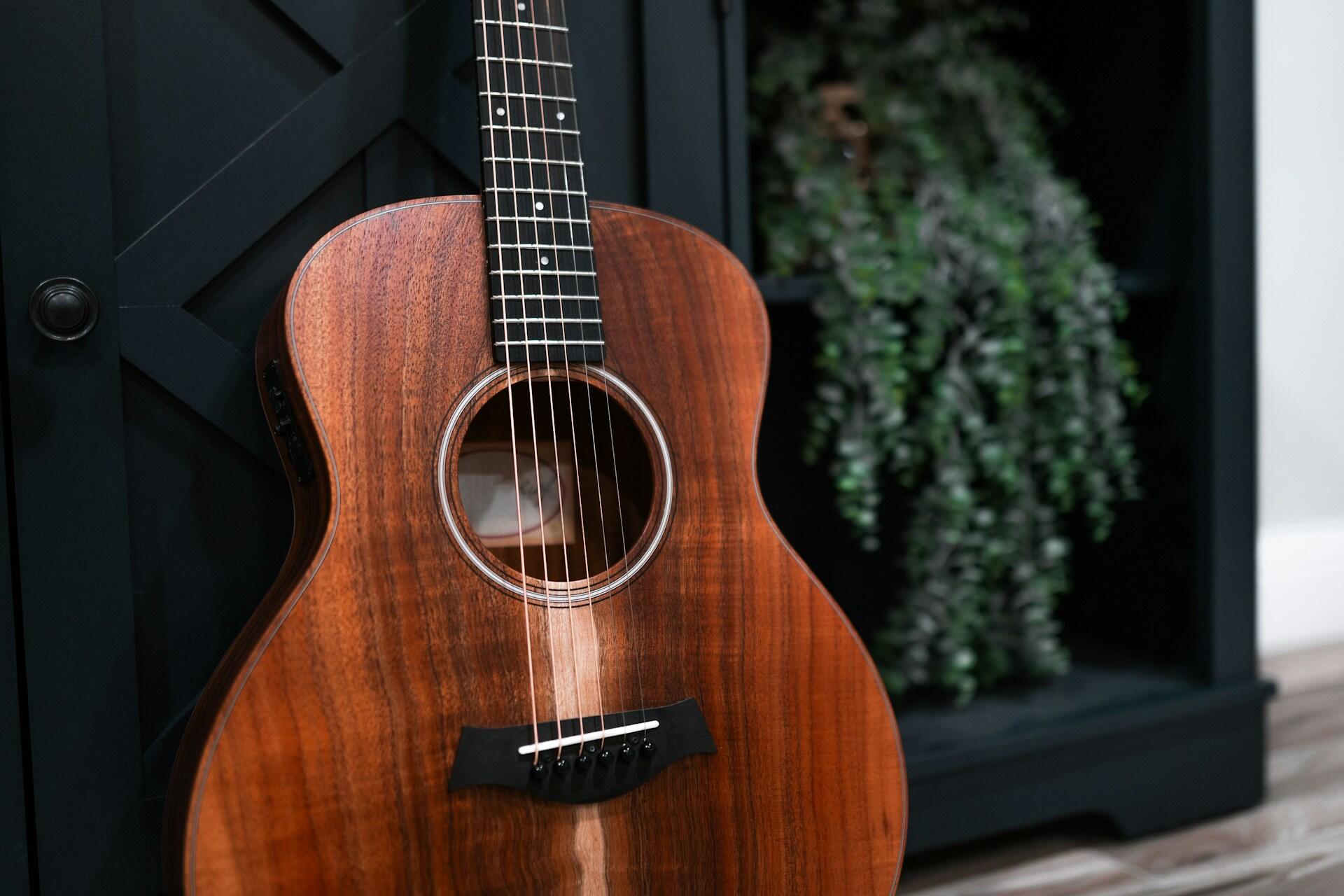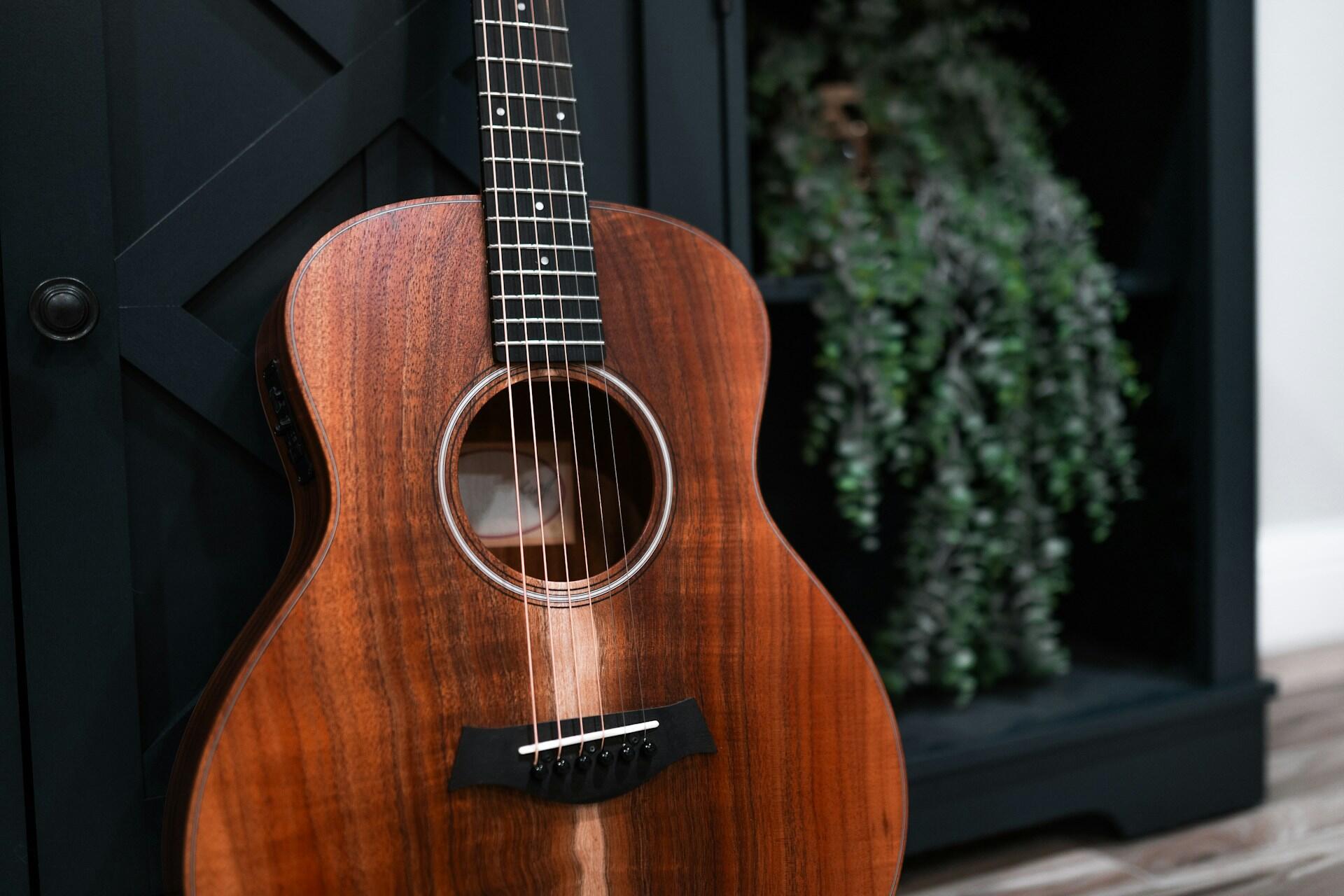

To play the open E chord, put your index finger on the 1st fret of the G string. Your middle finger goes on the 2nd fret of the A string, and your ring finger on the 2nd fret of the D string. Then strum all six strings, starting from the low E.
E major is one of the first chords most guitarists learn, and it rings out with a full, bright sound. This guide covers seven ways to play it, each with a chord chart. It also covers the notes in the chord, the key of E, and good practice habits.
Ways to play E major in this guide
7from the open shape by the nut up to the 12th fret





What Notes Are in an E Chord?
An E major chord has three notes: E, G#, and B. E is the root, G# is the major third, and B is the perfect fifth. Stacked in thirds, they form a major triad.
G# sounds the same as A♭, but in E major it’s always written as G#. That’s because the key of E has four sharps: F#, C#, G#, and D#. The open E shape plays E, B, E, G#, B, and E from the 6th string to the 1st. The root appears three times, which gives the shape its deep, ringing sound.
How to Play the Open E Chord
The standard open E uses three fingers and sounds all six strings. In chord shorthand, it’s written 022100, reading from the low E string to the high E.
- Finger 1: 3rd string, 1st fret
- Finger 2: 5th string, 2nd fret
- Finger 3: 4th string, 2nd fret
- Open: strings 1, 2, and 6
Press each string with your fingertips, just behind the fret. Keep your knuckles curved so no finger touches an open string. Watch the index finger, which sits right above the open B string.
Why the Open E Shape Matters
The open E shape is also the basis of the E-shape barre chord, one of the most common barre shapes. Refinger the chord with your middle, ring, and pinky fingers, then lay your index finger across all six strings. That index finger now acts as the nut, so you can slide the whole shape up the neck.
With the barre at the 1st fret, you’re playing F major. At the 3rd fret it becomes G, at the 5th fret A, and at the 7th fret B.
Two Compact E Voicings Near the Nut
The next two shapes use only four strings, so you mute the 5th and 6th strings. The first one is the open D chord shape moved up two frets. It asks for a wide stretch, so warm up your fingers first.
- Finger 1: 4th string, 2nd fret
- Finger 2: 3rd string, 4th fret
- Finger 3: 1st string, 4th fret
- Finger 4: 2nd string, 5th fret
- Muted: strings 5 and 6
The second voicing keeps the index and middle fingers from the open E. Your pinky adds a high G# on the 1st string, which gives the chord a sweet, bright top.
- Finger 1: 3rd string, 1st fret
- Finger 2: 4th string, 2nd fret
- Finger 4: 1st string, 4th fret
- Open: string 2
- Muted: strings 5 and 6
The chart doesn’t mark the 2nd string, but let it ring open. It sounds B, the fifth of the chord.
How Do You Play an E Barre Chord?
You can play E major as a barre chord in two main places. At the 7th fret, you use the A shape, with the root on the 5th string. At the 12th fret, you use the E shape, which is the open chord moved up a full octave.
E Barre Chord at the 7th Fret
This A-shape voicing puts your index finger across the 7th fret. The other three fingers line up side by side, two frets higher.
- Finger 1: barre across the strings at the 7th fret
- Finger 2: 4th string, 9th fret
- Finger 3: 3rd string, 9th fret
- Finger 4: 2nd string, 9th fret
- Muted: string 6
If three fingers in one fret feel crowded, flatten the ring finger across strings 2 to 4 instead.
E Barre Chord at the 12th Fret
This voicing is the open E shape, played 12 frets higher. Your index finger replaces the nut.
- Finger 1: barre across the strings at the 12th fret
- Finger 2: 3rd string, 13th fret
- Finger 3: 5th string, 14th fret
- Finger 4: 4th string, 14th fret
You could also play an E barre chord at the 12th fret, but it’s not really practical on acoustic guitar.
Kate Koenig, author of the Chord by Chord lesson series in Acoustic Guitar magazine
On an electric guitar, this shape works well. On an acoustic, try the 7th-fret barre instead, or play just the top four strings at the 12th fret.
More E Major Shapes Higher on the Neck
Two more voicings follow the CAGED system, which moves five open chord shapes along the fretboard. Each one gives E major a different color.
E Major at the 4th Fret
This voicing uses the open C shape, with a partial barre at the 4th fret. Hold your index finger in place while the others stretch toward the bass.
- Finger 1: strings 1, 2, and 3 at the 4th fret
- Finger 2: 2nd string, 5th fret
- Finger 3: 4th string, 6th fret
- Finger 4: 5th string, 7th fret
- Muted: string 6
From the 5th string up, this shape plays E, G#, B, E, and G#. The root sits under your pinky, so make sure that finger presses firmly.
E Major at the 9th Fret
Lastly, there’s the G shape, with a barre at the 9th fret. It’s a less common CAGED shape, but it sounds full.
- Finger 1: barre across the strings at the 9th fret
- Finger 2: 5th string, 11th fret
- Finger 3: 6th string, 12th fret
- Finger 4: 1st string, 12th fret
Play all six strings here, since the low string carries the root. The stretch from the 9th to the 12th fret is wide, so build up to it slowly.
What Are the Chords in the Key of E?
The key of E major has seven chords, one for each note of the E major scale. The chords on the 1st, 4th, and 5th notes are major, while those on the 2nd, 3rd, and 6th are minor. The 7th chord is diminished.
- I: E (E–G#–B)
- ii: F#m (F#–A–C#)
- iii: G#m (G#–B–D#)
- IV: A (A–C#–E)
- V: B (B–D#–F#)
- vi: C#m (C#–E–G#)
- vii°: D#dim (D#–F#–A)
E, A, and B, the I, IV, and V chords, are the core of countless songs in E. They also drive the 12-bar blues, a form that runs I, IV, I, V, IV, and I over twelve bars. Add C#m for the I–V–vi–IV progression, E–B–C#m–A, heard in many pop hits.
How to Practice E Major
Clean chords come from short, regular practice. A few focused minutes a day work best.
- Pick one string at a time: check that all six notes ring before you strum
- Place all three fingers together: lift them off, then set them down as one unit
- Practice changes: move between E, A, and B slowly, then speed up
- Use a metronome: it keeps your chord changes steady and even
When you move on to the E-shape barre, set your middle, ring, and pinky fingers first. Lay the index finger across the strings last. Let the weight of your arm hold the barre, rather than squeezing with your thumb.
Common Mistakes With E Major
Most problems with this shape come from a few small habits, and each one has a quick fix.
- Muting the B string: arch your index finger so it clears the open 2nd string
- Flat fingers: press with your fingertips so no finger touches the high E string
- Playing too far from the fret: fingers placed mid-fret cause buzzing
- Squeezing a barre too hard: pinching with the thumb tires the hand quickly
Related Chords to Learn Next
Once E major feels comfortable, try its close relatives. Each one changes or adds a single note.
- E minor (Em): E–G–B, played by lifting your index finger from the open E
- E7: E–G#–B–D, played by lifting your ring finger from the open E
- Emaj7: E–G#–B–D#, with the D string fretted at the 1st fret instead of the 2nd
- Esus4: E–A–B, with a fourth in place of the third
Sources
- "Learn 7 Ways to Play E Major | Chord by Chord," Kate Koenig, Acoustic Guitar, 6 Mar. 2021. Available at: https://acousticguitar.com/learn-7-ways-to-play-e-major-chord-by-chord/. Accessed 28 Sept. 2026.
- "E Chord on Piano, Guitar, and Ukulele," Musicca. Available at: https://www.musicca.com/dictionary/chords/e-major. Accessed 28 Sept. 2026.
- "Learn the CAGED System for Guitar," D’Addario, 2026. Available at: https://www.daddario.com/blogs/guitar/guitarists-guide-to-the-caged-system. Accessed 28 Sept. 2026.
- "Introduction to Triads," Robert Hutchinson, Music Theory for the 21st-Century Classroom, University of Puget Sound. Available at: https://musictheory.pugetsound.edu/mt21c/TriadsIntroduction.html. Accessed 28 Sept. 2026.
- "Enharmonic Notes," Robert Hutchinson, Music Theory for the 21st-Century Classroom, University of Puget Sound. Available at: https://musictheory.pugetsound.edu/mt21c/EnharmonicNotes.html. Accessed 28 Sept. 2026.
- "Diatonic Chords in Major," Robert Hutchinson, Music Theory for the 21st-Century Classroom, University of Puget Sound. Available at: https://musictheory.pugetsound.edu/mt21c/DiatonicChordsInMajor.html. Accessed 28 Sept. 2026.
- "The 12-Bar Blues," Robert Hutchinson, Music Theory for the 21st-Century Classroom, University of Puget Sound. Available at: https://musictheory.pugetsound.edu/mt21c/TwelveBarBlues.html. Accessed 28 Sept. 2026.
- "The Best-Seller Progression," Robert Hutchinson, Music Theory for the 21st-Century Classroom, University of Puget Sound. Available at: https://musictheory.pugetsound.edu/mt21c/BestsellerProgression.html. Accessed 28 Sept. 2026.
- "Simple “Sus” Chords," Robert Hutchinson, Music Theory for the 21st-Century Classroom, University of Puget Sound. Available at: https://musictheory.pugetsound.edu/mt21c/SimpleSusChords.html. Accessed 28 Sept. 2026.
- "How to Learn to Play a Bar Chord (Barre Chord) in Under 2 Minutes," Douglas Niedt. Available at: https://douglasniedt.com/techtiphowtoplayabarchordintwominutes.html. Accessed 28 Sept. 2026.
Summarize with AI:
Did you like this article? Leave a rating!

 Loading...