
The standard F chord on guitar is a barre chord at the 1st fret. Your index finger presses all six strings, and your other three fingers form an E major shape one fret higher. The chord holds three notes: F, A, and C.
That barre is a big step for most beginners, so this guide also covers easier ways in. You’ll find six diagrammed shapes, an easy Fmaj7, practice tips, and the chords that pair with F.
Notes in an F major chord
3F, A, and C: the root, major third, and perfect fifth





What Notes Are in the F Chord?
F major is a triad built from F, A, and C. F is the root, A sits a major third above it, and C sits a perfect fifth above it. Every shape below uses only those three notes.
The chord turns up in several keys. D’Addario points out that F is the I chord in the key of F, the IV chord in C, and the V chord in B♭.
How Do You Play the F Barre Chord at the 1st Fret?
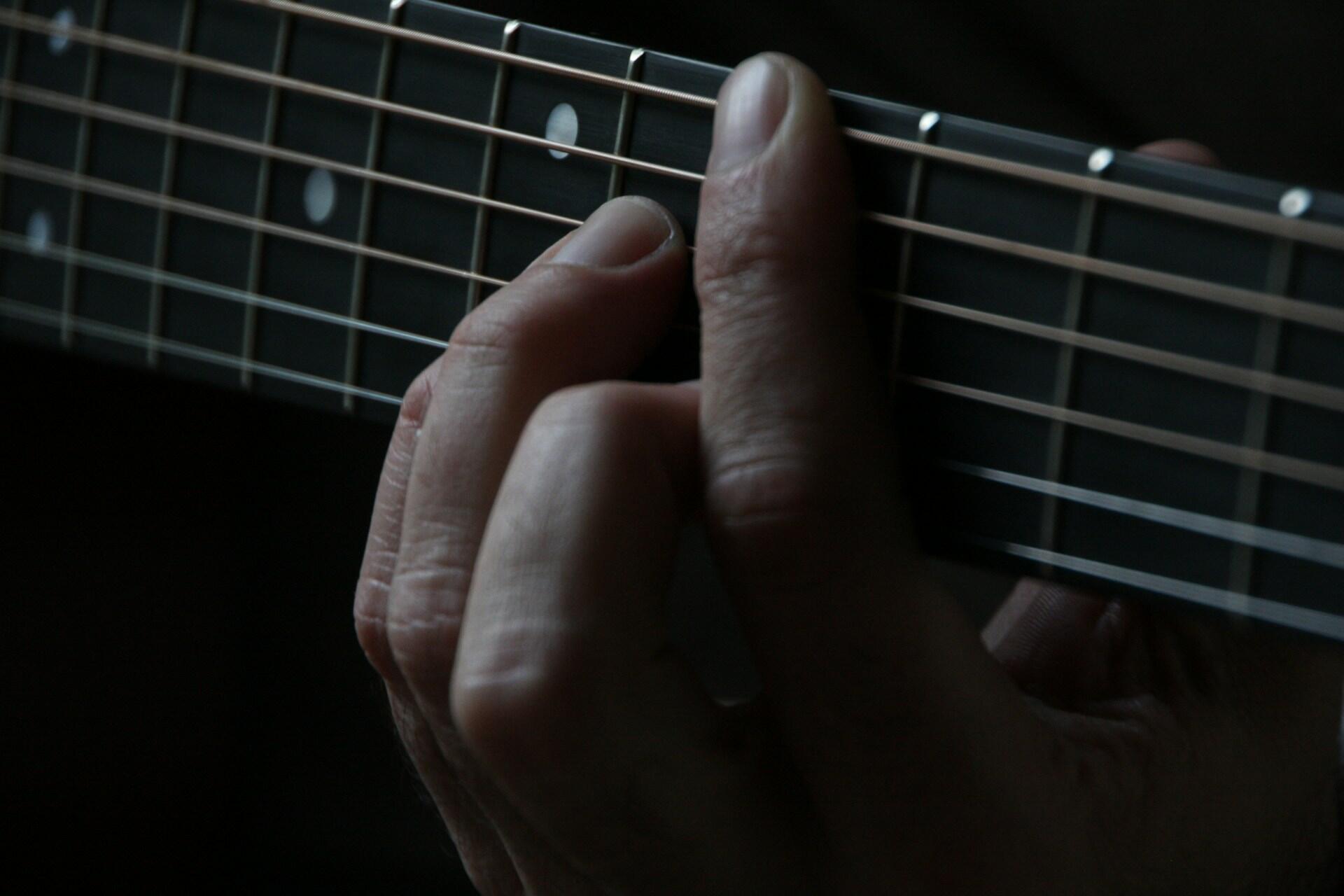
This is the full version most guitarists learn first. Lay your index finger flat across all six strings at the 1st fret, then add the other three fingers.
- Index finger (1): barre all six strings at the 1st fret
- Middle finger (2): 3rd string (G), 2nd fret
- Ring finger (3): 5th string (A), 3rd fret
- Pinky (4): 4th string (D), 3rd fret
From low to high, the notes are F, C, F, A, C, and F. The shape is an open E major chord moved up one fret, with your index finger acting as a new nut. Guitar World calls it the “E shape” for that reason.
You’re just moving the nut up the neck.
Jason Isbell, singer-songwriter and guitarist, in Guitar World
The shape is movable, too. Slide it up one fret and you have F♯ at the 2nd fret.
Is There an Easy F Chord on Guitar?
Yes. The easiest F chord drops the two bass strings and uses a small barre on the top two strings. You still play F, A, and C, just without pressing all six strings.
- Index finger (1): strings 1 and 2 at the 1st fret
- Middle finger (2): 3rd string (G), 2nd fret
- Ring finger (3): 4th string (D), 3rd fret
- Muted: 5th and 6th strings
Strum only the top four strings. From the D string up, the notes are F, A, C, and F, so the chord sounds complete. D’Addario teaches a close cousin that skips the high E string and adds a C on the A string at the 3rd fret.
Easy Fmaj7 Shape
If even the mini barre feels tight, try Fmaj7. Put your ring finger on the D string at the 3rd fret and your middle on the G string at the 2nd. Your index takes the B string at the 1st fret, and the high E rings open.
That open E adds a major seventh, so the chord holds F, A, C, and E. It sounds softer than F major and works as a stand-in while your barre gets stronger.
Where Else Can You Play an F Bar Chord?
Once the 1st-fret barre feels comfortable, try F higher up the neck. The “A shape” barre sits at the 8th fret and gives a brighter, tighter sound.
- Index finger (1): barre strings 1 to 5 at the 8th fret
- Middle finger (2): 4th string (D), 10th fret
- Ring finger (3): 3rd string (G), 10th fret
- Pinky (4): 2nd string (B), 10th fret
- Muted: 6th string
From the A string up, the notes are F, C, F, A, and C. Guitar World notes that some players barre the three 10th-fret notes with the ring finger instead.
What Are the No-Barre F Chord Variations?
You can also play F without any barre at all. These three shapes need careful muting and some stretch instead.
Variant 1: Open Position With a Low F
This shape keeps the low F on the 6th string but skips the middle strings. You fret only three notes.
- Index finger (1): 6th string (low E), 1st fret
- Middle finger (2): 2nd string (B), 1st fret
- Ring finger (3): 3rd string (G), 2nd fret
- Muted: 1st, 4th, and 5th strings
Let your index finger lean lightly against strings 4 and 5 to deaden them. With your strumming hand, stop before the 1st string. The notes you hear are F, A, and C.
Variant 2: Four Strings at the 3rd and 5th Frets
This version moves the root to the D string. It suits songs where you want a lighter, higher F.
- Index finger (1): 4th string (D), 3rd fret
- Ring finger (3): 3rd string (G), 5th fret
- Pinky (4): 1st string (high E), 5th fret
- Muted: 2nd, 5th, and 6th strings
Avoid strings 5 and 6 with your pick. Let your ring finger rest against the B string to keep it quiet. The notes are F, C, and A.
Variant 3: Stretch From the 3rd to the 6th Fret
The last shape needs no muting between strings, but it asks for a wider stretch. The chart starts at the 2nd fret, so count carefully.
- Index finger (1): 4th string (D), 3rd fret
- Middle finger (2): 3rd string (G), 5th fret
- Ring finger (3): 1st string (high E), 5th fret
- Pinky (4): 2nd string (B), 6th fret
- Skip: 5th and 6th strings
From the D string up, the notes are F, C, F, and A. Reaching the 6th fret with your pinky while your index holds the 3rd takes practice.
Why Is the F Chord So Hard for Beginners?
For most players, F is the first barre chord they meet. One finger has to press six strings evenly while three others fret separate notes.
Your gear can add to the struggle. D’Addario notes that heavy or worn strings make barre chords feel tougher. It also warns that F sounds harsh if even one string is slightly out of tune. Even Jason Isbell told Guitar World that barre chords are tough to learn.
How Should You Practice the F Chord?
Build the chord in stages, and keep sessions short. Your hand needs time to adapt.
- Start small: learn the easy four-string F first, then add the bass strings one at a time.
- Place the barre last: classical guitarist Douglas Niedt sets the other fingers first, then lays the index finger down.
- Try a capo: D’Addario suggests a capo on the 1st or 2nd fret while your hand builds strength.
- Drill the change: switch between C and F slowly, since the two chords often sit side by side.
After you form the F chord, pick the strings one at a time from low to high. If one buzzes, adjust only the finger on that string. Then strum the full chord again.
What Are Common F Chord Mistakes?
Most F chord problems have simple fixes. These four cover the usual issues.
- Pressing with the soft pad: roll your index finger slightly onto its side. Guitar World notes the side of the finger is harder, so pressure goes further.
- Squeezing with the thumb: Douglas Niedt calls hard pinching counterproductive. Use a little arm weight to pull the neck toward you instead.
- Forcing the high E string: if it keeps dying, leave it out. Guitar World suggests simply dropping that string.
- Playing out of tune: tune before every session, because F exposes small errors.
What Chords Go With F?
The key of F major has one flat, B♭, in its key signature. Its scale runs F, G, A, B♭, C, D, and E. Build a triad on each note, and you get F, Gm, Am, B♭, C, Dm, and Edim.
Two progressions will get you playing songs quickly. Try I–IV–V, which is F–B♭–C, then I–vi–IV–V, which is F–Dm–B♭–C. D’Addario lists songs that use F, including “Tiny Dancer” by Elton John and “My Girl” by the Temptations.
Related Chords: Fm, F7, and Fmaj7
Once the full barre sits well, a one-finger change gives you new chords. The first two keep the same barre at the 1st fret.
- Fm (F, A♭, C): lift your middle finger off the G string, and the barre covers it at the 1st fret.
- F7 (F, A, C, E♭): lift your pinky off the D string, and the barre plays E♭ there.
- Fmaj7 (F, A, C, E): use the easy open shape above for a gentle, jazzy sound.
Sources
- "How to Play the F Major Chord on Guitar," D’Addario, 2026. Available at: https://www.daddario.com/blogs/guitar/the-f-major-chord. Accessed 28 Sept. 2026.
- "F Chord," Musicca. Available at: https://www.musicca.com/dictionary/chords/f-major. Accessed 28 Sept. 2026.
- "Fmaj7 Chord," Musicca. Available at: https://www.musicca.com/dictionary/chords/f-major-seventh. Accessed 28 Sept. 2026.
- "F Minor Chord," Musicca. Available at: https://www.musicca.com/dictionary/chords/f-minor. Accessed 28 Sept. 2026.
- "F7 Chord," Musicca. Available at: https://www.musicca.com/dictionary/chords/f-dominant-seventh. Accessed 28 Sept. 2026.
- "F Major Scale," Musicca. Available at: https://www.musicca.com/dictionary/scales/f-major. Accessed 28 Sept. 2026.
- "Major Scales, Scale Degrees, and Key Signatures," Open Music Theory, VIVA Open Publishing. Available at: https://viva.pressbooks.pub/openmusictheory/chapter/major-scales/. Accessed 28 Sept. 2026.
- "Roman Numerals," Open Music Theory, VIVA Open Publishing. Available at: https://viva.pressbooks.pub/openmusictheory/chapter/roman-numerals/. Accessed 28 Sept. 2026.
- "How to Play Barre Chords: The 4 Most Important Shapes," Chris Bird, Guitar World. Available at: https://www.guitarworld.com/lessons/how-to-play-barre-chords. Accessed 28 Sept. 2026.
- "“The Biggest Pain in All Guitar Playing”: Jason Isbell Names the Hardest Thing for Beginners to Learn on Guitar," Phil Weller, Guitar World, 2025. Available at: https://www.guitarworld.com/artists/guitarists/jason-isbell-on-hardest-part-of-learning-guitar-for-beginners. Accessed 28 Sept. 2026.
- "How to Learn to Play a Bar Chord in Under 2 Minutes," Douglas Niedt. Available at: https://douglasniedt.com/techtiphowtoplayabarchordintwominutes.html. Accessed 28 Sept. 2026.
Summarize with AI:
Did you like this article? Leave a rating!

 Loading...