The definite integral is a case of the integral used to determine the value of the areas delimited by a graph within an interval and the horizontal axis. It can be found in various areas and contexts such as biology (in population growth), robotics (line-following algorithm), architecture (volumes of solids), etc. A specific example of an application will be given later.
Formally it is defined as follows:
Definition of the Definite Integral
Given a function f(x) of a real variable x and an interval [a,b] of the real line, the definite integral is equal to the area bounded between the graph of f(x), the x-axis, and the vertical lines x = a and x = b.
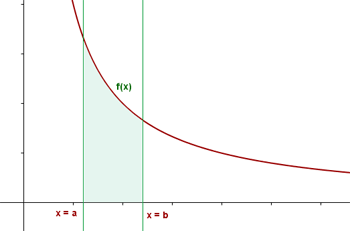
It is represented by  .
.
 is the integration sign.
- a is the lower limit of integration.
- b is the upper limit of integration.
 is the integrand or function to integrate.
 is the differential of x and indicates which is the variable of the function being integrated.


Properties of the Definite Integral
1 The value of the definite integral changes sign if the limits of integration are interchanged.

This property can help us avoid working with negative signs.
Example:

2 If the limits of integration coincide, the definite integral equals zero.

In reality, when the same limit of integration exists at both ends, there is no area to calculate, which is why the integral equals zero in this case.
Example:

3 If c is an interior point of the interval [a, b], the definite integral can be decomposed as a sum of two integrals extended to the intervals [a, c] and [c, b].

Since point c is between a and b on the x-axis, the area bounded by the interval [a,b] is the sum of the areas bounded by [a,c] and [c,b]. The same occurs with the value of the integral.
Example:
For 7 which belongs to the interval [3,10]:

4 The definite integral of a sum of functions is equal to the sum of integrals.

This property can help us avoid having very long expressions within the same integral, thus making calculations easier, or in other cases, grouping expressions for more convenient calculation.
Example:
For  and
and  ,
,

5 The integral of the product of a constant k by a function is equal to the constant k multiplied by the integral of the function.

This is extracting the constant outside the integral.
Example:
For the constant k=3:

Application Example
In this example we will implement the previous properties in an application of the integral to population growth for better visualization.
A population grows at a rate of  individuals per year (where
  is the number of years). In the first year the population is 1,500 people.
How much did the population grow between the first and third year? What is the population in the third year?
1 Given that it asks us for the population growth between 1 and 3, that is, the area under the curve of the growth rate between 1 and 3, we express it as follows:

Note: the following steps are to illustrate the use of properties; some of them can be omitted.
2 When we perform the calculations, note that we can use property 4 and separate it into a sum.

3 We can also use property 5 and extract the constant -3 that multiplies t.


4 Given that  we substitute and perform the corresponding calculations to find the answer to the first question:


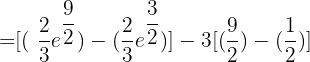


Thus the growth between the first and third year was approximately 33 individuals.
6 For the second question we follow this reasoning:
- In year 1 the population was 1,000 individuals.
- The growth between year 1 and 3 was approximately 33 individuals.
- Thus the population in year 3 is approximately 1,033 individuals.
Summarize with AI:
Did you like this article? Rate it!

 Loading...