Welcome to our section dedicated to calculating volumes of functions through the use of integral calculus. This is a topic of great importance in mathematics and physics, and mastering it is essential for tackling a variety of problems related to areas and volumes in three-dimensional space. In this guide, we will accompany you step by step on the journey of calculating volumes using integral techniques.
The process of calculating the volume of a function involves dividing a three-dimensional solid into infinitesimal elements, and adding up these elements using definite integrals to find the total volume. This allows us to understand and quantify the extent of objects in three-dimensional space with precision.
Let's start calculating integrals!
Find the volume of the frustum of a cone generated by the rotation around  of the area bounded by
 .
1 We represent the problem graphically

2 We substitute into the formula to find the volume

3 To solve the integral, we consider the substitution  and calculate its derivative

4 We use the integration formula

5 Since this is a definite integral, we can dispense with the constant of integration

6 We evaluate at the limits of integration

Then the volume is 
Find the volume generated by the surfaces bounded by the curve  and the lines
 , on rotating around the OX axis
1 We represent the problem graphically

2 We substitute into the formula to find the volume

3 To solve the integral, we consider the trigonometric identity  , so the integral is expressed as

4 Since this is a definite integral, we can dispense with the constant of integration

5 We evaluate at the limits of integration

Then the volume is 
Calculate the volume generated by a half-wave of the sine curve  , on rotating around the axis.
1 We represent the problem graphically

We observe that the sine curve corresponds to the figure in exercise 2
2 We substitute into the formula to find the volume
3 To solve the integral, we consider the trigonometric identity , so the integral is expressed as
4 Since this is a definite integral, we can dispense with the constant of integration
5 We evaluate at the limits of integration
Then the volume is
Find the volume of the solid of revolution generated by rotating around the axis the region determined by the function  , the x-axis and the lines .
1 We substitute into the formula to find the volume

2 We expand the integrand

3 We consider the trigonometric identity  . Since this is a definite integral, we can dispense with the constant of integration

4 We evaluate at the limits of integration

Then the volume is 
Find the volume generated by the circle  on rotating around the axis.
1 We express the equation of the circle in its standard form

2 The center of the circle is  and the radius
 . The points of intersection with the axis are:

3 From the general equation of the circle we obtain the function


4 We substitute into the formula to find the volume

5 We expand the integrand

6 Since this is a definite integral, we can dispense with the constant of integration

7 We evaluate at the limits of integration

Then the volume is 
Calculate the volume generated by rotating around the axis the region bounded by the graphs of  .
1 To find the points of intersection of the line and the parabola, we solve the system

We set them equal and factor to obtain

The roots are  . Then the points of intersection are:


2 We substitute into the formula to find the volume

3 We expand the integrand

4 Since this is a definite integral, we can dispense with the constant of integration

5 We evaluate at the limits of integration

Then the volume is 
Calculate the volume of the solid generated by rotating around the axis the region bounded by the graphs of 
1 To find the points of intersection of the line and the parabola, we solve the system

We set them equal and factor to obtain

The roots are  . Then the points of intersection are:


2 We substitute into the formula to find the volume

3 We expand the integrand

4 Since this is a definite integral, we can dispense with the constant of integration

5 We evaluate at the limits of integration

Then the volume is 
Calculate the volume generated by a triangle with vertices  on rotating
 around the axis.
1 We represent it graphically

The equations of the lines passing through  and
 are

2 We substitute into the formula to find the volume, observing that for the line segment we consider the interval  and for the line segment we consider the interval


3 We expand the integrand

4 Since this is a definite integral, we can dispense with the constant of integration

5 We evaluate at the limits of integration and obtain

Then the volume is 
Find the volume of the figure generated by rotating the ellipse  around the axis.
1 We represent it graphically

2 The center of the ellipse is  . The points of intersection with the axis are:

3 From the equation of the ellipse, we obtain the function
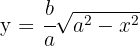
Since the ellipse is a symmetric curve, the volume asked for is twice the volume generated by the arc between  and
 .
4 We substitute into the formula to find the volume

5 We expand the integrand

6 Since this is a definite integral, we can dispense with the constant of integration

7 We evaluate at the limits of integration

Then the volume is 
Calculate the volume of the cylinder generated by the rectangle bounded by the lines  , and the axis on rotating around this axis.
1 We substitute into the formula to find the volume

2 Since this is a definite integral, we can dispense with the constant of integration

3 We evaluate at the limits of integration

Then the volume is 
Calculate the volume of the sphere of radius  .
1 We start from the equation of the circle 
2 Rotating a semicircle around the x-axis gives a sphere

3 From the equation of the circle, we obtain the function

4 We substitute into the formula to find the volume

5 We expand the integrand

6 Since this is a definite integral, we can dispense with the constant of integration

7 We evaluate at the limits of integration

Then the volume is 
Calculate the volume generated by the rotation of the area bounded by the parabola  and the line
 , around the
 axis.
1 We represent it graphically

Since it rotates around the axis, we apply:

The volume will be the difference between the one generated by the line and the one generated by the parabola between the limits  .
Since the parabola is symmetric with respect to the axis, the volume is equal to twice the volume generated between  .
2 We substitute into the formula to find the volume

3 Since this is a definite integral, we can dispense with the constant of integration

4 We evaluate at the limits of integration

Then the volume is 
Find the volume of the ellipsoid generated by the ellipse  , on rotating around the axis.
1 We express the ellipse in its standard equation


2 The center of the ellipse is  . We apply the formula obtained in exercise 9
3 Substituting the known values, we obtain

Find the volume of the solid of revolution generated by revolving the function  , defined on the interval
 , around the OX axis.
1 We illustrate the function.

2 We calculate the integral:

Let  for
 .
- Draw the graph of
 .
- Calculate the area of the region bounded by and the OX axis on the interval
 , where
 .
- Calculate the volume of the solid of revolution generated by revolving the region from part (b) around the OX axis.
- What happens to the area you calculated in part (b) if
 ? And to the volume of the solid of revolution?
a

b We calculate the integral on the interval . That is, the area under the curve:

c Now, we revolve this same area around the OX axis:

d If in the result of part (b), we have

That is, the area under the curve goes to infinity if the interval we take goes to infinity. However, let us note that

That is, the volume of the solid remains bounded.
Summarize with AI:
Did you like this article? Rate it!

 Loading...


 , where the radius is the function value, so adding them up with a definite integral gives:

 from 1 out to infinity grows without bound, but the solid you get by spinning that same region around the x-axis has a volume that settles at
 .
 ; and that decays fast enough to converge, while the original does not.