Before anything else, let us establish some alternative notation for the derivatives of a function  .
.
The reason for establishing alternative notations for the same concept is because there are occasions when the developments are very large or complicated, and it is necessary for practicality to make the notations less extensive, since what is important here is that they continue to represent the same concept.
The first derivative of a function has the three notations we have here:
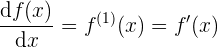
and the second derivative of a function (the derivative of the derivative), has the following alternative notations:
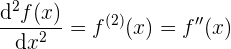
in this case, for clarity purposes, we will use the notation  for the first derivative, and
  .
.
Once the notation we will use is established, let us discuss certain characteristics that we can study of functions.
Speaking more precisely, let us learn about the criteria that informs us where a function acquires its maximum or minimum possible value within an established region, which is why they are called relative or local maxima and minima.
Review maxima and minima of functions with Superprof's private mathematics classes.


Relative Extrema
Before anything else, let us identify the type of point we wish to locate. In simple terms, these are points where a function acquires a maximum or minimum possible value, that is, in comparison to the points of a nearby neighborhood, we call this type of points relative or local extrema.
If  is a function derivable at
 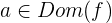 , then
  is a relative or local extremum if:


Relative Maxima
If is a function derivable at , then is a relative or local maximum if:

Relative Minima
If is a function derivable at , then is a relative or local minimum if:

Calculation of Maxima and Minima
Consider the following function 
To find the local extrema, we will follow these steps:
1Find the first derivative of the function and calculate its roots.
First, the derivative of the function:

Now its roots, solving the equation:
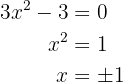
So its roots are:

2Perform the second derivative, and calculate the sign that the roots take in it.
Let us calculate the second derivative of the function:

Evaluate the roots obtained in the second derivative:
 ,
,  at
at  the function has a relative maximum
 , at
, at  the function has a relative minimum
3Calculate the image (in the function) of the relative extrema.
 , at
, at  the graph of the function has a relative maximum
 , at
, at  the graph of the function has a relative minimum
Study of Relative Extrema from Growth Analysis
If we have already studied the increasing and decreasing behavior of a function, there will be:
- A maximum at the point of the function when it changes from increasing
 to decreasing
  .
. - A minimum at the point of the function when it changes from decreasing to increasing .
Example:
Consider the following function 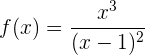
To find the local extrema, we will follow these steps:
1Find the domain of the function, the first derivative, and calculate its roots.
First, the domain of the function:
Let us find the points where the function is undefined, that is, values where 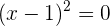
That value is , it is the value we must remove, therefore 
Now let us calculate the derivative of the function:

Now its roots, solving the equation:
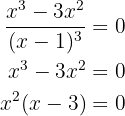
Its roots are:

2Take the values calculated and generate sectors of the real line.
Next, we take a value from each sector, evaluate it in the first derivative, and observe the signs obtained, in order to analyze the nature of the function in each sector.
Take the values calculated and generate sectors of the real line:
The values are  , so the sectors are
Evaluate an element from each sector in the first derivative:
- Let
 , then
  at
at  the function is decreasing
 - Let
 , then
  at
at  the function is increasing
 - Let
 , then
  at
at  the function is decreasing
 - Let
 , then
 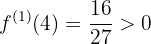 at
at  the function is increasing
In the following table we can see the information obtained:
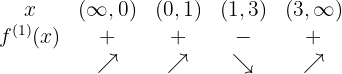
3Interpret the information and identify the maxima or minima.
We observe that two sign changes are generated. The one found from to we discard because there is an indeterminacy there.
The next sign change is from to , and since it is from decreasing to increasing, then at  there is a relative minimum.
4Evaluate the number in the function to know the point on the plane.
We see that 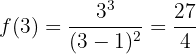 , so at the point
  , the function has a relative minimum.
Exercises to Practice
Find the maxima and minima of the following functions:

1 Find the first derivative of the function and calculate its roots.
First, the derivative of the function:

Now its roots, solving the equation:
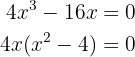
Its roots are:

2 Perform the second derivative, and calculate the sign that the roots take in it.
Let us calculate the second derivative of the function:

Evaluate the roots obtained in the second derivative:
 , at
, at  the function has a relative minimum
 , at
, at  the function has a relative minimum
3 Calculate the image (in the function) of the relative extrema.
 , at
, at  the graph of the function has a relative minimum
 , at
, at  the graph of the function has a relative maximum
 , at
, at  the graph of the function has a relative minimum

1 Find the first derivative of the function and calculate its roots.
First, the derivative of the function:

Now its roots, solving the equation:
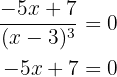
means that its root is:

2 Perform the second derivative, and calculate the sign that the roots take in it.
Let us calculate the second derivative of the function:

Evaluate the root obtained in the second derivative:
 , en the function has a relative minimum.
3 Calculate the image (in the function) of the relative extrema.
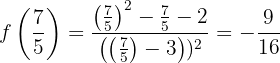
at  the graph of the function has a relative minimum

1 Find the first derivative of the function and calculate its roots.
First, the derivative of the function:

Now its roots, solving the equation:
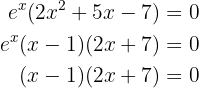
means that its roots are:
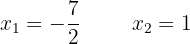
2 Perform the second derivative, and calculate the sign that the roots take in it.
Let us calculate the second derivative of the function:

Evaluate the roots obtained in the second derivative:
 , at the function has a relative minimum
3 Calculate the image (in the function) of the relative extrema.
 , at
, at 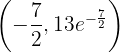 the graph of the function has a relative maximum
 , at
, at  the graph of the function has a relative minimum

In this case, it is necessary to keep in mind its domain, since it is possible that we need to discard values for not belonging to it.
In fact, it should always be done, but it is not done when it is clear what the domain is.
0. Find the domain of the function:
The domain of the natural logarithm function is when the argument is positive, so we must solve 
The solutions of  are
are  . This means we must generate the sectors
  , and from there take a number from each sector, evaluate it in
  and know the sign generated, to finally solve.

This means that the solution of the inequality, therefore the domain of the function is 
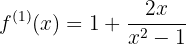
1. Find the first derivative of the function and calculate its roots.
First, the derivative of the function:
Now its roots, solving the equation:
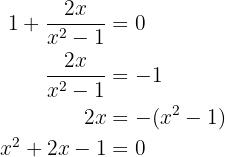
Its roots are:

We discard  since
since 
2. Perform the second derivative, and calculate the sign that the roots take in it.
Let us calculate the second derivative of the function:
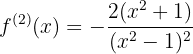
Evaluate the roots obtained in the second derivative:
 , at
, at  the graph of the function has a relative maximum

1. Find the first derivative of the function and calculate its roots.
First, the derivative of the function:

Now its roots, solving the equation:
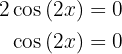
Its roots are:
 , with
2. Perform the second derivative, and calculate the sign that the roots take in it.
Let us calculate the second derivative of the function:

Evaluate the roots obtained in the second derivative:
 , at
, at  the function has a relative minimum for each
 , at
, at 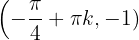 the graph of the function has a relative minimum for each
 , at
, at 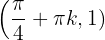 the graph of the function has a relative maximum for each
Problems
Determine ,  , and
, and  so that the function
  has a minimum at
  , and takes the value
  at and
  at .
at .
The problem translates to the following conditions occurring:


which means we must calculate the first derivative of the function:

and with this perform the evaluations:



generating a system of three by three equations:
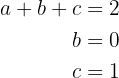
whose solution is 
Determine , , and so that the function  has a maximum at
  , a minimum at , and takes the value at .
The problem translates to the following conditions occurring:

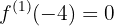
which means we must calculate the first derivative of the function:

and with this perform the evaluations:


generating a system of three by three equations:
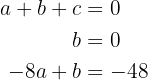
whose solution is 
Determine the value of , , , and  so that the function
  has a maximum at
  and a minimum at
  .
.
The problem translates to the following conditions occurring:


means we must calculate the first derivative of the function:

and then make the corresponding evaluations:




generating the following system of four by four equations:
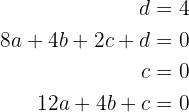
whose solution is 
Given the function: 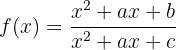
Calculate , , and , so that has a local extremum at  and the curve passes through the origin of coordinates.
The problem translates to the following conditions occurring:


means we must calculate the first derivative of the function:
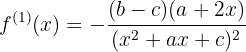
and then make the corresponding evaluations:
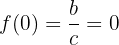


generating the following system of three by three equations:
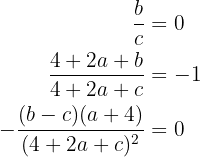
whose solution is 
Find and so that the function:  has extrema at the points
  and
and  . For those values of and , what type of extrema does the function have at and at ?
Let us calculate the first and second derivative of the function. This is to find the conditions for them to be extrema and later to know their nature.

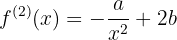
Now, since we want the function to have extrema at the points and , we establish the following equalities:


generating a system whose solution is:  and
and  .
.
We have found the values that cause the function to have extrema in the indicated place. Now let us see their nature. For this, we need the second derivative of the function:

Now let us see the nature of each extremum:
 , at , the function has a relative minimum
 , at , the function has a relative maximum
Summarize with AI:
Did you like this article? Rate it!

 Loading...