

The ACT is one of the most popular standardized tests for college admissions, along with the SAT. Many students can manage to achieve a decent result on the test with minimal preparation, but when it comes to admissions, a stellar score is much more impressive. Find out what’s on the test and how you can prepare to earn the highest possible marks to make your college application stand out.
| Section | # of Questions | Test Length (Minutes) | Avg. Minutes per Question |
|---|---|---|---|
| English | 50 | 35 | 0.7 (42 seconds) |
| Math | 45 | 50 | 1.1 (67 seconds) |
| Reading | 36 | 40 | 1.1 (67 seconds) |
| Science (Optional) | 40 | 40 | 1 |
| Writing (Optional) | 1 | 40 | 40 |


Detailed Breakdown of ACT Test Sections
The ACT experienced an overhaul in 2025. The current test format today is known as the Enhanced ACT, and the old test is called the Legacy ACT.
Now, there are three core subjects: English, math, and reading. You can opt in for the science and/or writing components, but they're not required. For some college programs, the science and/or writing portions can be valuable, so be sure to check with your prospective institutions.
Here’s what the usual schedule of the ACT sections and time looks like for the online test, so you know what to expect:
7:45 - 8 AM
Arrive at the Test Center and Check In
You will not be allowed to enter after 8 AM.
8 to 8:45 AM
Settling In
Students finish up their check-ins, get their materials, and have procedures explained to them by the proctors. You’ll be instructed on how and when to leave the testing room, depending on whether you’re taking any elective sections. Be sure to ask the proctor any questions you have before the test begins.
8:45 AM
English Test Starts (35 minutes)
The first of the three required components, English, is the first test of the day.
9:20 AM
Math Test Starts (50 minutes)
There is no break between the English and Math portions.
10:10 AM
Break
You’ll have a 15-minute break to use the restroom, stretch, and have a snack.
10:25 AM
Reading Test Starts (40 minutes)
The final mandatory section.
11:05 AM
Core Test Ends
If you aren’t taking the elective sections, you will finish the core assessment at this time and can leave.
11:15 AM
Optional Science Test Starts OR Optional Writing Test Starts (40 minutes)
There may be a brief break to allow those who are only taking the core sections to pack up and leave without disturbing the remaining students.
If you’re taking only the writing section option, you’ll take it now. If you’re taking both the science and writing portions, you’ll take the science portion first.
11:55 AM
ACT + Science OR Writing Ends
If you only take one elective section, you’ll leave the test center at this time.
Break
A short, 5-minute break at this time allows those who have finished to leave while others prepare for the final optional writing section.
~12:00 PM
Optional Writing Test Starts (40 minutes)
Only those taking the essay portion remain in the testing center.
1:00 PM
All Testing Ends
By this time, all parts of the assessment are complete.
As you can see, it takes about 5 hours to complete all 5 sections of the ACT.
If you’re taking a paper test, the times may be slightly extended to account for the passing out and collection of papers, but you can expect to be entirely done with the ACT by 1:30 PM.
Students with extra time allotments will have an extended schedule.

English Section
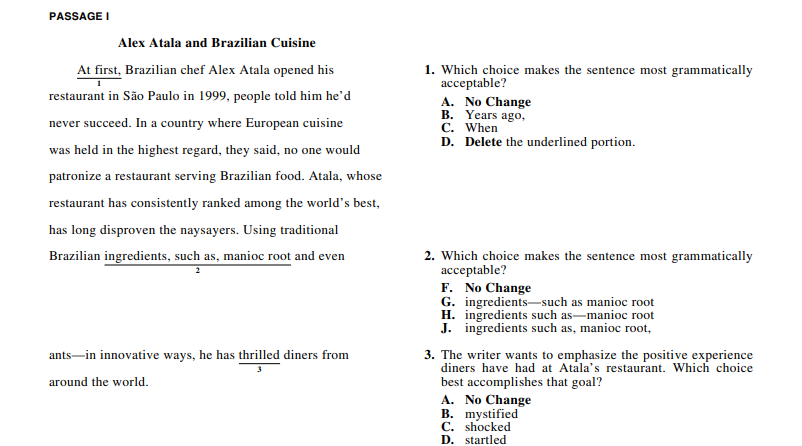
The ACT English section is designed to test understanding of the English language, including grammar, punctuation, sentence structure, usage, and organization.
Short passages, generally about 200 words in length, present associated questions that ask the test-taker to improve or correct the writing. Some questions ask about specific, underlined sentences or excerpts, and others ask about the passage as a whole.
Students must be able to quickly identify errors and wording that could be clearer, as well as which of the provided options best fix the problem. Analyzing text and thinking like an editor who can make clear, correct choices quickly is the main strategy.
Find out more about the English section and the exact things evaluated on it with our comprehensive guide to the ACT English section.
The ACT is always administered in this order: English, math, reading, optional science OR writing (if not taking science), optional writing (if taking science).
Mathematics Section
The math ACT focuses mainly on the mathematical concepts usually learned in high school up to the beginning of senior year.
Having a solid command of algebra, geometry, trigonometry, and functions is crucial. The ACT does not provide a formula sheet, so memorizing the most important formulae is imperative.
Statistics, functions, and probability are also frequent topics on the test. Being able to read mathematical models (diagrams, charts, graphs, etc.) is required.
More than memorization, students need to be able to apply different mathematical concepts to multi-step problems.
Calculators are allowed, provided they adhere to the ACT’s acceptable model rules.

Reading Section
Short passages, usually about 700 words long, pose questions that test comprehension.
Being able to understand the text beyond the surface level is required. Questions will ask about the main ideas, details, and vocabulary usage in the text, as well as require inferences.
Topics vary broadly, including literary narrative, fiction, the sciences, and the humanities.
Prepare for the assessment with our guide to the ACT reading section, including the types of prompts and questions found on the test.
ACT scores are typically released within a few weeks after your test date. Online test scores are usually available sooner than paper tests.
ACT.org
Science Section (Optional)
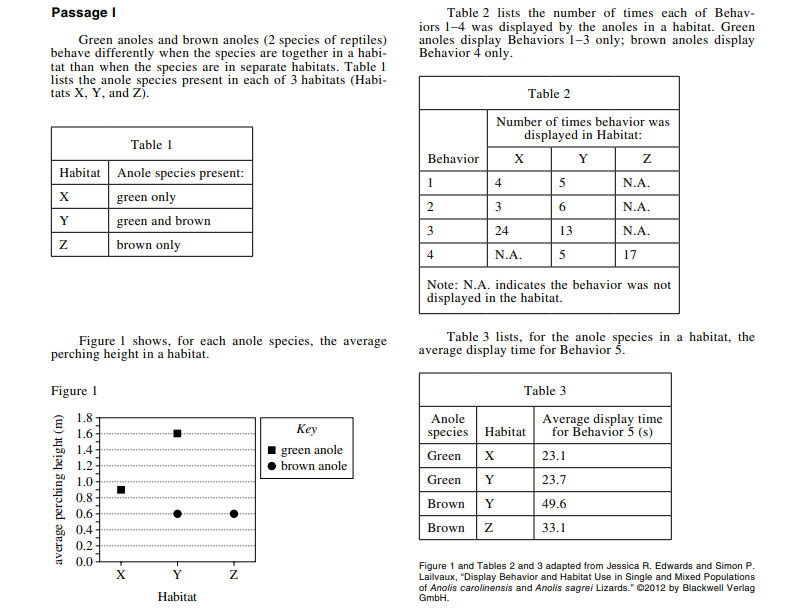
Unlike the math section, you don't need to memorize many scientific formulas or the ability to demonstrate knowledge of scientific principles. Instead, an understanding of the scientific process is helpful. They should be able to perform logical reasoning and data analysis.
Many of the questions include models, like charts, graphs, and data tables, paired with short research summaries. Test-takers are evaluated on their competency for drawing logical conclusions backed by the presented information. It’s more of an assessment of your ability to complete data analysis in scientific contexts than strictly a science test.
Writing Section (Optional)
In the essay section of the test, students are tasked with writing a response to a prompt about a divisive issue.
The topic is introduced through three opposing viewpoints. You can choose to defend one specific viewpoint or come up with your own unique perspective.
The aim is to create a clear argument backed by any available information from the prompt, any real-world knowledge the student may have, and logical opinions. It challenges you to quickly organize your ideas and effectively write in a controlled style with minimal grammar and spelling errors.
Find out how to improve your writing abilities for the ACT with our ACT writing section guide.
Effective Preparation Strategies for Each Section
Earning a desirable result on the ACT requires studying. It’s not like your usual school test, however, so special prep is necessary.
Here’s how you can improve your abilities in each section, as well as the entire ACT as a whole.
English Section
Read official practice test passages and similar texts to practice noticing grammar rules in context, rather than just trying to memorize them. Gain experience seeing the types of wording choices that make ideas clearer, and understand why they work.
Practice identifying verb tenses and agreements, modifiers, and transitions. Improve your understanding of proper punctuation use and expand your vocabulary.
Mathematics Section
Brush up on the main math topics most often tested in the math section, especially algebra, functions, geometry, and statistics. Take many practice exams to understand the types of questions typically asked so you can identify your weak areas.
Improve your ability to do mental math to reduce your calculator reliance, which can slow you down on test day.
Learn more about mastering the math ACT section with our guide!
Reading Section
Depending on the text selection and the questions, it can be helpful to read the passage first in some cases and the questions first in others. Through practice sessions, you can learn which approach works best for your brain and with which types of passages.
Answers are often designed to be nearly correct, so you need to practice identifying the exact information in the excerpt that proves an answer true or false, while filtering out irrelevant details.
Science Section
Practice examining diagrams, graphs, tables, and experiment summaries with official practice materials to improve your comprehension speed. Focus on identifying trends, patterns, and relationships in the data, so you can explain what the data actually means.
While the questions are all related to science, you don’t need to spend time memorizing facts. Instead, focus on having a deeper, logical understanding of how to interpret data and draw conclusions.
For more tips on how to prepare for the science ACT, check out our guide!
Writing Section
The only way to improve at the essay portion is to practice with other essay prompts. Reading the text, forming an opinion, and then planning a coherent argument take time. With repeated practice, you can learn how to complete those steps more quickly.
The physical writing portion is also greatly helped through repeated practice. Learning how to construct effective sentences quickly without a lot of revision is critical.
Taking multiple timed mock assessments helps you learn how to pace yourself. Study examples of high and low-scored submissions to learn what makes an answer strong or weak.
Skills for Overall ACT Prep
The ACT is a standardized test with conventions that you can learn in advance. Understanding how the ACT is worded and the types of answers the test-makers are looking for can help you have an easier time going through all the questions.
- Take timed practice assessments of each section and at least 1-2 full-length timed tests, too. Getting comfortable with the ticking clock while focusing means you can find a natural rhythm and speed.
- Taking practice exams also shows you where you lost time and accuracy, giving you specific areas to work on.
- Get familiar with the way questions and answers are presented. The way test-makers present prompts and choices is specific, and often different from what you might be used to seeing on other exams. When you understand how the test is constructed, you can avoid panicking, taking too much time on one question, and making common mistakes.
How the ACT Scoring System Works
ACT scores can range from 1 to 36 for each main section as well as the overall composite score.
Each section and each question in each section of the ACT carries the same weight. Points are awarded for correct answers, and no points are deducted for incorrect or blank answers.
The composite score is the average of each of the three mandatory components rounded to the nearest whole number. The science and writing portions do not influence the composite.
This means you should never leave a question blank, even if you don’t know the answer or if you run out of time to consider the question fully. You have a 100% chance of not earning any points on a blank answer, but a 25% (or higher, if you eliminate an obviously wrong answer) chance of earning points on a guessed answer.
A “good” ACT score depends on your individual goals. Many colleges will tell prospective applicants the average range of scores that accepted students achieve.
Of course, people generally try to earn the highest they can, even taking the test 2-3 times to try to earn higher scores.
in 2024
How Optional Tests Impact Your Score
The elective portions do not impact your composite score.
Many colleges don’t even require students to take these assessments as part of their application, which is why they are now non-essential.
Check with the admissions department for the school(s) and specific program(s) you plan to apply to to confirm if they prefer or require applicants to take these optional sections, and if so, if there’s a target score to aim for.
You determine which set of scores is sent to colleges or scholarship programs. You can choose to send either scores from a specific test, or your superscore.
ACT.org
Superscoring on the ACT
Some colleges accept “superscores,” which is a composite figure made up of the student’s very best scores in individual sections across different test dates. You can either take several attempts, trying your best in all categories each time, or spend your energy on a specific section(s) per test.
Again, check with the college(s) you want to attend to understand their policies.
For many students, the ACT is a critical part of the college application process. Knowing how to get familiar with the test and prepare for each section means you have an increased chance of getting the result you want.
References
- ACT Education Corp. (2025). Preparing for the ACT test. In Preparing for the ACT Test. https://www.act.org/content/dam/act/unsecured/documents/Preparing-for-the-ACT-e.pdf
- Allen, J., Thomas, J., Dreyer, S., Johanningmeier, S., Murano, D., & ACT Education Corp. (2026). Design framework for the ACT enhancements. https://www.act.org/content/dam/act/unsecured/documents/R2519-Design-Framework-for-the-ACT-Enhancements-2026-02.pdf
- Free ACT practice tests and prep. (n.d.). ACT. https://www.act.org/content/act/en/products-and-services/the-act/test-preparation/free-act-test-prep.html
- Preparing for the ACT - Exam sections & structure. (n.d.). ACT. https://www.act.org/content/act/en/products-and-services/the-act/test-preparation/act-exam-sections-and-structure.html
- The Princeton Review. (n.d.). The Princeton Review | Test prep, tutoring, and admissions. https://www.princetonreview.com/college/act-sections
- Waite, H. (Ed.). (n.d.). 2025 ACT Test Changes. kaptest.com. https://www.kaptest.com/study/act/test-changes-2025/
- Western Interstate Commission for Higher Education. (2024). AVERAGE ACT® TEST SCORES BY STATE GRADUATING CLASS OF 2025. ACT https://www.act.org/content/dam/act/unsecured/documents/2025-Average-ACT-Scores-by-State-Average-Score-by-Section.pdf
Summarize with AI:
Did you like this article? Leave a rating!

 Loading...