

One of the three mandatory sections of the ACT, the English assessment is designed to measure how well students understand written passages from the perspective of an editor or writer. Students must quickly read selections of text and decide whether the text is correct and clear or needs changes. Discover what to expect in the English section and study methods to help you prepare.


Understanding the ACT English Section
The purpose of the English section ACT is to measure how well students can read, understand, and edit written passages, typically as part of a college application. Grammar, usage, punctuation, rhetorical skills, and the ability to make writing clear and logical through edits are the main skills evaluated.
Unlike the reading section, the English section goes beyond simply reading passages and comprehending their content. Instead, the focus is more on structure and conveying ideas clearly.
The English section puts you in the position of a writer who makes decisions to revise and edit a text.
ACT website
Structure and Timing
The English section on the enhanced ACT consists of 50 multiple‑choice questions distributed across 6-7 passages. This is a big change from the old, pre-2025 version of the test, which had many more questions. Now, students have more time to give each answer, reducing the pressure slightly.
1-2 of the passages and their accompanying questions are Field Test Passages, which are not scored. However, they are not indicated, so you must assume that each passage is operational.
minutes
seconds
Passage lengths may vary, with the shortest being about 180 words and the longer ones reaching about 340 words. Each one is accompanied by 5-10 multiple-choice questions.
Questions are designed to assess students’ grasp of different aspects of writing and editing, especially elements and techniques of writing that convey ideas most effectively.
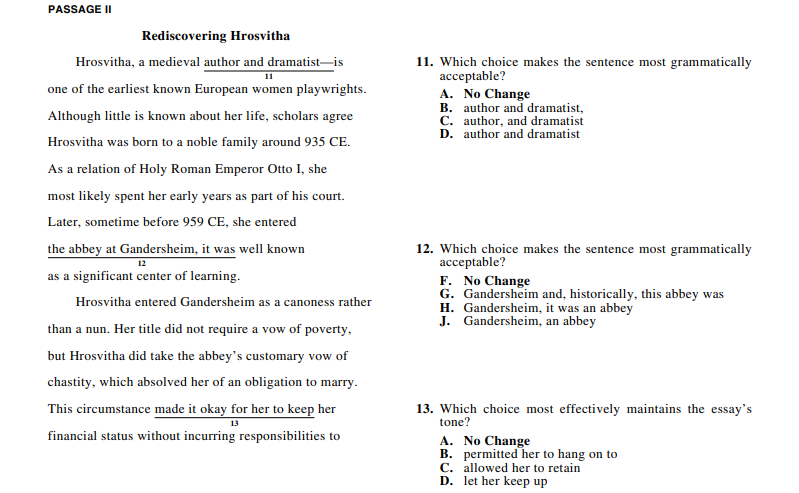
Passages may have an underlined portion that the questions will address specifically. Or, the questions may ask about the passage as a whole, in which case there may not be any underlined section.
Some prompts offer the multiple-choice option “NO CHANGE,” which may sometimes be the correct answer.
Learn about all the sections on the ACT to earn the best scores possible.

Content Areas Covered
The content present in the given text selections varies. It’s not necessary to have prior understanding of any of the presented topics; students are evaluated on their editing abilities, not on their education about various topics.
There are three main types of passages on the test:
- Informational passages: General or specific information about a topic from a subject area such as the humanities, social sciences, or natural sciences.
- Argumentative passages: Present a clear position about a focused issue, generally using a lot of examples and explanations to help the reader (the test-taker) understand enough context to answer the given questions.
- Narrative passages: Usually an excerpt from a literary text (such as a memoir or piece of fiction) and may feature a first-person perspective.
Each type of passage naturally presents opportunities for different question types.
Reporting Categories
The given questions on the assessment are designed to address three main writing and language skill categories. The main focus of all the questions is on how to make the text clearer and more organized.
Here’s how the reporting categories are distributed across the test:
| Reporting Category | % of Questions |
|---|---|
| Production of Writing | 38-43 |
| Knowledge of Language | 18-23 |
| Conventions of Standard English | 38-43 |
Production of Writing
Making up about 15-17 of the operational questions on the exam, this category focuses on organizing content to best convey the writer’s ideas. Particular focus is given to effectively supporting the passage’s purpose and meaning, and how changing the structure of an excerpt can influence the message.
Students may be asked to evaluate possible revisions that add or refine supporting details, change the order of presented information, alter transition words, and remove superfluous information from the selection.
Knowledge of Language
Focusing on clarity, precision, and effectiveness through stylistic choices, this category usually makes up 7-9 of the operational questions.
Students are tasked with deciding how to improve the excerpt’s comprehensibility and accuracy through simplification, revised phrasing, and vocabulary choices. Examining how style and word choice fit the tone and contribute to consistency through the text is also a major aspect.
Conventions of Standard English
This category typically consists of 15-17 operational questions that focus on grammar, usage, and punctuation. Students are asked to identify grammatical issues and punctuation across an entire sentence or the passage as a whole.
Being able to follow the construction of the selection through multiple paragraphs is imperative.
Discover how to prepare for the reading section of the ACT.

Effective Study Techniques for Test Takers
One of the top mistakes students make about tests like the ACT and SAT is not studying and preparing for them properly, if at all. Even the best test-taker can benefit from a few prep sessions!
For the English assessment specifically, students should brush up on the rules of grammar and language, as well as take time to understand how the test works.
Practicing with Sample Questions & Practice Tests
When you understand how the selected texts are presented, what types of questions to expect, and how the test-makers want you to answer, the pressures of test day are greatly reduced.
Use the official ACT website to complete individual practice passages during your prep. Focus on accuracy before you move on to speed.
Improve your answering abilities by:
- Writing down every mistake and its grammatical rule.
- Tracking which types of questions slow you down.
- Reviewing similar examples until the rule feels natural.
Note what types of questions are the most difficult for you to understand and why, so you can research to fill the gaps in your comprehension.
Read the reasoning behind the wrong and right answers in the answer key to build your understanding of how the topics tested in the reporting categories work.
When you’re comfortable with the test content, work on improving your speed. Remember, you only have 35 minutes to read all the selections and answer all the prompts! Being able to quickly read, comprehend, and then identify the correct answer is crucial.
Take at least two practice tests under simulated exam conditions (timed, no distractions) to check your pacing and get used to performing under pressure.
Learn how to prepare for the writing ACT section.
Understanding Grammar Rules
The English ACT is about more than memorizing vocabulary words and definitions. While that’s part of the test, it’s also imperative to understand rules about grammar, usage, punctuation, and structure.
The grammar rules that most often appear on the ACT assessment include:
- Comma use: Separate clauses with a comma + conjunction (and, but, so). Avoid commas between a subject and a verb.
- Apostrophes: Show possession (the student’s essay) or contractions (don’t, it’s). Avoid using apostrophes for multiples (❌ Two dog’s; ✅Two dogs)
- Pronoun use: Pronouns must agree in number and should be replaced with proper nouns in situations where the pronoun causes ambiguity.
- Verb tense: Keep the tense consistent within sentences and paragraphs.
- Parallel structure: Items in a list should follow the same grammatical form.
Make a cheat sheet of the grammar rules that you often make mistakes on so you can quickly refer to them in the weeks leading up to the test. Repeated exposure will ensure they eventually stick in your head.

Strengthening Reading and Revision Skills
Becoming more fluent in reading critically, with an eye for spotting errors and ways to improve writing, is a helpful skill for the English ACT.
Practice reading various texts, like news articles, scholarly publications, blogs, opinion pieces, books, and magazines, while identifying the writer’s purpose, the main ideas, and the clarity of the piece.
What tone does the writer’s structure and word choice convey? Is there a better way they could have phrased something while maintaining the style? Are the ideas clear and easy to understand?
Learning how to quickly make these observations will help you easily spot the correct answers.
English passages are written in-house, not chosen from existing content like reading passages for their appropriateness in assessing writing and language skills and to reflect students’ interests and experiences.
ACT.org
Common ACT Challenges and Skills to Overcome Them
Even with preparation, many students find the English ACT challenging. Writing and reading preferences can be subjective, which makes it difficult to choose the objectively right answer sometimes. Remembering all the grammar rules is difficult. Managing to finish the assessment under pressure from a short time limit is stressful.
Utilize these ACT English section tips to approach the exam with confidence.
Challenge: Running Out of Time
Even though many students know the material, they may end up scoring lower than anticipated because they run out of time to finish. The pace on each ACT section is borderline gruelling, and the pressure from the clock can even make you go slower than usual due to nerves.
Solution: Taking timed practice tests
Running through several timed practice tests helps you learn how to pace yourself and get comfortable with the clock in advance. Practice answering groups of questions in smaller blocks of time to keep yourself on track (for example, finish one passage with 5 questions in 7 minutes). You’ll build your internal clock to sense how long a question “should” take.
Discover tips to prepare for the math ACT section.
Yes. You are not penalized for wrong answers, so you should never leave a question blank. If possible, eliminate any wrong answers first. If you have time to go back and review the questions you guessed on, do so.
Challenge: Confusing Grammar Terms
Unless you’re an English grammar enthusiast, you may not remember terms like “dangling participle." The good news is you don't necessarily need to memorize these terms. You can learn to identify what makes a sentence more or less functional, even if you can’t name the grammar rule infraction.
Solution: Get familiar with typical usage
Focus on recognizing patterns in sentences and paragraphs that work and don’t work. Use context clues (especially easy on the ACT since it usually underlines the aspect in question) to understand the question. Read publications and practice test answer keys while studying to learn about typical and proper language usage.
Challenge: Misreading Questions
The English ACT often phrases questions indirectly, asking for the most effective or clearest answer among multiple correct-looking options. Small details in the question’s wording change the meaning.
Solution: Calmly evaluating the prompt and multiple-choice answers
Carefully look for keywords in the question like “best,” “most,” or “least.” Make sure you fully reread the sentence or paragraph with your choice inserted to make sure it still makes sense in context.
Challenge: Overthinking “Style” Questions
Questions that ask the student to choose a more concise answer, maintain the tone, or fit the writer’s goal can be jarring. It’s easy to assume the longest answer is the most formal, or make other assumptions.
Solution: Having confidence and checking the answers carefully
Typically, the most succinct, straightforward answer is the best. The ACT usually looks for writing that is smooth and avoids clutter, instead of flowery or poetic phrasing. Simply check each answer in situ and see if it fits the tone of the surrounding text.
Get tips and strategies for the science portion of the ACT.
Challenge: Not Knowing How to Prep
Not everyone knows how to self-study and prep, especially for unusual tests like the ACT and SAT. Since these exams impact your ability to get into the college program you want, it's important to treat them seriously.
Solution: Devising a study plan
If you need help getting ready for the English ACT or any other ACT section test, consider tutoring. Tutoring can get you test-ready quickly and effectively, so you can stress less about assessments while scoring high.
The ACT can feel like a nerve-wracking assessment. To mitigate issues, simply spend a few hours in the weeks leading up to the exam taking practice tests and reading why the answers are right or wrong. Familiarity and repetition are the best tools for this type of assessment. With a little preparation, students can more easily find success and high scores on the English ACT.
📝 What part of the English ACT is most challenging?
References
- ACT Education Corp. (2025). Preparing for the ACT test. In Preparing for the ACT Test. https://www.act.org/content/dam/act/unsecured/documents/Preparing-for-the-ACT-e.pdf
- Allen, J., Thomas, J., Dreyer, S., Johanningmeier, S., Murano, D., & ACT Education Corp. (2026). Design framework for the ACT enhancements. https://www.act.org/content/dam/act/unsecured/documents/R2519-Design-Framework-for-the-ACT-Enhancements-2026-02.pdf
- Description of English Test. (n.d.). ACT. https://www.act.org/content/act/en/products-and-services/the-act/test-preparation/description-of-english-test.html
- Laszlo, S. (2026, March 27). What to expect on the enhanced ACT English Test (2026) - Test Innovators. Test Innovators. https://testinnovators.com/blog/act-english/
Summarize with AI:
Did you like this article? Leave a rating!

 Loading...