

When preparing for the ACT, students need to know how to tackle the expectations in each section. Although the Writing Test is optional, many students choose to complete it to boost their college applications. Find out how to craft a high-scoring essay for the writing ACT.


What Is the ACT Writing Section?
The ACT Writing Test is an optional essay. Like the SAT, the long-form written section of the test was widely retired in recent years. Though, depending on your state, you may need to take the test as part of state education requirements.
Students are given a prompt to analyze and are asked to take a clear stance and construct a coherent argument with reasons and examples, demonstrating their understanding of English Language Arts (ELA).
Yes, however, it’s an optional section. Students can choose to add the written portion to their test to bolster their college and university applications, especially if their degree program involves ELA.
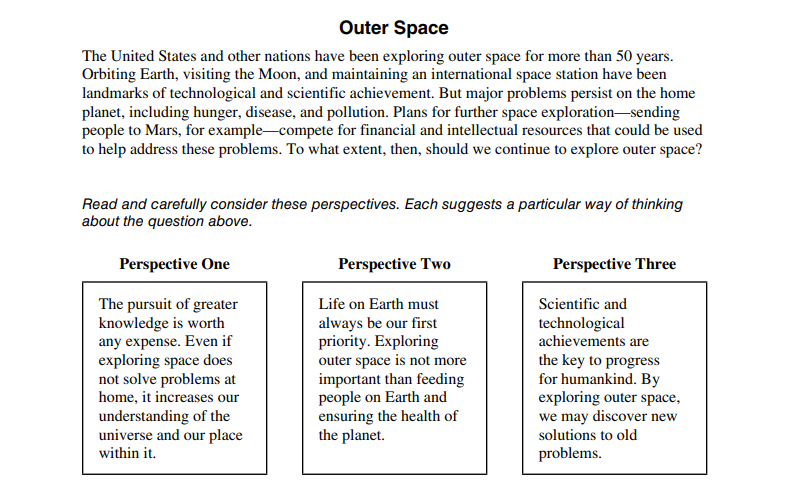
The prompt describes a complex issue and presents three different perspectives on the issue. Students then develop their own stance and write an essay that compares and contrasts their perspective against the ones given in the prompt.
The student aims to create a cohesive response that demonstrates logical, clear reasoning and an organized structure in delivering the information. The test aims to measure how well the student can absorb new information, organize their thoughts, and write academically under pressure. It can be a helpful skill that prepares students for college-level writing.
Learn how to approach the ACT reading section.

Is the ACT Writing Section Required?
For most students, the Writing Test on the ACT is not required. It’s an optional portion that students can elect to take after finishing the core tests of English, Reading, and Math.
Very few colleges require applicants to submit scores from the ACT written test. You may need to reach out to your prospective college or university’s admissions department to ask is the writing section of the ACT required or considered important.
Most colleges favor application essays instead, but providing both a good score on the written ACT and a well-constructed admissions essay can earn you an edge into your desired schools.
No. Whether you take the writing test or not, it does not affect your composite score; the writing portion is scored on its own.
Another reason to take the ACT writing test is to earn scholarships. Students can search the ACT website for scholarships relating to the writing portion. Certain colleges and local or private initiatives may also provide scholarship opportunities for students who score well on the writing portion.
The Writing Test does not impact your ACT composite score, but it may be important for your college application, so you should always try your best if you’re completing the written portion.
Structure and Timing of the ACT Writing Section
The Writing Test for the ACT is 40 minutes long and takes place after you’ve completed the three main sections of the test and/or the optional science test portion.
There is only one essay question in the test.
Students are presented with a concept and information about three differing perspectives on the concept. Then, students must digest the information and develop their own perspective on the issue. The essay should be about the student’s perspective compared and contrasted with the three given perspectives and the issue as a whole. Students are allowed to come up with a unique perspective or adopt one (or more) of the given perspectives in whole or in part.
The essay is not about choosing the “correct” viewpoint; it’s about being able to craft a cohesive essay in a short time.
The ACT writing test is 40 minutes long and consists of only 1 essay question.
These topics are examples of the types of prompts that are found on the ACT essay test:
- Intelligent machines and whether they’re helpful in society
- Extracurricular activities and what code of conduct should be expected within them
- Climate change and its veracity, as well as who has responsibility for making changes, if any
- Medical care access and costs
Generally, ACT writing prompts cover a timely, relevant topic that has room for varying strong opinions. Students choose an opinion to defend and can draw on examples they’ve witnessed or learned in real life as evidence.
Discover tips for taking the English ACT test section.

How to Spend Your 40 Minutes in the ACT Writing Test
Many students get tripped up in the ACT and other standardized tests, like the SAT, because of the pressure induced by the short time limit. The best way to mitigate stress is by practicing in advance with simulated essay tests.
We’ll cover strategies for studying for the writing ACT in the next section, but for now, keep this suggested timeline in mind for test day.
Minutes 0-5
Get Situated and Gather Information
Take a deep breath so you can focus on actually absorbing the words you’re reading. Quickly, yet thoroughly, read the essay prompt and the provided perspectives.
Minutes 5-15
Parse Information and Develop a Plan
Re-read the prompt and make notes (underline, circle, or highlight) about the important parts of the question and perspectives, as well as the parts that inspire your ideas.
In the planning space, jot down short sentences or bullet points to organize your thoughts. Note ideas and supporting evidence in a clear, concise way. Create a simple essay outline following a typical 5-paragraph structure.
It’s better to spend a little more time planning since it will help you stay on track in your essay writing, saving more time in the long run.
Minutes 15-35
Craft Your Essay
Take your time in composing a well-phrased, well-thought-out essay with minimal spelling and grammar errors. Some errors are unlikely to negatively impact your score, but consistent errors may.
Minutes 35-40
Proofreading
Re-read your essay and make any changes as needed. If one of your sections becomes too messy/full of corrections, rewrite it at the end of the page. Make a note in between the lines (not in the margins) indicating the paragraph was moved to the end of the essay.
ACT Writing Section Scoring
The ACT writing test is scored in four areas:
- Ideas and Analysis
- Development and Support
- Organization
- Language Use
Each area is scored on a scale from 1 to 6. The final score is the average of the total from the four domains. The purpose of the exercise is for students to demonstrate their mastery of ELA.
Here’s a quick review of what test-scorers are looking for when grading ACT essays.
Ideas and Analysis
- ✅ Writer’s ability to understand the issue and convey an understanding of the purpose of writing.
- Did the student present a clear stance (thesis) on the subject?
- Did the writer present multiple clear points of examination in support of their argument?
Development and Support
- ✅ Writer’s ability to explain and explore their ideas in a way that helps the reader understand the issue.
- How well did the writer present their arguments?
- How well did the writer connect their argument points with their reasoning and with the original content?
- How effective and persuasive are the arguments given?
- Did the writer present nuance or contradiction in a reasonable, clear manner (as opposed to confusing or murky)?
As you write, ask yourself if your logic is clear, if you have supported your claims, and if you have chosen precise words to communicate your ideas.
ACT.org
Organization
- ✅ Writer’s ability to arrange their essay clearly, displaying purpose and cohesive ideas.
- Did the writer stay on track throughout the entire essay?
- Did the writer effectively transition between ideas?
- How well did the writer build upon each idea, showing that each separate thought strengthens the others?
Language Use
- ✅ Writer’s use of grammar, syntax, word choice, mechanics, and tone to convey clear ideas.
- Did the writer use precise, effective, varied vocabulary?
- How clear are the sentences; do they effectively convey the idea contained within?
- How did the writer use language to convey emotion and/or authority about the argument?
- Did the writer avoid most spelling, grammar, and punctuation errors?
For a more in-depth explanation of what constitutes the different scores, read the extended analysis on the ACT website. The highest total score a student can earn on the essay is a 12, and the lowest is a 6.
Preparing for the ACT Writing Section
Now that you know a little more about the expectations in an ACT essay, you can work on developing the required skills. Even though the ACT essay is optional, being able to analyze information and quickly come up with ideas about it well enough to write or speak on the issue is a valuable life skill in academia and beyond; it’s worth practicing!
Understand the Rubric
As mentioned above, the experts who read and score the ACT essays are looking for specific qualities. Review the information about scoring on the official ACT website to understand what qualities you need to develop in your writing style.
Approaching the essay with certain content targets in mind helps you stay on track and feel confident about what you’re putting on the page. There are many ways to write essays; the ACT essay is only one specific style.
Read example questions and sample answers. Read the scoring and explanations given for each score level to understand what to avoid and what to aim for.
Here are the scores you can achieve on the essay portion, and what percentile they translate to:
| ACT Essay Total Score | Percentile |
|---|---|
| 12 | 100 |
| 11 | 99 |
| 10 | 99 |
| 9 | 97 |
| 8 | 93 |
| 7 | 74 |
| 6 | 61 |
| 5 | 34 |
| 4 | 21 |
| 3 | 9 |
| 2 | 4 |
Get Familiar with Essay Questions
Read example questions to understand how the information is presented. Practice quickly absorbing information and forming opinions and ideas based on the given text and perspectives.
Learn how to identify the crux of the issue and develop your own perspective quickly. The perspective you choose in your essay doesn’t necessarily need to be the opinion you hold in your real life; you just need to be able to pick a perspective you can quickly and effectively defend in the time given.
Find out how to prepare for the math ACT.
Practice Planning Quickly
Many students struggle and lose minutes because they didn’t spend enough time planning their outline and organizing their arguments in advance. This leads the writer to lose track of what they’re trying to convey, resulting in convoluted sentences and wasted time.
Planning is a critical part of the essay process, especially in the restrictive ACT environment. Practice quickly transcribing your ideas into easy-to-remember bullet points you can refer back to while composing.
Included with the prompt are planning questions that will help you analyze the different perspectives and develop your own.
ACT.org
Learn how to list the important aspects, omit weaker arguments, and note your supporting evidence effectively.
The best responses are specific and concise, relying on logic and information rather than appeals to emotion.
Many high-scoring essays use an introduction, two or three body paragraphs, and a conclusion. However, the exact number of paragraphs is less important than argument soundness and composition quality. No matter what, the essay should have a beginning, middle, and end.
Learn to Indicate Specific Examples
Do not use general statements throughout the entire essay. Writers should use specific examples that demonstrate a clear understanding of the topic and information given, as well as critical thinking and the ability to convey ideas.
Most essays will require you to draw on experiences from school and classes, history, current events, and/or personal experience. Any examples that back up your idea are valid; they don’t need to be dramatic to be effective.
Instead of saying an idea is important, demonstrate how it’s important using these examples.
Learn which techniques you need to prepare for the science ACT.
Brush Up Your Writing Skills
Clarity, directness, and brevity are rewarded in the ACT essay rubric. Avoid being overly formal or flowery; a touch of formality or poetry with sophisticated words can be effective if used well, but overall, focus on more straightforward phrases and show that you can explain complicated ideas simply. Use effective transitions rather than putting more than one idea in a sentence or paragraph.
The essay scorers know you’re writing against the clock. They aren’t looking for a highly polished essay. They’re looking for effective thinking and communication.
That said, it helps to expand your vocabulary so you can express ideas with fewer words and avoid repeating yourself too much.
Reading in general is a good way to improve your own skills. Read sample essays, books, news articles, blogs, etc. Note the words and sentence structures that are effective, and those that aren’t. Think about whether their arguments are well-supported by their essay, and if they aren’t, identify why so you can avoid the same mistakes.
Create Effective Opening and Closing Statements
The introduction and conclusion are just as important as the supporting information in the middle of your essay.
A strong opening clearly states your position and prepares the reader for the explanation to follow. A successful conclusion reiterates your ideas and ties them all together.
Making both cohesive with the rest of the text shows you thought about your stance thoroughly and had a clear idea going into penning the first sentence.
Find out how ACT scoring works and more!
Practice Under Test Conditions
After polishing your comprehension, planning, and composition skills, the next step is to practice physically writing faster.

The written ACT will require you to handwrite your essay, so you’ll need to have legible handwriting and be able to write fast enough to get all your ideas down quickly.
Many students also struggle with hand cramping, so taking time to practice using less force on the pencil can be helpful.
If you're taking the digital ACT on a computer, improve your typing skills by focusing on reducing errors and increasing speed.
Overall, you want to practice reading the prompt, coming up with a plan, and executing an essay in 40 minutes.
Going through this process a few times before test day will help you understand which aspects you struggle with most, so you can focus more on those things. You’ll also tune your internal clock to be better able to track the minutes passing and perform accordingly, reducing stress.
Re-read your essays and grade them against the rubric (perhaps with the help of a friend, parent, or teacher). Make note of any improvements you need to work on, and continue to practice.
The writing ACT is an optional test, but if you're going through the trouble of completing it, you may as well do the very best you possibly can!
References
- Laszlo, S. (2026, January 7). FAQS: The Ins and Outs of the ACT. Scoir. https://www.scoir.com/blog/act-ins-and-outs
- Review, P. (2025, June 12). How long is the ACT? The Princeton Review. https://www.princetonreview.com/college-advice/how-long-is-the-act
- Writing test prep. (n.d.). ACT. https://www.act.org/content/act/en/products-and-services/the-act/test-preparation/writing-test-prep.html
Summarize with AI:
Did you like this article? Leave a rating!

 Loading...