

The ACT science section often confuses students who expect the test to be strictly about existing scientific knowledge. In reality, the test assesses students’ abilities in reading, data interpretation, reasoning, and performance under pressure. For some students, the science ACT is an important part of college admissions.


Understanding the ACT Science Section
The science portion of the ACT does not examine your ability to learn or memorize information that you learn in school or elsewhere.
Instead, it measures your ability to interpret data, analyze experiments, and evaluate scientific arguments. The focus is on how you think and how well you understand scientific reasoning and processes.
It’s important to develop your skills in being able to read, interpret, and draw conclusions from new information under a time limit.
Find out how to prepare for the math ACT section.
Format and Structure
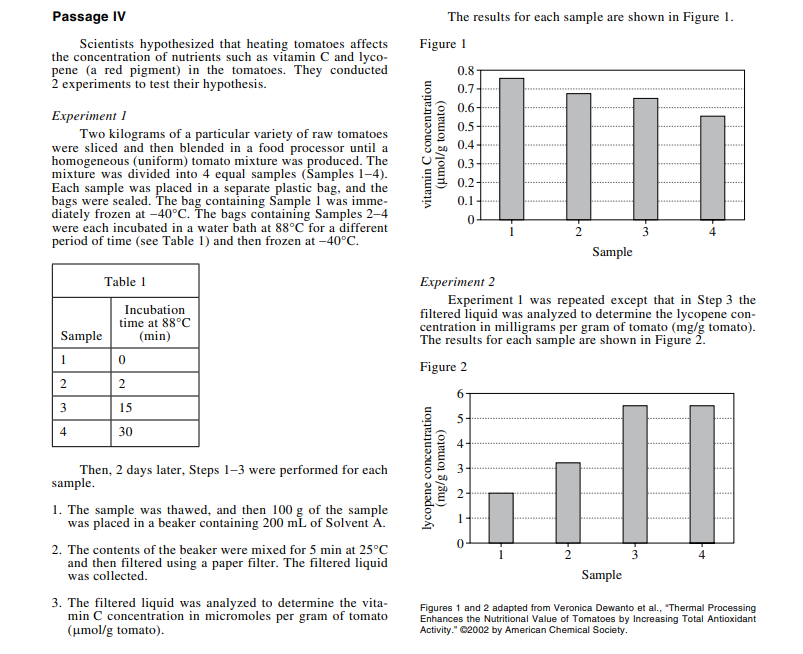
This ACT section consists of 7 passages, which are like small case studies that present scientific information in paragraph form, with some including charts, tables, and graphs.
Six of the passages are scored, and one passage is an unscored Field Test Passage.
multiple-choice questions
minutes to answer the questions
There are three types of passages included in each version of the test:
- Data Representation: Information is primarily presented through tables, graphs, and/or charts.
- Research Summaries: Text-based selections that describe scientific investigations, including experiment design and methods, hypotheses, and results.
- Conflicting Viewpoints: Text and/or models that present differing explanations about a scientific topic.
Each type of passage presents opportunities for different types of questions designed to assess specific skills.

There are three main areas of assessment (known as reporting categories) that the questions aim to address:
Interpretation of Data
Making up 38-50% of all questions, the focus is on reading and analyzing the text and models. Students must demonstrate their ability to interpolate (calculate figures not already given) and extrapolate information, translate data into models, recognize trends, and otherwise digest the data into different forms.
Scientific Investigation
Often the smallest part of the assessment, making up 18-32% of all questions, students are tasked with demonstrating knowledge of the scientific process. This includes identifying parts of experiments like controls, variables, tools, and procedures, as well as making predictions about repeated experiments.
Evaluation of Scientific Arguments and Models with Evidence
Students must evaluate presented data, including experiment procedures, for validity. Making up 24-38% of questions on the test, students must think critically to determine if an experiment is sound and if the presented conclusions can be backed up by the given information.
The science ACT consists of seven passages, each with several multiple-choice questions. In total, there are 40 questions, and students have 40 minutes to complete the assessment.
Note that the passages give students all the information they need for the test. Having background information on different topics can be helpful for contextual reasons, but the most important thing is having knowledge about the scientific process and how to analyze data.
To compare the science ACT with the SAT, the SAT does not have a dedicated scientific analysis test; instead, scientific questions are mixed in with reading and math sections.
If you’re pursuing a degree in STEM, the science ACT can be more valuable than the SAT.
Learn how to give yourself the best chance of getting a good score on the English ACT.
The science section measures the interpretation, analysis, evaluation, reasoning, and problemsolving skills required in the natural sciences.
ACT.org
Content Areas Covered
Even though you don’t need to know any specific scientific subject in-depth, it helps to have some level of knowledge in a variety of topics. Having the right foundational knowledge of a subject can help you read and interpret the presented information faster.
The topics included on every ACT science test include:
- Biology
- Chemistry
- Earth/ space sciences (e.g., geology, astronomy, and meteorology)
- Physics
Additionally, up to three questions may have a focus on engineering and design thinking, asking students to apply the information in real-world situations.
Again, all the information you need for the exam’s questions is presented in the passages and models. So, a deep understanding of chemistry is less important than knowing how to read a chart and analyze data to draw conclusions. For example, instead of asking you to explain a chemical reaction, a question may ask you to identify which graph shows the correct trend given the information in the passage.
Recent Changes to the ACT Science Section
The entire ACT underwent a major overhaul in 2025. Sections were shortened in length, giving students more time on average per question while reducing the overall test duration. Some parts of the assessment were made optional, and colleges generally tell students if they should take the optional sections for their applications.
Optional Status
One of the biggest recent changes was that the science portion became optional.
If you choose to take the science ACT, it will take place after you’ve taken the three required sections: math, English, and reading.
No. In the new ACT format, the science section is optional.
The decision to make the assessment optional aligns with evolving trends in standardized testing and college admissions processes. Many colleges are looking beyond exam scores, or not looking at them at all, making them superfluous for many students.
Some colleges or college programs, particularly in STEM, may require or urge applicants to take the science ACT. In some cases, it can add a competitive edge to your application even if it’s not required.
Test Duration Adjustments
The old version of the ACT allowed students 35 minutes to answer all 40 questions, giving them an average of 53 seconds to spend per question. Now, students have 40 minutes to answer all 40 questions, increasing the average time per question to 1 minute.
Additionally, since the entire section is now optional, students may spend much less time testing if they do not take the optional portion(s).
The writing section is now optional as well, so even if you do want to take the science exam, you can avoid spending 40 more minutes on the writing portion if you don’t want to take it.

Should You Take the ACT Science Section?
Signing up for the science ACT depends on your specific goals and college plans.
College programs in scientific disciplines, like chemistry, biology, and engineering, may highly value a strong science ACT score. A solid number demonstrates a student’s abilities in scientific reasoning, working with data, and understanding experiments.
If you aren’t applying to a scientific or STEM program, or if the colleges you are applying to don’t value the science ACT score, you might be able to comfortably skip the test. Providing ACT or SAT scores in other areas may be suitable.
Effective Preparation Strategies to Ace the Science Section
Like other standardized tests, studying for the science ACT requires students to prep with specific methods.
Rather than learning specific topics, your study plan needs to focus on increasing reading speed, understanding the format itself, and the pressure that comes with time limits.
Some material will present conflicting viewpoints, and the questions will ask you to distinguish among them.
ACT.org
Prep with Official ACT Materials
To get familiar with the way the passages are presented, the types of questions asked about the given information, and how the test-makers expect you to answer, there’s no other way than practicing with official ACT science questions.
To make the most of your study sessions:
- Start by going through passages at your own pace, learning how to recognize the most important information and how to read the various types of charts given.
- Carefully examine each answer, identifying which key words make the answer either right or wrong by cross-referencing all the given information. Choose the answer you believe is right, and check with the answer key.
- Read the answer key’s explanations for why each answer is either right or wrong, learning what the test-makers are looking for.
- Note which types of questions you struggle with the most and spend more time practicing those types. Common mistakes include misreading text, misinterpreting a chart/graph/table, not understanding a trend, and not understanding what makes an experiment sound or unsound.
Be sure to practice interpreting the given visual elements, so you can more quickly understand the axis, units, labels, etc., on exam day. Learn how to infer trends and make comparisons with the information presented.
Discover how to practice for the ACT Reading section.
Gain Background Science Knowledge
Although it’s not imperative to have a wide range of specific knowledge going into the test, it can certainly help. Having foundational biology, chemistry, Earth science, and engineering knowledge means you might be able to spend less time comprehending a passage to the point where you can formulate an answer.
Even if none of the questions address any specific things you already know, being familiar with science is an important and helpful skill.
Practice Under Test Conditions
The hardest part of these types of assessments is usually the strict time limit.
After you familiarize yourself with the test’s format and hone your answering skills, you must increase your speed. First, practice answering at a rate of one question per minute. When that feels more natural, increase the number of questions you answer per practice session.
Complete 1-2 full-length practice exams before exam day to get a solid sense of how long you should spend reading passages and answering questions. This way, you’ll be able to navigate the assessment without glancing at the clock too much.
Discover more about the ACT test as a whole.
On the ACT, you don’t lose any points for wrong answers, so it’s best to answer every question even if you aren’t sure of the correct choice. Try to eliminate any obviously wrong answers and make an educated guess.
Prep with Tutoring
Tutoring can help students prepare for the science ACT or any other ACT section. With guidance from a professional tutor, you can stay on track with your study plan, improving your test-taking abilities at an efficient and comfortable pace.
Getting valuable feedback from a tutor about your struggles in the test is a great way to improve your performance and confidence.
The science ACT asks students to approach new data with an analytical mind. The aim is to examine students’ abilities to understand information and apply it in different ways. It can be an important part of college applications for certain students, while others can decide to skip the hassle.
🧪 Do you plan on taking the science ACT?
References
- ACT Education Corp. (2025). Preparing for the ACT test. In Preparing for the ACT Test. https://www.act.org/content/dam/act/unsecured/documents/Preparing-for-the-ACT-e.pdf
- ACT Science Section Test tips. (n.d.). ACT. https://www.act.org/content/act/en/students-and-parents/high-school-success/testing-advice-for-the-act/act-science-test-tips.html
- Allen, J., Thomas, J., Dreyer, S., Johanningmeier, S., Murano, D., & ACT Education Corp. (2026). Design framework for the ACT enhancements. https://www.act.org/content/dam/act/unsecured/documents/R2519-Design-Framework-for-the-ACT-Enhancements-2026-02.pdf
- Description of science test. (n.d.). ACT. https://www.act.org/content/act/en/products-and-services/the-act/test-preparation/description-of-science-test.html
- Laszlo, S. (2026, March 27). What to expect on the enhanced ACT Science Test (2026) - Test Innovators. Test Innovators. https://testinnovators.com/blog/act-science/
Summarize with AI:
Did you like this article? Leave a rating!

 Loading...