


Analogical reasoning definition
Analogical reasoning, also known as analogical argument or argument by analogy, suggests that if two or more things are similar in one way, they are probably similar in other ways.
Using analogies can explain or clarify an object or idea through comparison. Analogical reasoning uses analogies to persuade or make an argument.
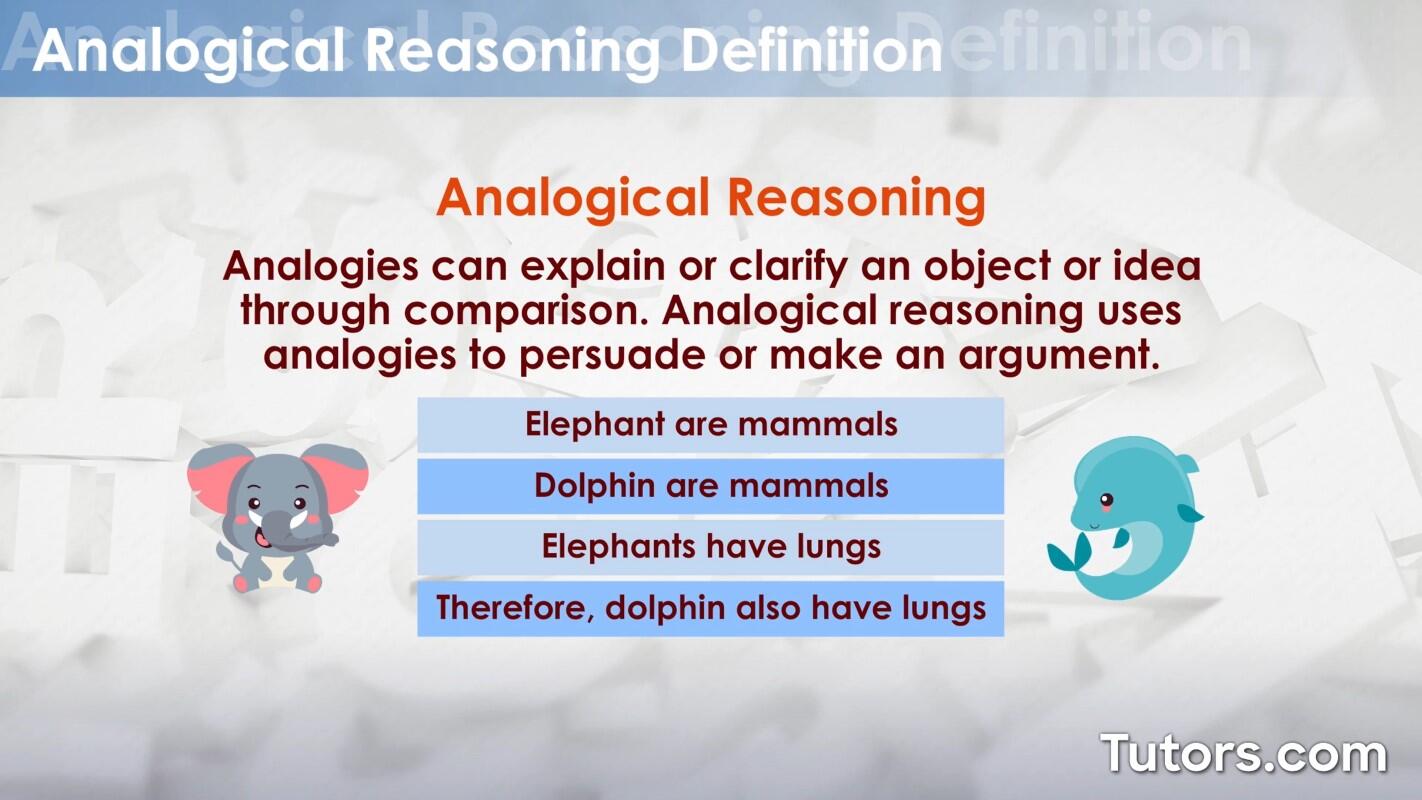
There are typically two to three premises in an analogical argument, which ultimately identify the analogy. Those premises are then used to come to some conclusion.
The analogical argument would then be structured as follows:
| Premise 1 | Object A has traits 1, 2, and 3. |
| Premise 2 | Object B has traits 1, 2, and 3. |
| Premise 3 | Object A also has trait 4. |
| Conclusion | Therefore, Object B also has trait 4. |
Analogical thinking
Analogical thinking is when someone uses information from one area to help with problem-solving in another area. Through this type of critical thinking, several everyday items made their way into production thanks to technology developed by NASA.
Companies took the technology developed for space exploration and found ways to transform it, creating real-world products widely used today. Items such as memory foam, baby formula, thermometers, invisible braces, and even the Super Soaker exist today due to analogical problem solving.
Argument by analogy examples
The first step in creating an analogical argument is to determine how the two things are similar. Then determine if those similarities support the conclusion. Consider these examples:
| Example 1 | Example 2 | Example 3 | |
|---|---|---|---|
| Premise 1 | Water is slippery. | A chimpanzee's brain is capable of reasoned thought. | News reporters report facts. |
| Premise 2 | Oil is slippery. | A human brain is capable of reasoned thought. | Weather reporters report facts. |
| Premise 3 | It is possible to slip on water and fall. | The new medication strengthened the memories of chimpanzees. | People do not blame weather reporters for bad weather. |
| Conclusion | Therefore, it is also possible to slip on oil and fall. | Therefore, the new medication will also strengthen the memories of humans. | Therefore, people should not blame news reporters for bad news. |
Analogical induction
Argument by use of analogy can be made through inductive reasoning, meaning it creates an assumption based on the identified similarities. While the premises are typically accurate, the conclusions based on the similarities may or may not be correct. The following uses analogical induction and produces a potentially inaccurate conclusion:
| Premise 1 | The marble pulled from the bag is blue. |
| Premise 2 | The second marble pulled from the bag is also blue. |
| Premise 3 | Both marbles are from the bag. |
| Conclusion | Therefore, all of the marbles in the bag are blue. |
Deductive analogy
Analogical arguments can also be made through deductive reasoning. Through this approach, the premises lead to a correct conclusion. The following uses analogical deduction:
| Analogy | Water is analogous to juice. |
| Explanation | Water and juice are both liquids. |
| Premise | If you carelessly walk on a floor with water on it, you will slip. |
| Premise | If you carelessly walk on a floor with any liquid on it, you will slip. |
| Conclusion | Therefore, if you carelessly walk on a floor with juice on it, you will slip. |
False analogy
Analogical arguments must be checked to make sure the conclusion is accurate. Sometimes the argument creates a false analogy where the similarities between the two things lead to an invalid conclusion. Consider the following:
| Premise 1 | Tyler drives a truck and is a teacher. |
| Premise 2 | Zachary drives a truck. |
| Premise 3 | Tyler is a teacher. |
| Conclusion | Therefore, Zachary too must be a teacher. |
Summarize with AI:
Did you like this article? Rate it!

 Loading...