


What is an apostrophe as a literary device?
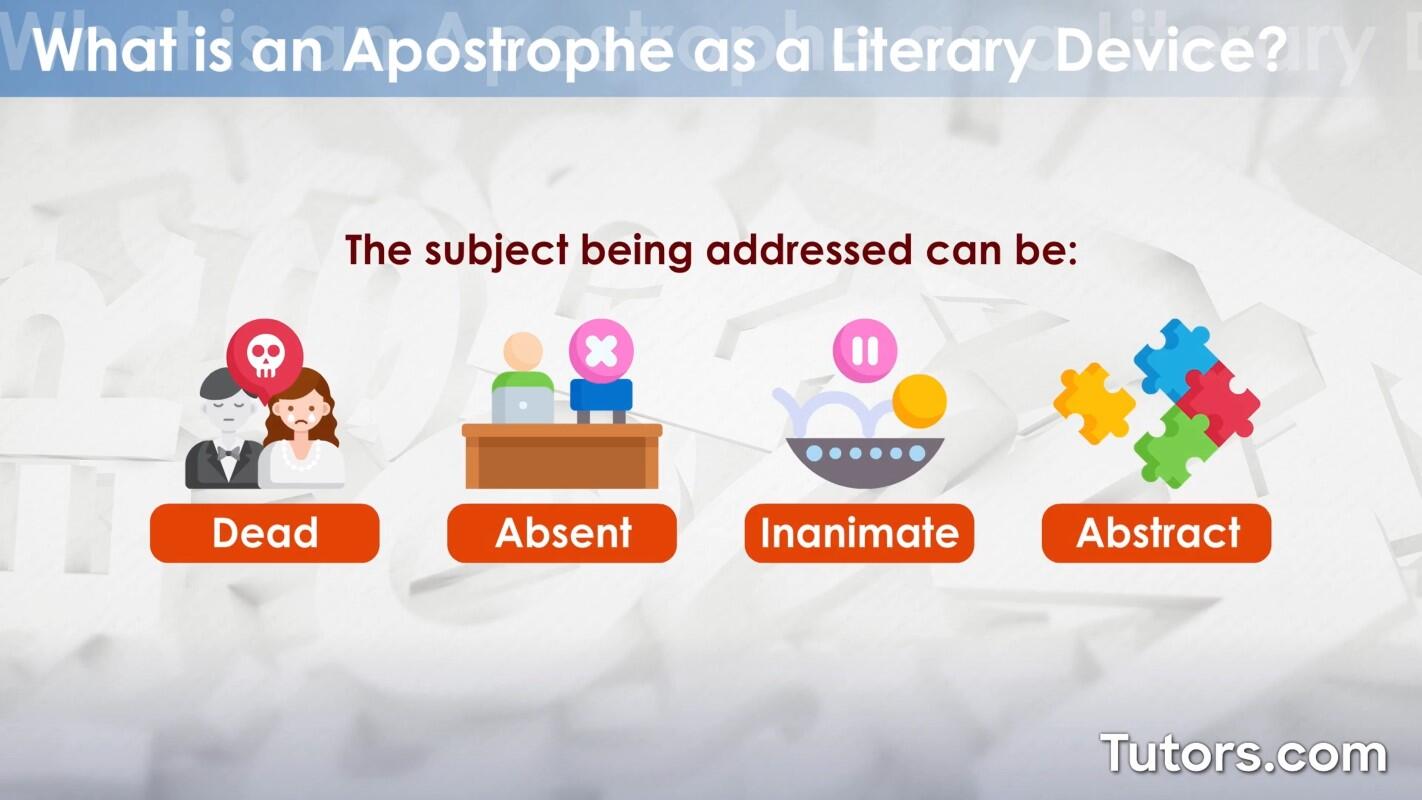
An apostrophe is a literary device writers use to address someone or something that is not physically present. The subject may be dead, absent, inanimate, or abstract.
The literary device should not be confused with the punctuation mark. As a punctuation mark, the apostrophe forms contractions (e.g., cannot = can’t) or shows possession (e.g., Mike’s dog).
An apostrophe refers to an address to someone or something not physically present.
The subject being addressed can be dead, absent, inanimate, or abstract.
The literary device is used both in everyday language and literary works.
Apostrophe as a figure of speech does not relate to the apostrophe as a punctuation mark.
Functions of an apostrophe
The function of an apostrophe depends upon who or what is being addressed:
| Subject | Description | Function | Use |
|---|---|---|---|
| Dead | Addressing someone who has died | Highlights the impact the person has had on the speaker, whether good or bad | • Conversing with a dead loved one • “Grandma, I know you’ll always be with me.” |
| Absent | Speaking to a person who is alive, but not physically present | Allows the character to speak about the subject without reservation | • Questioning someone who is absent • “Sally, why do you never answer your phone?” |
| Inanimate | Talking directly to an inanimate object; these objects are typically personified (given human characteristics) | Emphasizes the importance of the object to the speaker by using human characteristics | • Addressing a stoplight • “Why won’t you turn green!?” |
| Abstract | Addressing an abstraction such as an emotion (love) or event (death) | Allows the speaker to grasp or present the abstraction in human terms that are easier to understand | • Speaking directly to a personified emotion • “Love, you can be so cruel.” |
Apostrophe examples
The following examples illustrate the use of apostrophes in everyday speech, film, and music:
| Subject Type | Example | Subject | Source |
|---|---|---|---|
| Dead | “Dad, I know you are in a better place.” | Dad | Everyday speech |
| Absent | “John, where are you hiding?” | John | Everyday speech |
| Inanimate | “Don’t worry Wilson, I’ll do all the paddling. You just hang on.” | Wilson the volleyball | Tom Hanks in Castaway |
| Abstract | “Hello darkness, my old friend / I’ve come to talk with you again.” | Darkness | “The Sound of Silence” by Simon and Garfunkel |
Apostrophe examples in poetry
Examples of apostrophes in poetry include the following:
| Subject Type | Example | Subject | Source |
|---|---|---|---|
| Dead | “O Captain! My Captain! Our fearful trip is done” | Remembering Abraham Lincoln and his untimely death | “O Captain! My Captain” by Walt Whitman |
| Absent | “Wild nights - Wild nights! / Were I with thee / Wild nights should be / Our luxury!” | Thinking of an absent lover | “Wild night – Wild nights” by Emily Dickinson |
| Inanimate | “Sylvan historian, who canst thus express / A flowery tale more sweetly than our rhyme.” | Speaks to the images found on a Greek urn | “Ode on a Grecian Urn” by John Keats |
| Abstract | “Death, be not proud, though some have called thee / Mighty and dreadful, for thou art not so.” | Directly addresses death as a personified being | “Death Be Not Proud” by John Donne |
Apostrophe examples in literature
Examples of apostrophes from literature include the following:
| Subject Type | Example | Subject | Source |
|---|---|---|---|
| Dead | "Alas, poor Yorick! ... Where be your gibes now? your gambols? your songs? your flashes of merriment, that were wont to set the table on a roar?" | Hamlet’s court jester who had died before the action of the play | Hamlet by William Shakespeare |
| Absent | “O Romeo, Romeo! wherefore art thou Romeo?” | Speaking about a seemingly absent Romeo | Romeo and Juliet by William Shakespeare |
| Inanimate | “Oh! Stars and clouds and winds, ye are all about to mock me; if ye really pity me, crush sensation and memory; let me become as naught; but if not, depart, depart, and leave me in darkness.” | The titular protagonist declares his feelings directly to the stars, clouds, and winds | Frankenstein by Mary Shelley |
| Abstract | “Welcome, O life! I go to encounter for the millionth time the reality of experience and to forge in the smithy of my soul the uncreated conscience of my race.” | Addressing life as a personified being | A Portrait of the Artist as a Young Man by James Joyce |
Summarize with AI:
Did you like this article? Rate it!

 Loading...