


What is a debate?
A debate is a form of public discourse that presents organized arguments by two opposing sides. In a typical debate, two sides (affirmative and negative) are given a proposition to debate using a structured format that differs based on the type.
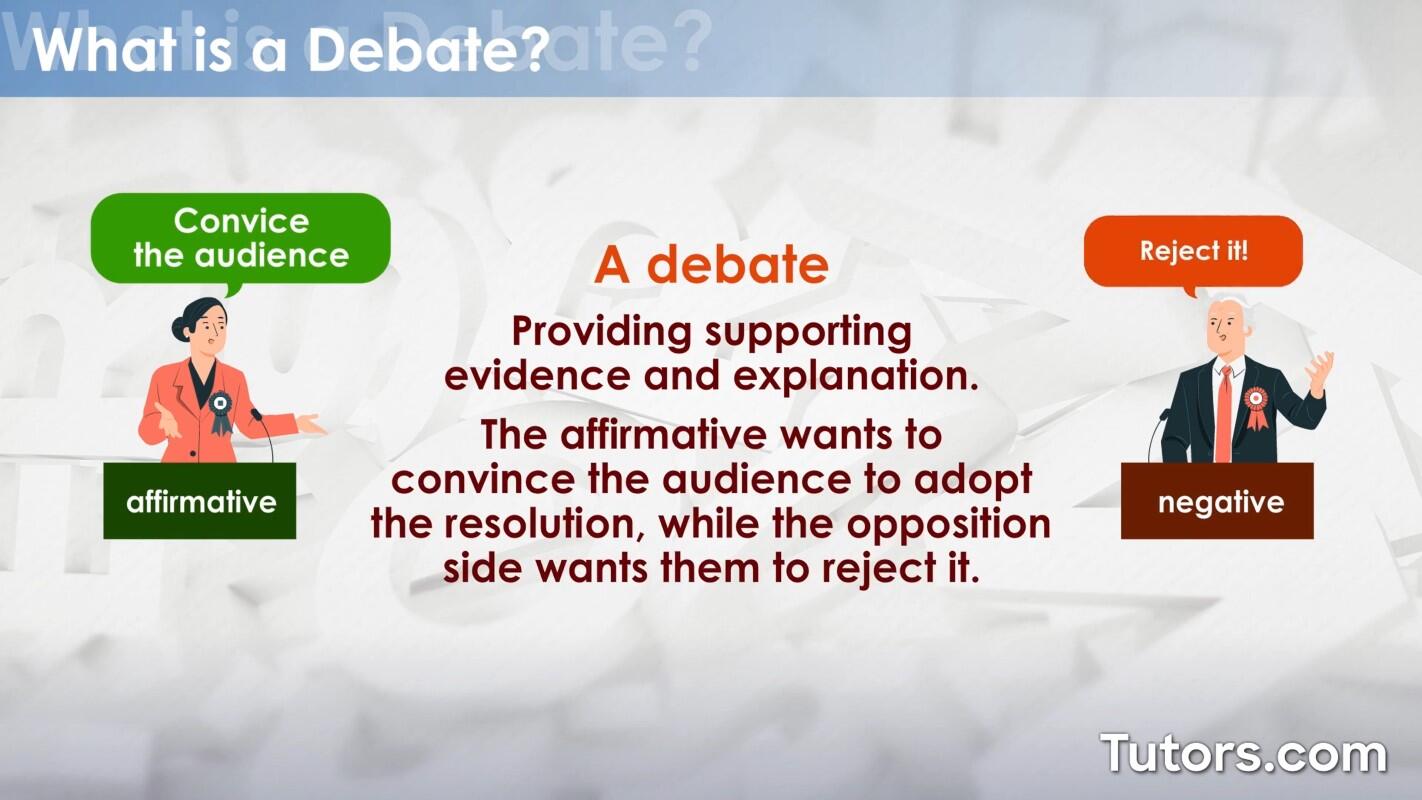
The affirmative side advocates for the proposition, providing supporting evidence and explanation, while the opposing side refutes the resolution. Therefore, the affirmative wants to convince the audience to adopt the resolution, while the opposition side wants them to reject it.
The audience varies depending on the topic of the debate. Consider the following examples:
Political: Voters
Policy: Lawmakers
Trial: Jury
Public Debate/Forum: Community members
Debate questions
The basis of a debate stems from the resolution, a declarative statement determined by a question. The resolution contains the claim the two sides will debate. These statements derive from debate questions:
| Debate Question | Resolution |
|---|---|
| Should school uniforms be mandatory? | Schools should require uniforms. |
| Is animal testing ever justified? | Animal testing is never justified. |
| Is social media harmful to adolescents? | Social media negatively affects adolescents. |
| Does homework help students succeed? | Homework is not beneficial. |
| Should everyone be required to vote? | The law should require everyone to vote. |
| Do kids need recess? | Kids need recess during the school day. |
| Is skill or effort more important? | Effort is more important than skill. |
| Should colleges pay their athletes? | Colleges should not pay student-athletes. |
| Is homeschooling better than public schooling? | Public school is more beneficial than homeschooling. |
| Is cyberbullying worse than traditional bullying? | Cyberbullying is worse than face-to-face bullying. |
Structure for debate
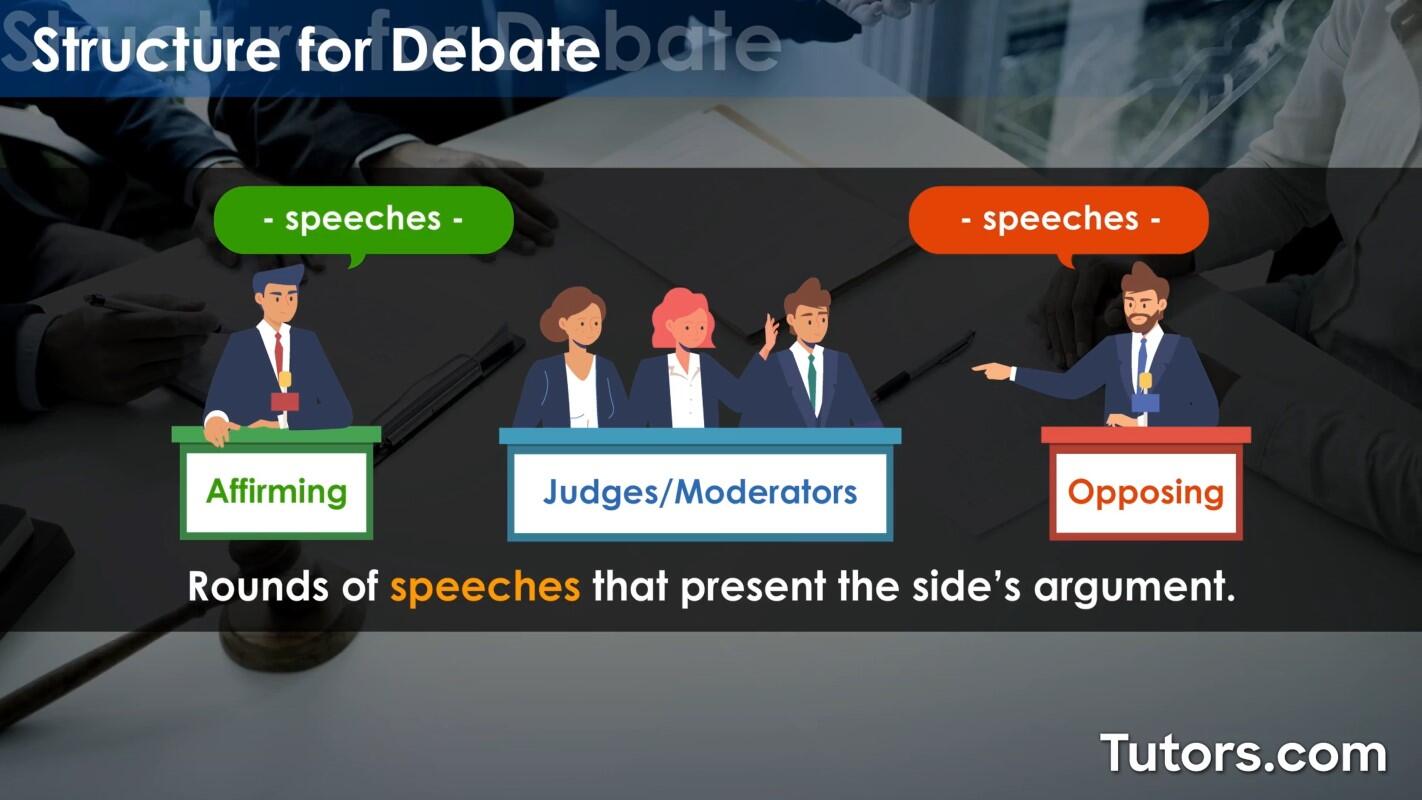
The specific structure depends on the form of debate. However, every formal debate contains a judge, opposing sides, speeches, and a decision.
Debates are set up to persuade a panel of judges rather than the opponent.
There are always two sides in a debate – one that agrees with the resolution (affirming) and one that disagrees (opposing).
Each debate includes rounds of speeches that present the side’s argument. The placement of the speech in the debate impacts its purpose.
The constructive speech is each team’s first speech to build their case.
Rebuttals provide the opportunity for both sides to discredit their opponent’s argument.
Cross-examination allows each side to question the other side.
The period where speakers from both sides can ask and answer each other’s questions is called crossfire. The grand crossfire functions in the same way, except all four speakers participate.
Closing statements offer each side a final opportunity to present their argument.
Upon conclusion of the debate, the judge(s) or moderator decides the winning side.
Types of debates
Team policy, Lincoln-Douglas, spontaneous argumentation, public forum, and parliamentary are the most common types of debates.
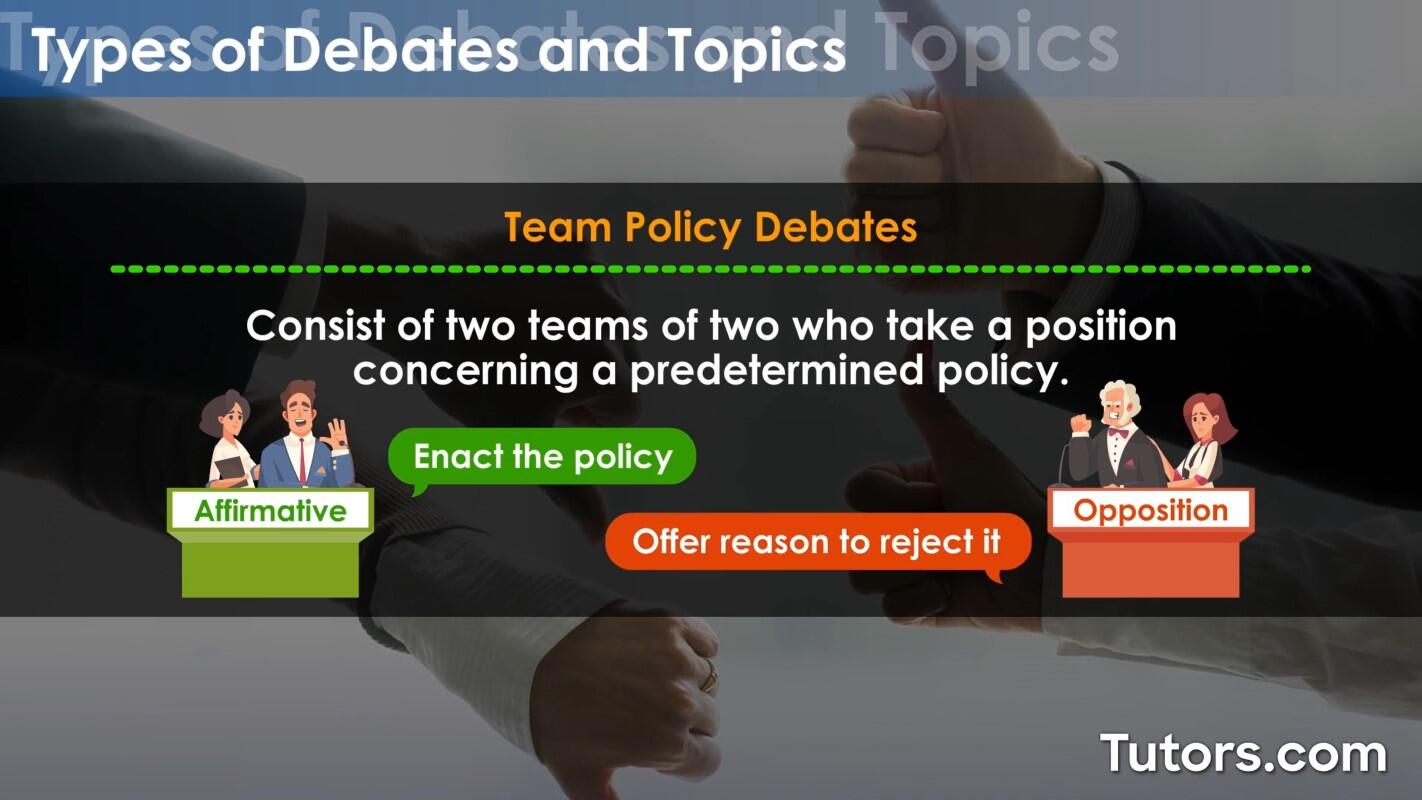
Team policy debates consist of two teams of two who take a position concerning a predetermined policy. One team argues to enact the policy while the opposing team members offer reasons to reject it.
Policy debates are structured as follows:
| 1st affirmative constructive | 8 minutes |
| Cross-examination of the 1st affirmative | 3 minutes |
| 1st negative constructive | 8 minutes |
| Cross-examination of the 1st negative | 3 minutes |
| 2nd affirmative constructive | 8 minutes |
| Cross-examination of the 2nd affirmative | 3 minutes |
| 2nd negative constructive | 8 minutes |
| Cross-examination of the 2nd negative | 3 minutes |
| 1st negative rebuttal | 5 minutes |
| 1st affirmative rebuttal | 5 minutes |
| 2nd negative rebuttal | 5 minutes |
| 2nd affirmative rebuttal | 5 minutes |
Lincoln-Douglas debates consist of one speaker debating against another speaker and are a common form of high school debates. The topic typically concerns social and philosophical issues with questions concerning ideas such as morality, justice, democracy, etc. They focus on determining if certain thoughts or actions are good or bad, right or wrong, and moral or immoral. Presidential debates typically look most like Lincoln-Douglas debates.
| Speaker A: Making the case | 6 minutes |
| Speaker B: Cross-examination of speaker A | 3 minutes |
| Speaker B: 1st rebuttal | 7 minutes |
| Speaker A: Cross-examination of speaker B | 3 minutes |
| Speaker A: 1st rebuttal | 4 minutes |
| Speaker B: Final rebuttal | 5 minutes |
| Speaker A: Closing rebuttal | 5 minutes |
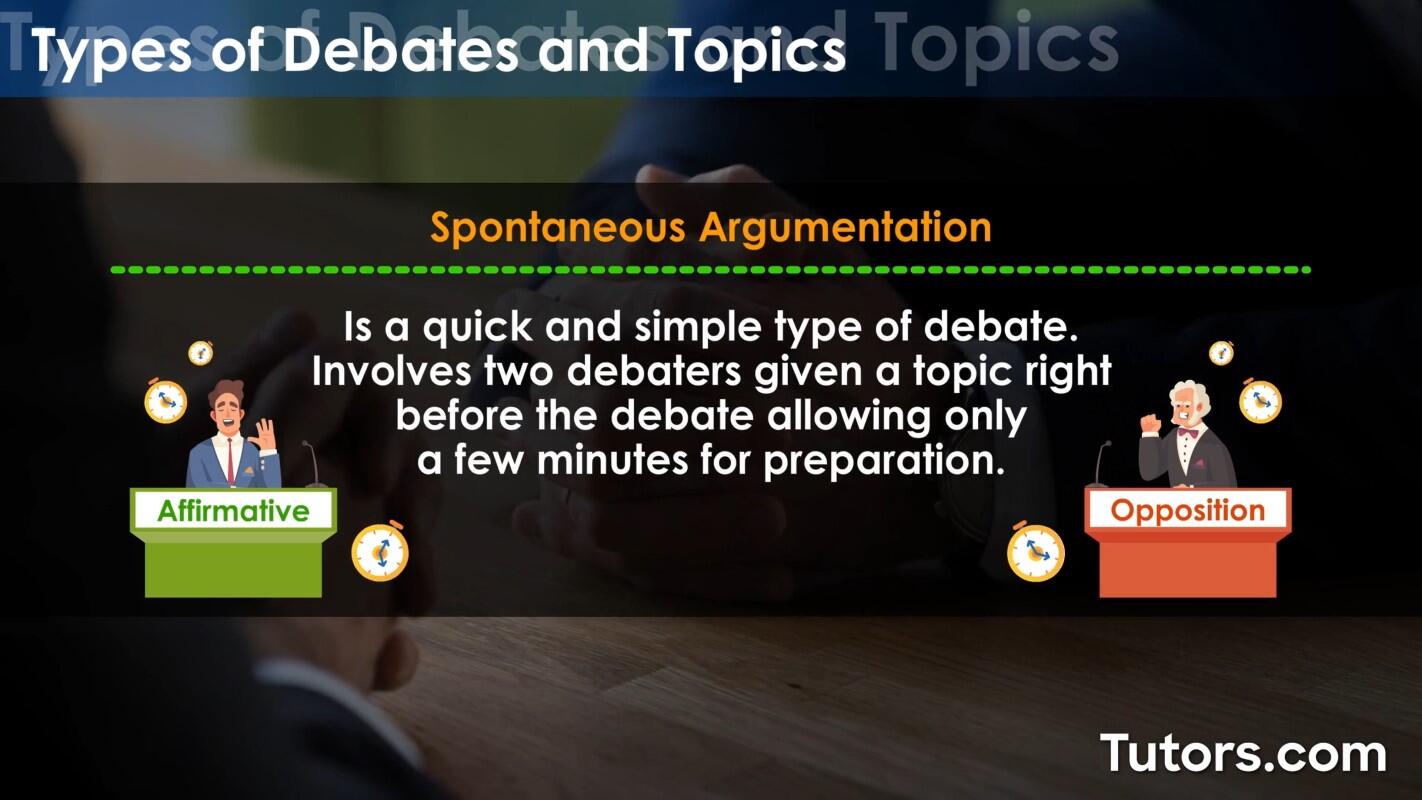
Spontaneous argumentation (SPAR) is a quick and simple type of debate. It typically involves two debaters given a topic right before the debate, allowing only a few minutes for preparation.
| Affirmative case | 3 minutes |
| Cross-examination of the affirmative | 1.5 minutes |
| Negative case | 3 minutes |
| Cross-examination of the negative | 1.5 minutes |
| Negative counter-arguments | 2 minutes |
| Affirmative counter-arguments | 2 minutes |
| Negative closing statement | 2 minutes |
| Affirmative closing statement | 2 minutes |
Public forum debates feature two teams with two speakers each who debate a topic regarding a current event.
| Speaker 1: Constructive speech (pro or con) | 4 minutes |
| Speaker 2: Constructive speech (pro or con) | 4 minutes |
| Cross-fire | 3 minutes |
| Speaker 3: Rebuttal speech (pro or con) | 4 minutes |
| Speaker 4: Rebuttal speech (pro or con) | 4 minutes |
| Cross-fire | 3 minutes |
| Speaker 1: Summary | 2 minutes |
| Speaker 2: Summary | 2 minutes |
| Grand cross-fire | 3 minutes |
| Speaker 3: Final focus (closing statement) | 2 minutes |
| Speaker 4: Final focus (closing statement) | 2 minutes |
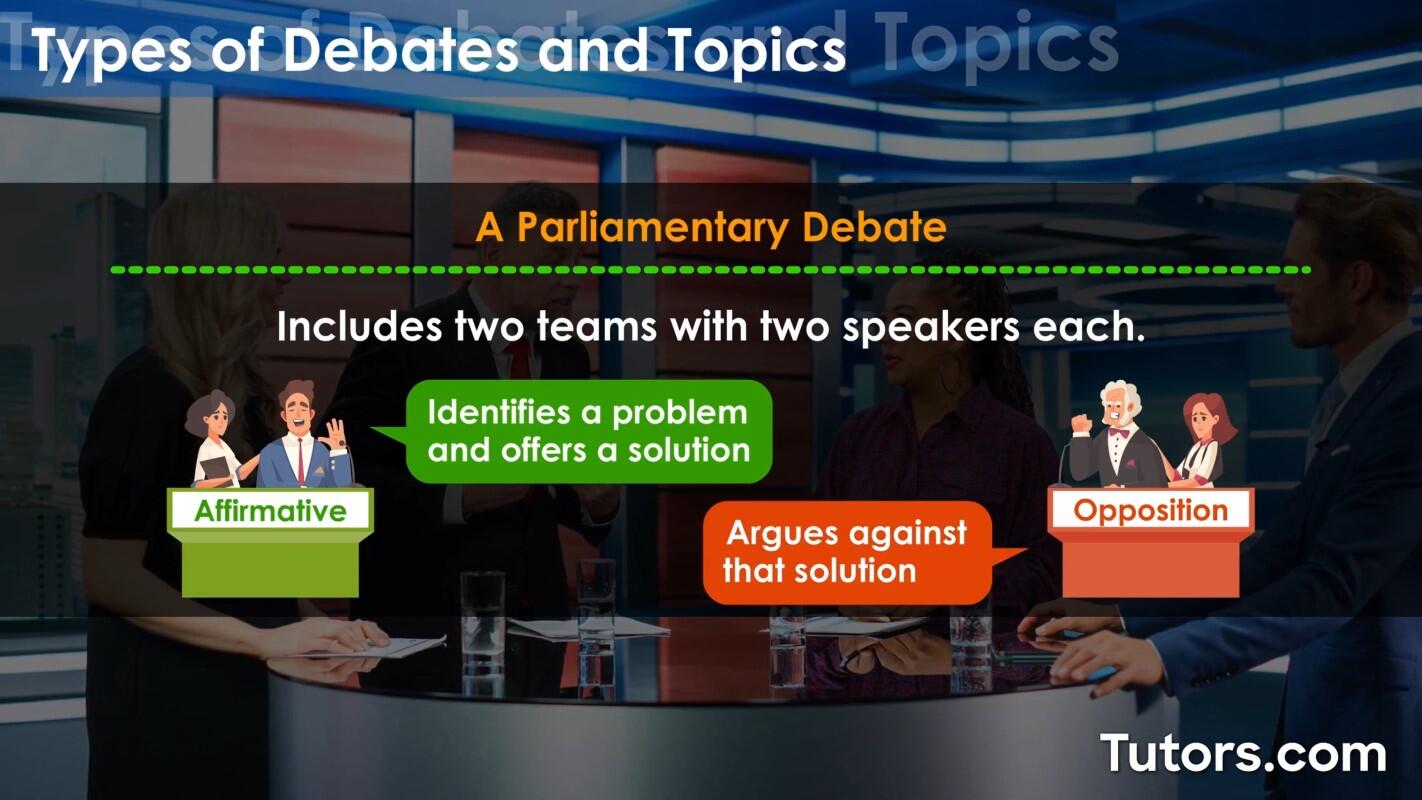
A parliamentary debate includes two teams with two speakers each. The affirmative team is often referred to as the government and is trying to uphold the resolution, whereas the negative team (the opposition) opposes the government’s viewpoint. The government identifies a problem and offers a solution, while the opposition argues against that solution. The rules for this type of debate originated from British parliamentary procedure.
| 1st affirmative constructive | 7 minutes |
| 1st negative constructive | 8 minutes |
| 2nd affirmative constructive | 8 minutes |
| 2nd negative constructive | 8 minutes |
| Negative rebuttal | 4 minutes |
| Affirmative rebuttal | 5 minutes |
Debating tips
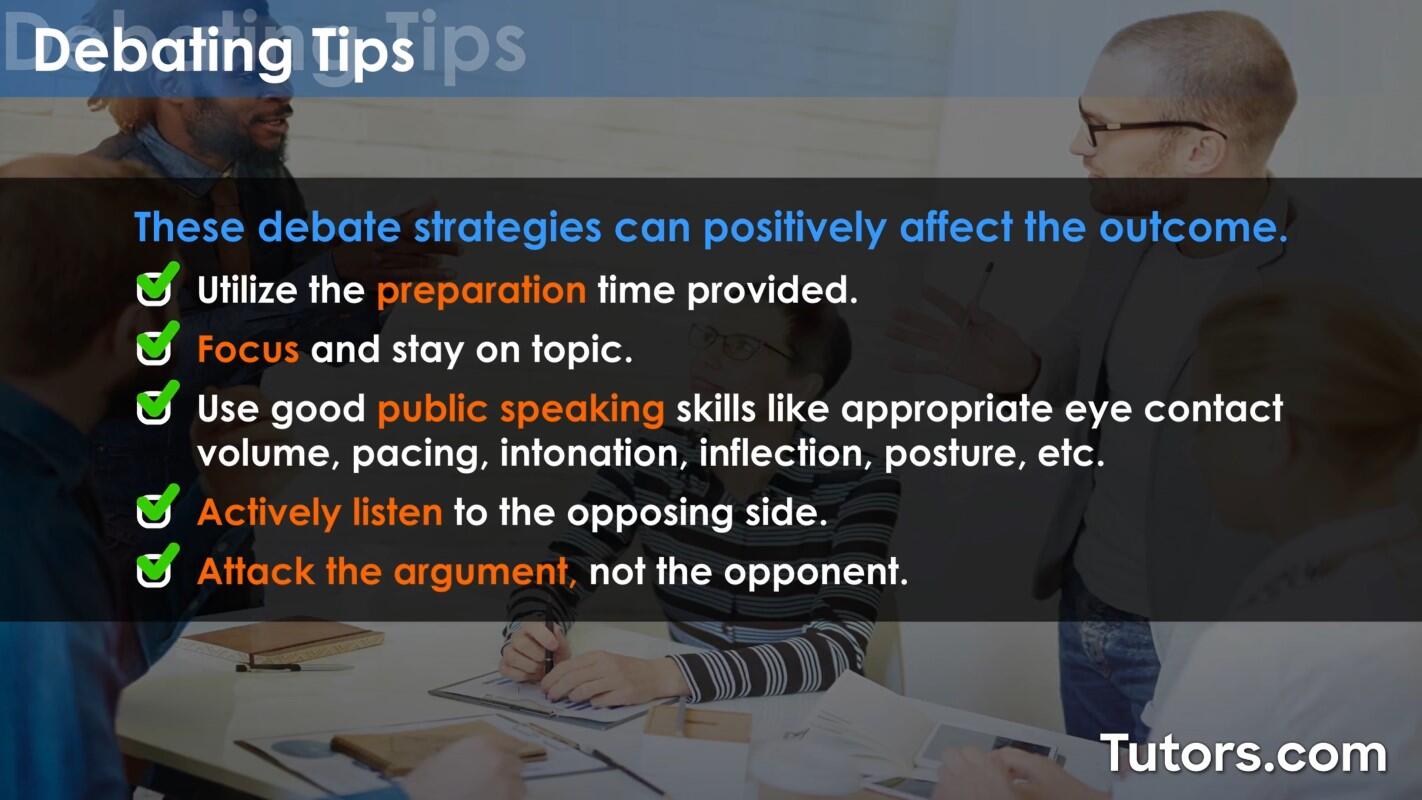
When debating, the following strategies can positively affect the outcome:
While some debate formats allow for a limited amount of preparation time, utilize the time provided. It is best to take as much time as possible to formulate an argument. Going into a debate unprepared not only impacts the argument but can negatively influence body language, eye contact, volume, pacing, etc.
Focus and stay on topic. Make sure each sentence has a purpose and supports the argument.
Use good public speaking skills like appropriate eye contact, volume, pacing, intonation, inflection, posture, etc., which show the speaker’s confidence. Sometimes the presentation can be as important as what is presented.
Debates provide speakers with the opportunity to respond to their opponent’s argument. Focus on actively listening to the opposing side. While it is possible to predict their argument, providing a direct response to something they said is much more persuasive than moving forward as if there is no opposing side.
The point of a debate is to attack the argument, not the opponent.
Debate topics
The following are example topics for each main type of debate:
Team Policy Debate
The United States federal government should substantially increase its protection of its water resources.
The United States federal government should substantially increase its security cooperation with the North Atlantic Treaty Organization in one or more of the following areas: artificial intelligence, biotechnology, and cybersecurity.
New York should offer universal healthcare to its residents.
Lincoln-Douglas Debate
In a democracy, a free press ought to prioritize objectivity over advocacy.
Radicalism is preferable to incrementalism to achieve social justice.
Civil disobedience in a democracy is morally justified.
The actions of corporations ought to be held to the same moral standards as the actions of individuals.
Spontaneous Argumentation (SPAR)
Lying is sometimes justified.
High schools should require uniforms.
Voting is a duty and not a right.
The pen is mightier than the sword.
Money can buy happiness.
Public Forum Debate
Japan should revise Article 9 of its Constitution to develop offensive military capabilities.
The United States should establish a comprehensive bilateral trade agreement with Taiwan.
Parliamentary Debate
In the US criminal justice system, truth-seeking ought to be valued above attorney-client privilege.
Chain stores are detrimental to the best interests of the American public.
The United States Senate should eliminate the filibuster.
Summarize with AI:
Did you like this article? Rate it!

 Loading...