


What is a prefix?
A prefix is a letter or group of letters added to the beginning of a word, changing its overall meaning and creating a new word. Prefixes cannot stand alone; they must be attached to a complete word.
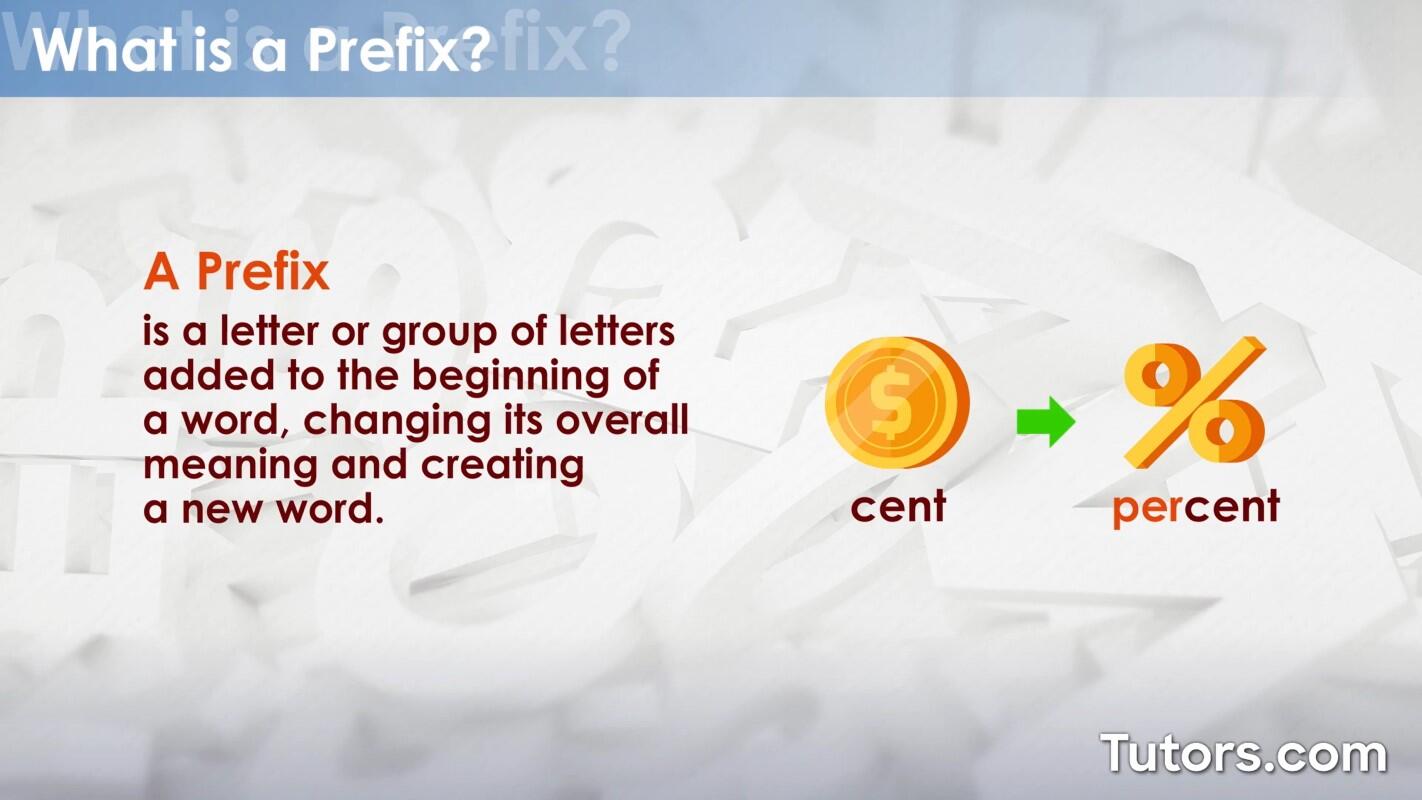
A prefix is a type of morpheme. With a few exceptions, do not hyphenate after a prefix unless it precedes a proper noun (e.g., pre-Columbian, trans-Atlantic).
Prefix and suffix
Prefixes and suffixes are both kinds of affixes. A suffix, unlike a prefix, attaches to the end of a word. Suffixes can change the meaning and function of a word.
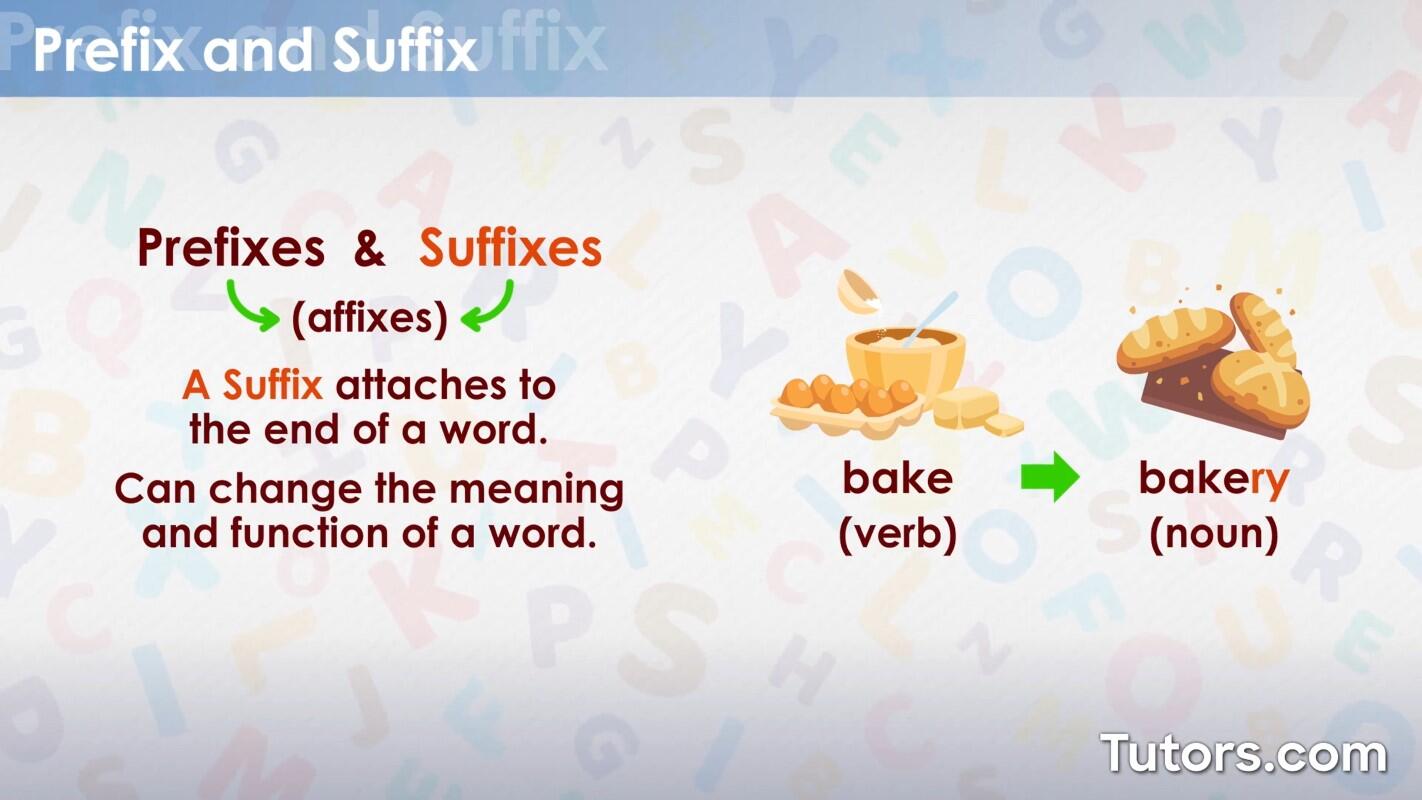
Adding a suffix to a verb, noun, or adjective can change the word's part of speech from adjective/verb to noun or from verb/noun to adjective.
| Prefix | Root Word | Suffix |
|---|---|---|
| reread (verb) | read (verb) | reader (noun) |
| invisible (adjective) | visible (adjective) | visibility (noun) |
| precaution (noun) | caution (noun) | cautionary (adjective) |
Some words that seem like prefixes and suffixes, such as auto- and -wide, are combining forms. These English words are often derivatives from Latin or Greek words and can be words on their own or combined to make new words.
Prefix examples
The following chart contains a list of the most common prefixes in the English language:
| Prefix | Meaning | Examples |
|---|---|---|
| anti- | opposite; counteracting | anticipate; antifreeze |
| de- | make opposite of; remove, reduce | decrease; deactivate |
| dis- | not; opposite of; remove | dissimilar; disappear |
| en-, em- | put; go into; to cause to be | enable; empower |
| fore- | before; in front of | forecast; foreshadow |
| in-, im- | into; inside; within | inject; implant |
| in-, im-, ir-, il- | not | insincere; impatient; irregular; illegal |
| inter- | between; among | interstate; intersect |
| mid- | middle | midfield; midair |
| mis- | bad; wrong; failure; lack | misinformation; misquote |
| non- | not | nonexistent; nonpoisonous |
| over- | above; too much | overachieve; overpass |
| pre- | before; in front of | prevent; predict |
| re- | again | redo; rejoin |
| semi- | half; partial; happening twice | semiannual; semicircle |
| sub- | below; under; secondary; less than complete | submarine; subpar |
| super- | above; over | superimpose; superstar |
| trans- | across; beyond; change; through | transformation; transportation |
| un- | not; opposite of | unnecessary; unable |
| under- | beneath; below; less in degree | underground; underachieve |
Another type of prefix may come before a person’s name, like Mr., Miss, Mrs., or Dr.
The following example sentences correctly incorporate the use of the most common prefixes:
Anti-: The store ran out of antibacterial soap.
De-: Tim forgot the company deducts taxes from his pay.
Dis-: Once the cruise ship docked, the passengers disembarked.
En-: Matadors use the color red to enrage the bulls.
Em-: The candidate felt empowered after receiving the president's endorsement.
Fore-: The backdrop on the stage shows flowers in the foreground with trees in the background.
In-: Unfortunately, he voted too late, so it was invalid.
Im-: The player's injury impaired his ability to play well.
Ir-: After the accident, the car's damage was irreparable.
Il: The doctor's handwriting was illegible.
Inter-: The interoffice mail should be arriving any minute.
Mid-: Larger familiesneed cars that are bigger than midsize sedans.
Mis-: John thought his email was misinterpreted as a demand rather than a request.
Non-: The teacher found the student's reason for being late nonsensical.
Over-: Tracy paid her rent on time, so it wasn't overdue.
Pre-: The preface of the book explains the author's motivation.
Re-: Steve didn't hear the message, so his dad had to repeat himself.
Semi-: The semiprofessional player finally called up to the majors.
Sub-: Take the subway when you visit New York City; it is cheaper than a taxi.
Super-: Trent's supervisor complimented him on a job well done.
Trans-: What kind of transportation do you prefer? Car or plane?
Un-: The point of the assignment was unclear.
Under-: The realtor underestimated the value of the house.
Summarize with AI:
Did you like this article? Rate it!

 Loading...