


What is blank verse?
Blank verse is a poetic form usually in unrhymed iambic pentameter, but poets can use other metrical patterns. Due to its lack of rhyme yet use of meter, many poets utilize this verse form because it is like normal speech with a musical effect.
Poets and classical playwrights would use blank verse in dramatic monologues and longer narrative poems. Poets believed that the rhythmic pattern would capture readers’ attention, making their work more enjoyable.
Features of blank verse
Blank verse poems contain the following features:
Lines: Blank verse poems can contain any number of lines.
Rhyme Scheme: Poems written in blank verse do not follow a rhyme scheme.
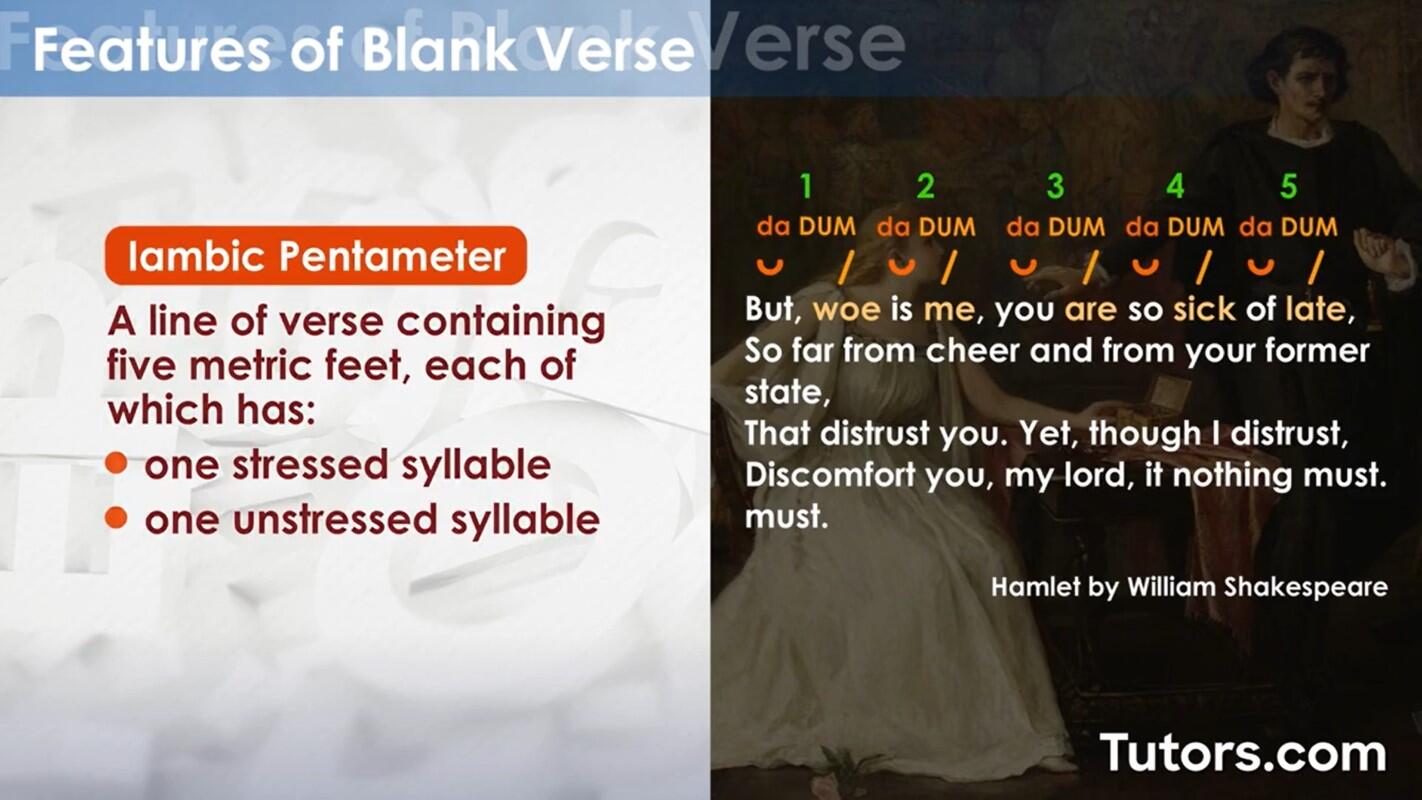
Iambic Pentameter: Iambic pentameter is a line of verse containing five metric feet, each of which has one stressed syllable and one unstressed syllable. Iambic identifies how the syllables are stressed (da DUM), while pentameter identifies the number of iambs (penta = five).
Therefore, each metric foot contains two syllables, giving each line of blank verse ten total syllables (5 feet x 2 syllables per foot = 10 syllables).
Consider the following example of blank verse from William Shakespeare’s play Hamlet:
| Line | This a- | bove all | to thine | own self | be true |
|---|---|---|---|---|---|
| Iambic | da DUM | da DUM | da DUM | da DUM | da DUM |
| Syllables | 2 | 2 | 2 | 2 | 2 |
| Metric Feet | 1 | 2 | 3 | 4 | 5 |
History of blank verse
Blank verse was first introduced to English speakers in the mid-1500s by the Earl of Surrey, Henry Howard, when he translated Virgil’s Aeneid from Latin to English. Playwrights like Christopher Marlowe and William Shakespeare helped popularize blank verse in the English language.
18th and 19th century English poets, such as John Keats, William Wordsworth, and Alfred Lord Tennyson, widely used blank verse in their poetry.
Blank verse vs. free verse
Blank verse and free verse compare in the following ways:
| Characteristic | Blank Verse | Free Verse |
|---|---|---|
| Rhyme Scheme | unrhymed lines | unrhymed lines |
| Metrical Pattern | iambic pentameter | no metrical pattern |
| Usage | 16th – 19th-century poets | contemporary poets |
| Example Line | When I see birches bend to left and right / Across the lines of straighter darker trees, / I like to think some boy’s been swinging them. -- “Birches” by Robert Frost | I celebrate myself, and sing myself, / And what I assume you shall assume, / For every atom belonging to me as good belongs to you. -- “Song of Myself” by Walt Whitman |
While both forms are similar in that neither contains a rhyme scheme, free verse does not follow any metrical pattern, whereas blank verse poetry consistently uses iambic pentameter. Free verse is not bound by any specific poetic rules or consistent meter, hence being identified as “free.”
Blank verse examples
The following lines from famous poems and dramatic works employ the use of blank verse:
Paradise Lost by John Milton
Of Mans First Disobedience, and the Fruit
Of that Forbidden Tree, whose mortal taste
Brought Death into the World, and all our woe,
With loss of Eden, till one greater Man
Restore us, and regain the blissful Seat…
Romeo and Juliet by William Shakespeare
O, then, I see Queen Mab hath been with you.
She is the fairies' midwife, and she comes
In shape no bigger than an agate-stone
On the fore-finger of an alderman,
Drawn with a team of little atomies
Athwart men's noses as they lie asleep…
“The Second Coming” by William Butler Yeats
Turning and turning in the widening gyre
The falcon cannot hear the falconer;
Things fall apart; the centre cannot hold;
Mere anarchy is loosed upon the world…
“Mending Wall” by Robert Frost
Something there is that doesn’t love a wall,
That sends the frozen-ground-swell under it,
And spills the upper boulders in the sun;
And makes gaps even two can pass abreast.
“The Idea of Order at Key West” by Wallace Stevens
The sea was not a mask. No more was she.
The song and water were not medleyed sound
Even if what she sang was what she heard,
Since what she sang was uttered word by word.
Summarize with AI:
Did you like this article? Rate it!

 Loading...