


What is tone?
In literature, tone refers to the author’s attitude toward a subject. Tone is developed through word choice, sentence structure, and images. Types of tone include optimistic, fear, and humor.
A person’s tone of voice, body language, and facial expressions can give away their feelings and attitudes; an author’s tone does the same thing for a piece of writing.
Types of tone
The types of tone are typically categorized by the emotion the author wishes to portray. Some of the main types include optimistic, fear, and nostalgia:
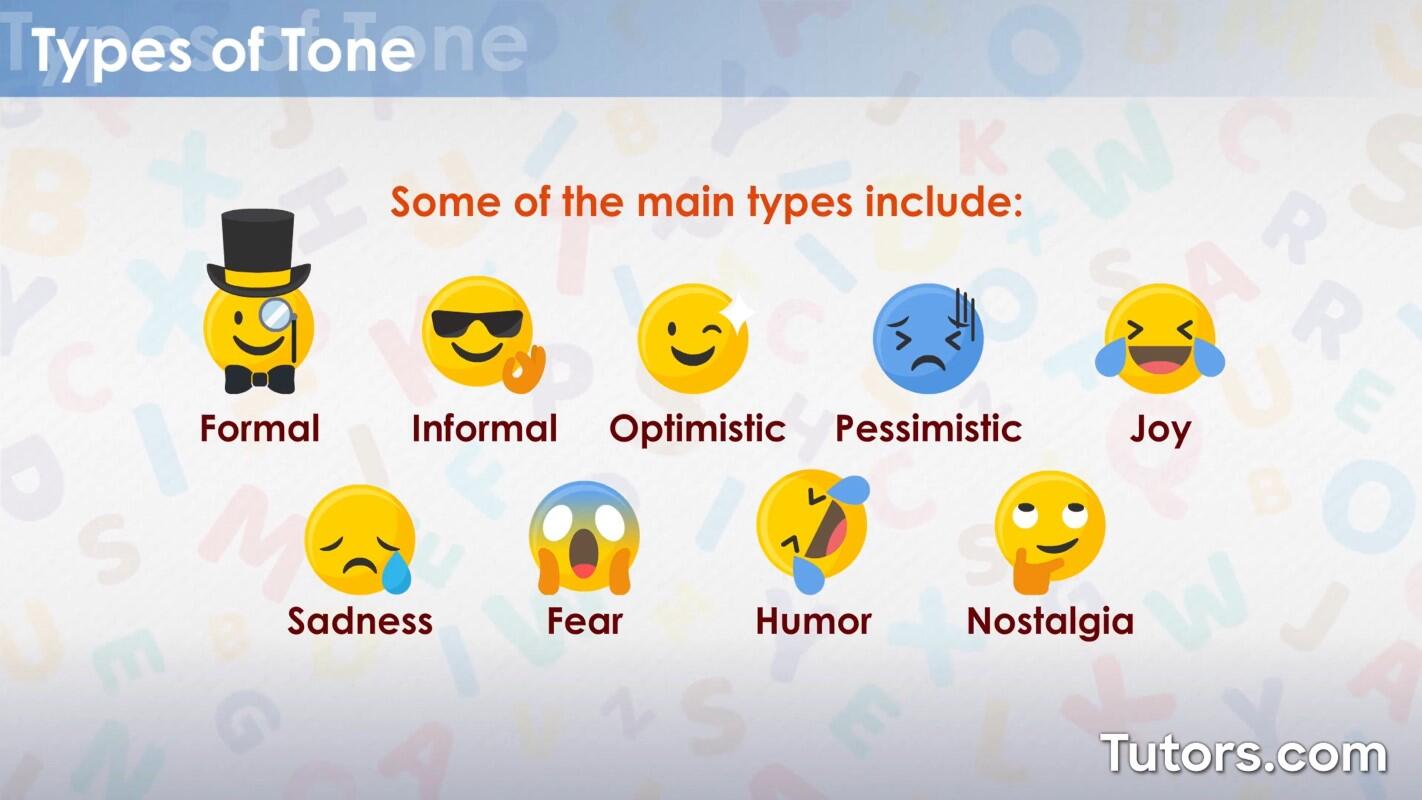
| Tone | Explanation |
|---|---|
| Formal | Academic writing with high-level vocabulary; presents factual information |
| Informal | Conversational and expressive; uses contractions, first person point of view, and emotion |
| Optimistic | Expresses a sense of hope and the belief in a positive future |
| Pessimistic | Conveys a sense of hopelessness and a bleak outlook of the future |
| Joy | Communicates upbeat and cheerful experiences |
| Sadness | Portrays sorrow and grief to make the reader sympathize with the characters |
| Fear | Depicts threatening occurrences to play off of universal fears |
| Humor | Presents ideas that lighten the story's moods; offers complex ideas in simplistic ways |
| Nostalgia | Evokes affection and longing for the positive memory of the past |
Use of tone
Tone provides the reader with insight into the author's attitude toward the subject. To develop the desired tone, authors use diction, syntax, and imagery.
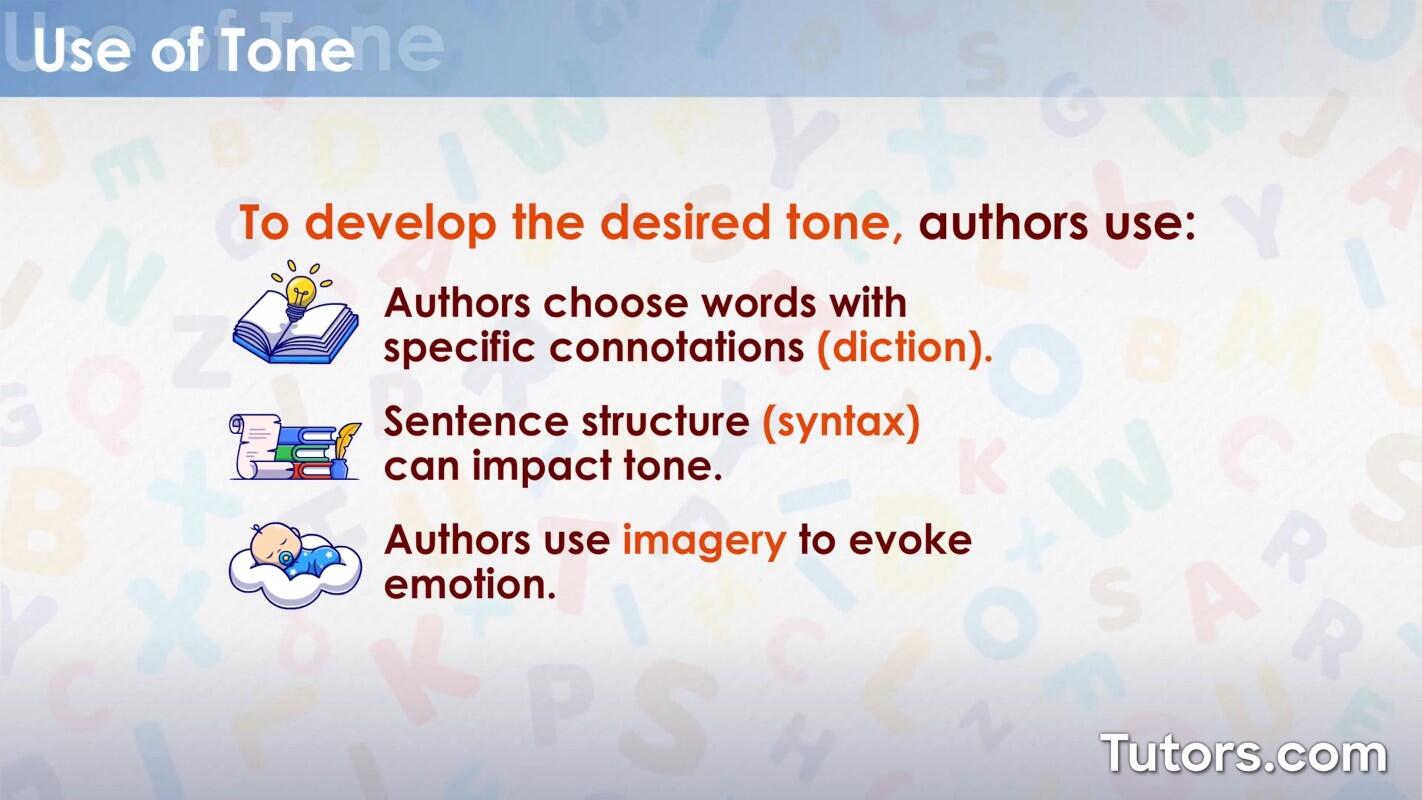
Authors choose words (diction) with specific connotations, which is the emotional impact of the word.
Words with negative connotations (e.g., arrogant, nosy, stubborn) cause the reader to reflect on the ideas negatively.
For a positive reaction, authors focus on words with positive connotations (e.g., confident, interested, dedicated).
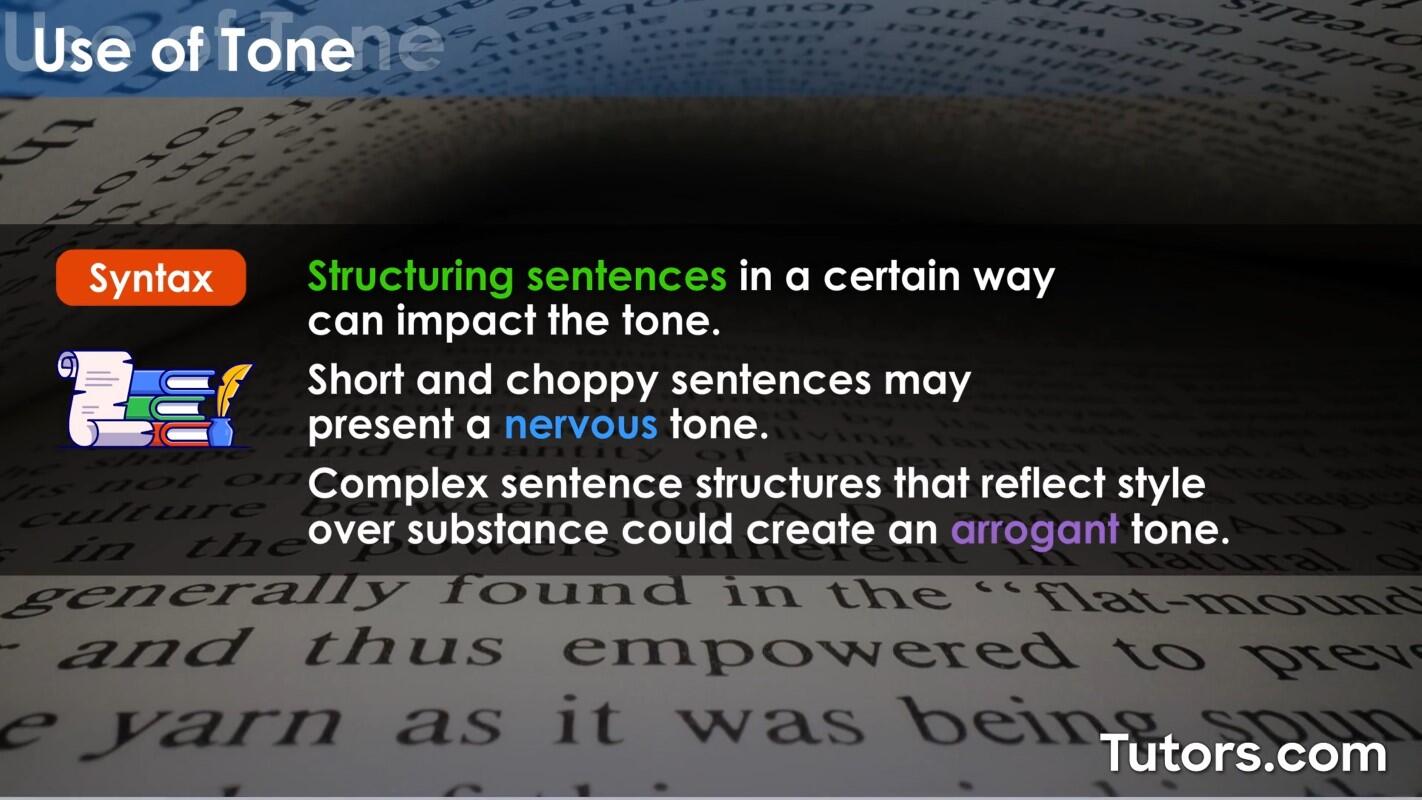
Structuring sentences in a certain way (syntax) can impact the tone. Short and choppy sentences, with the character not able to complete each sentence, may present a nervous tone. If authors want to create an arrogant tone, they can use complex sentence structures that reflect style over substance.
Authors can also use imagery connotatively. Visions of animals frolicking in the wilderness and the sounds of birds chirping suggests a different tone than the smell of burning rubber and the sounds of hundreds of cars honking while at a standstill.
Tone vs. mood
The mood of a piece of literature is the feeling experienced by the reader, whereas the tone is the author's attitude toward the subject.
Consider this quote from Charlotte's Web by E.B. White:
"But I feel peaceful. Your success in the ring this morning was, to a small degree, my success. Your future is assured. You will live, secure and safe, Wilbur. Nothing can harm you now."
At the end of the novel, Wilbur survives while Charlotte does not. The author creates a mood of sadness, and the tone reflects peace and acceptance.
Tone examples
The following chart details tonal words categorized by type of tone:
| Formal | Informal | Optimistic | Pessimistic |
|---|---|---|---|
| Matter-of-fact | Colloquial | Encouraging | Cynical |
| Neutral | Familiar | Hopeful | Despairing |
| Objective | Friendly | Idealistic | Gloomy |
| Serious | Intimate | Promising | Hopeless |
| Straightforward | Relaxed | Sanguine | Meaningless |
| Fear | Humor | Joy | Nostalgia | Sadness |
|---|---|---|---|---|
| Anxiety | Amused | Carefree | Appreciative | Depressed |
| Apprehensive | Comical | Giddy | Pensive | Disheartened |
| Sinister | Joking | Happy | Reflective | Miserable |
| Terror | Sarcastic | Jovial | Reverent | Regretful |
| Timid | Silly | Lighthearted | Sentimental | Somber |
The following example sentences illustrate the identified tone:
Formal: According to the data presented by the Environmental Protection Agency, carbon emissions have dropped by 10%.
Informal: Hey! I can't make it tonight. Maybe we can catch a quick bite tomorrow.
Optimistic: The coach is encouraged by our improvements and promised a win tomorrow night.
Pessimistic: I don't think I'll ever be able to take a Disney cruise. It's just too expensive.
Fear: What was that? Did you hear that sound? We should leave now!
Humor: The milk squirting out of his friend's nose was a good indication that the story he told was quite humorous.
Joy: After receiving the acceptance letter, his excitement caused him to jump for joy.
Nostalgia: Thinking about the summers I spent at the lake brought back fond memories of growing up.
Sadness: Moving in the middle of senior year was miserable, she thought while she tried to blink away the tears from her eyes.
Examples of tone in literature
The following literary quotes illustrate the specific tone of each author:
Humor – The Hitchhiker's Guide to the Galaxy by Douglas Adams
"For instance, on the planet Earth, man had always assumed that he was more intelligent than dolphins because he had achieved so much—the wheel, New York, wars and so on—whilst all the dolphins had ever done was muck about in the water having a good time. But conversely, the dolphins had always believed that they were far more intelligent than man—for precisely the same reasons."
Pessimistic – The Scarlett Letter by Nathaniel Hawthorne
"The founders of a new colony, whatever Utopia of human virtue and happiness they might originally project, have invariably recognized it among their earliest practical necessities to allot a portion of the virgin soil as a cemetery, and another portion as the site of a prison."
Nostalgia – To Kill a Mockingbird by Harper Lee
"Neighbors bring food with death and flowers with sickness and little things in between. Boo was our neighbor. He gave us two soap dolls, a broken watch and chain, a pair of good-luck pennies, and our lives. But neighbors give in return. We never put back into the tree what we took out of it: we had given him nothing, and it made me sad."
Examples of tone in poetry
The following lines from famous poems illustrate the specific tone of each poet:
Depressed – "Annabel Lee" by Edgar Allan Poe
And this was the reason that, long ago,
In this kingdom by the sea,
A wind blew out of a cloud, chilling
My beautiful Annabel Lee;
So that her highborn kinsmen came
And bore her away from me,
To shut her up in a sepulcher
In this kingdom by the sea.
Optimistic – "Mother to Son" by Langston Hughes
But all the time
I’se been a-climbin’ on,
And reachin’ landin’s, And turnin’ corners, And sometimes goin’ in the dark
Where there ain’t been no light.
So boy, don’t you turn back.
Joy – "A Birthday" by Christina Rosetti
My heart is like a singing bird
Whose nest is in a water’d shoot;
My heart is like an apple-tree
Whose boughs are bent with thickset fruit;
My heart is like a rainbow shell
That paddles in a halcyon sea;
My heart is gladder than all these
Because my love is come to me.
Summarize with AI:
Did you like this article? Rate it!

 Loading...