


What is a suffix?
A suffix is a letter or group of letters added to the end of a word to change either its meaning, grammatical function, or part of speech. The addition of a suffix can form a noun, adjective, verb, and adverb.
Attaching a suffix impacts a word in one of two ways: inflectional and derivational.
Inflectional: Inflectional suffixes alter the grammar of a word without changing its basic meaning. The change typically revolves around quantity (single vs. plural) or tense (past, present, future).
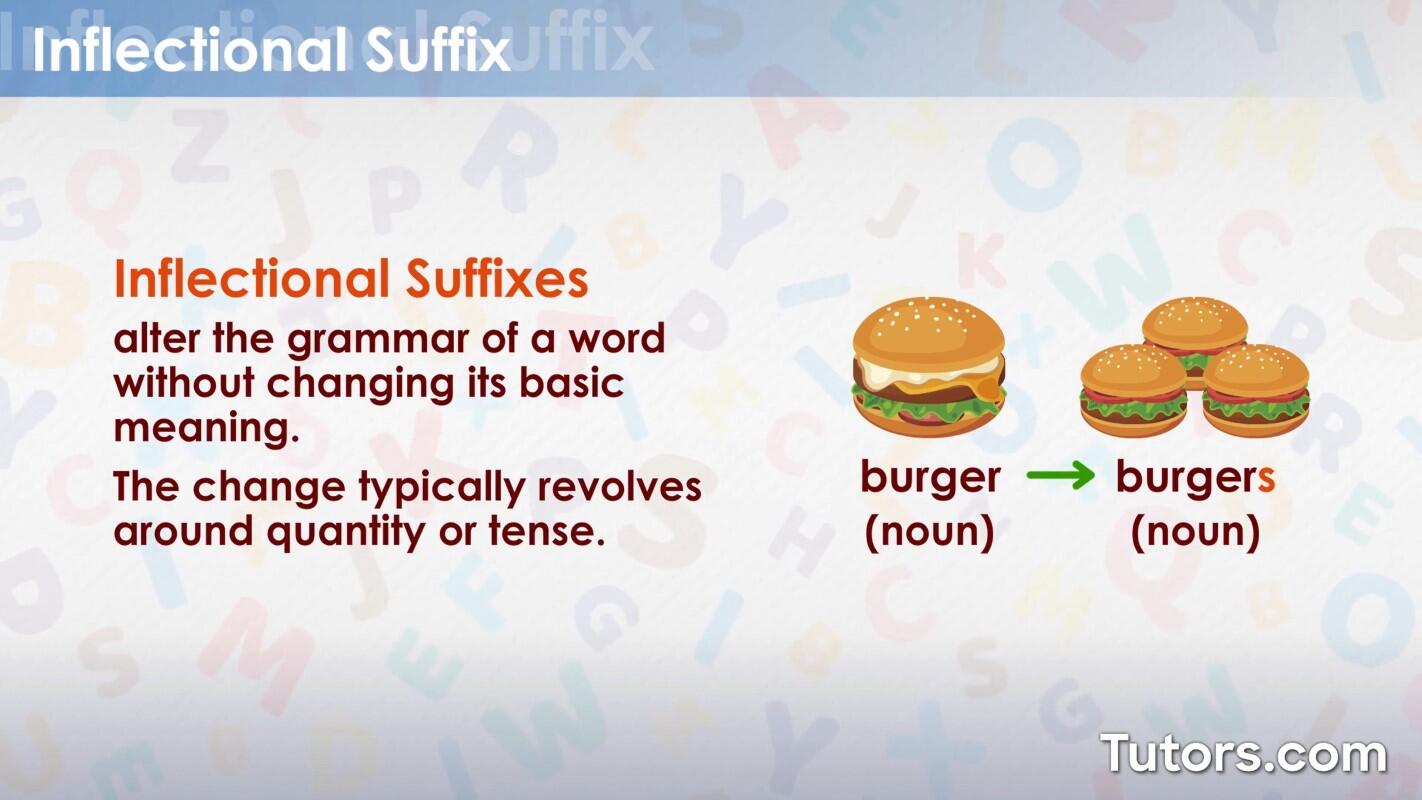
The following are inflectional suffixes:
| Suffix | Grammatical Change | Example |
|---|---|---|
| -ed | past tense | play→played |
| -en | past participle irregular | bite→bitten |
| -en | irregular plural | ox→oxen |
| -er | comparative | smaller→smaller |
| -est | superlative | bright→brightest |
| -ing | continue/progress | nap→napping |
| -s | 3rd person singular | talk→he talks |
| -s | plural | lion→lions |
Derivational: Adding a derivational suffix changes the meaning and part of speech of the root word. However, there is still a connection between the original and new words. Essentially, the new meaning is derived (obtained) from the root or base word.
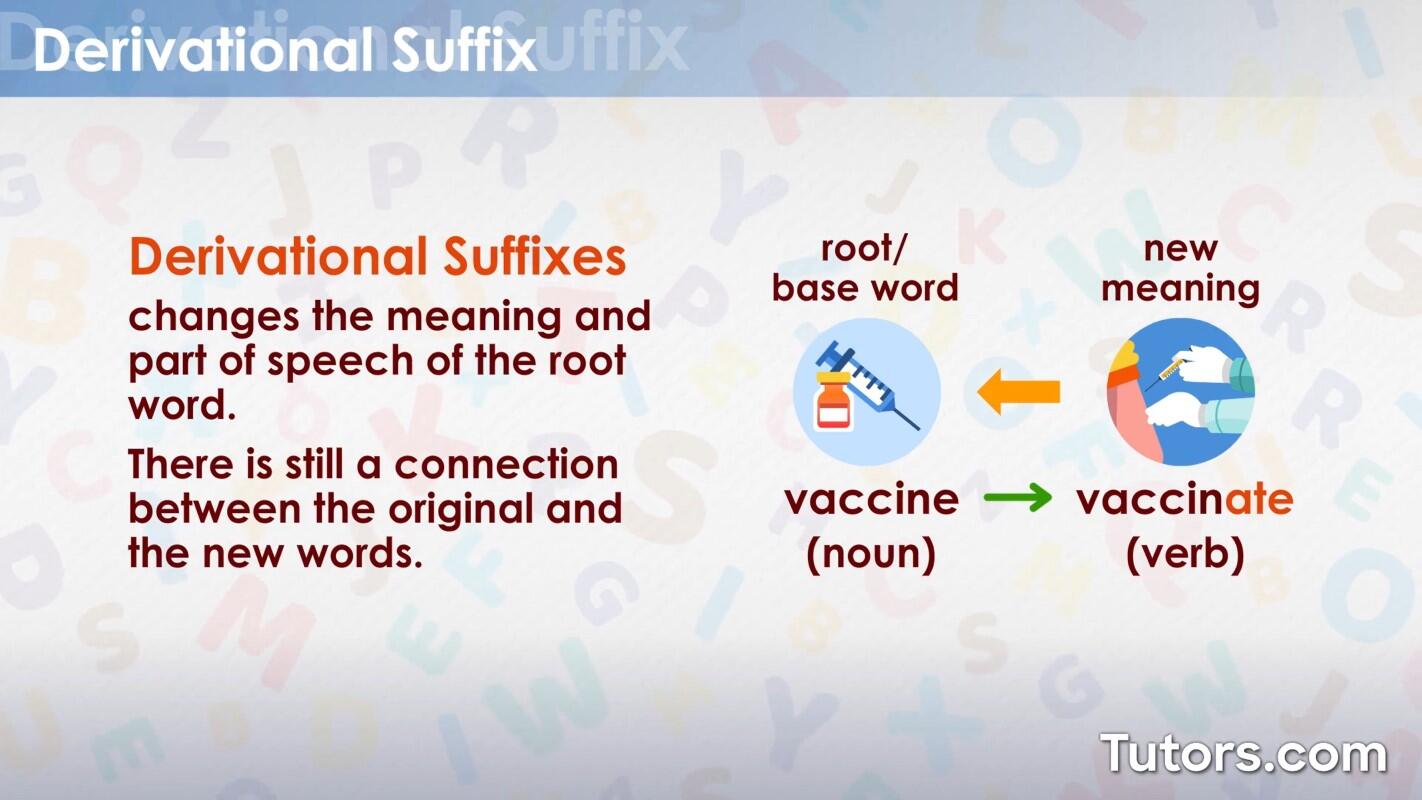
| Suffix | Part of Speech | Example |
|---|---|---|
| -er | noun | farm→farmer |
| -ment | noun | excite→excitement |
| -ness | noun | useful→usefulness |
| -sion | noun | confuse→confusion |
| -al | adjective | accident→accidental |
| -able | adjective | predict→predictable |
| -ary | adjective | planet→planetary |
| -y | adjective | dirt→dirty |
| -ate | verb | active→activate |
| -ize | verb | symbol→symbolize |
| -ly | adverb | quiet→quietly |
Suffix grammar rules
When adding suffixes to words, the following rules apply:
Rule 1: Suffixes that start with a consonant attach directly to the end of the word.
plain → plainly
Rule 2: When the root word ends in a consonant before a -y, change the -y to an -i.
lazy → laziness
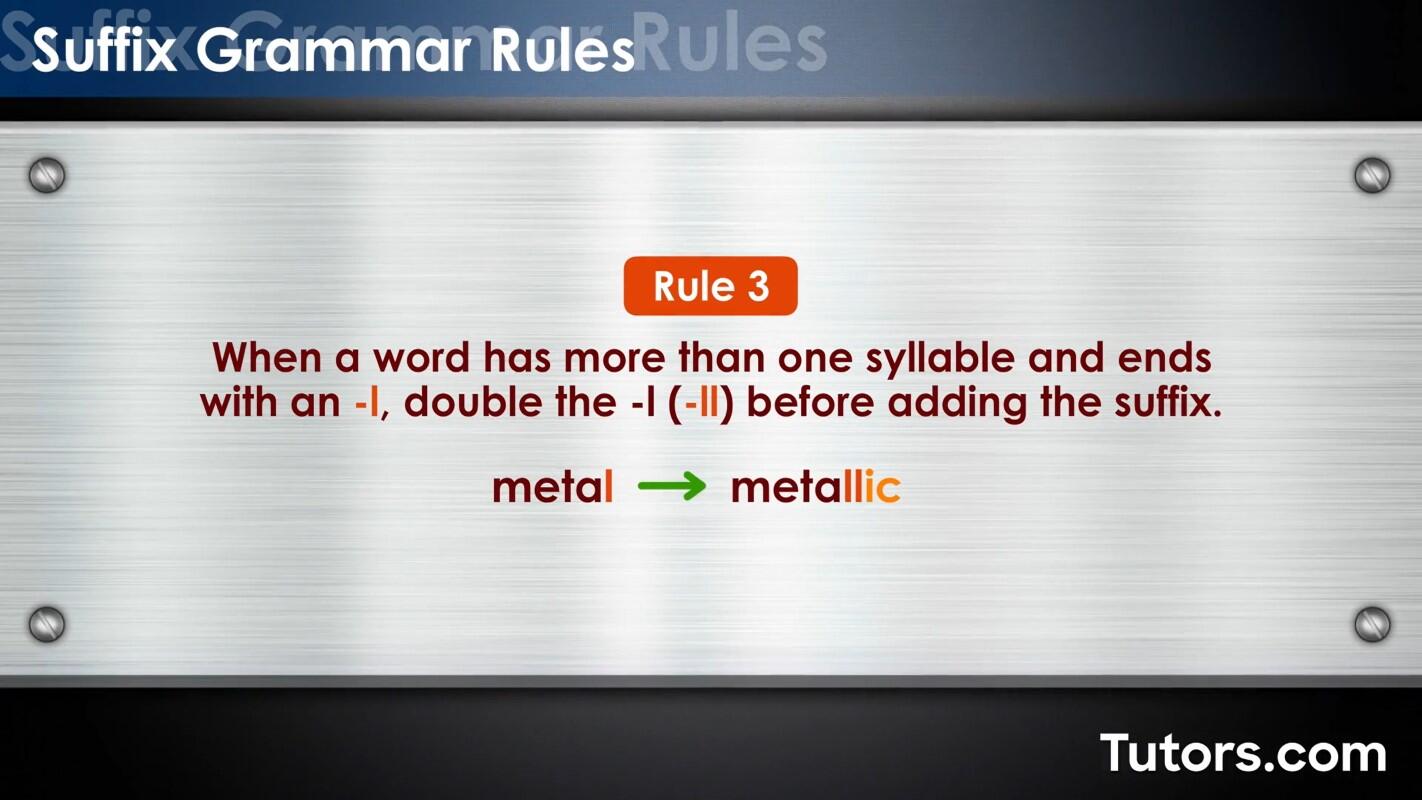
Rule 3: When a word has more than one syllable and ends with an -l, double the -l before adding the suffix. This rule does not apply to words that end in -w, -x, or -y. This rule may vary depending on preference. Doubling the -l in words such as cancel and travel is more common in British English vs. American English. However, most of the time, both spellings are acceptable.
metal → metallic
Rule 4: When a root word ends in -ie, change it to a -y before adding the suffix -ing.
tie → tying
Rule 5: When adding a suffix that begins with a vowel, consider the following:
Simply add the suffix to a root word that ends in two consonants.
scroll → scrolling
If the root word has one syllable, one short vowel, and one final consonant, double the final consonant before adding the suffix.
run → running
For root words that end with a silent -e, drop the -e and add the suffix.
excite → excitable
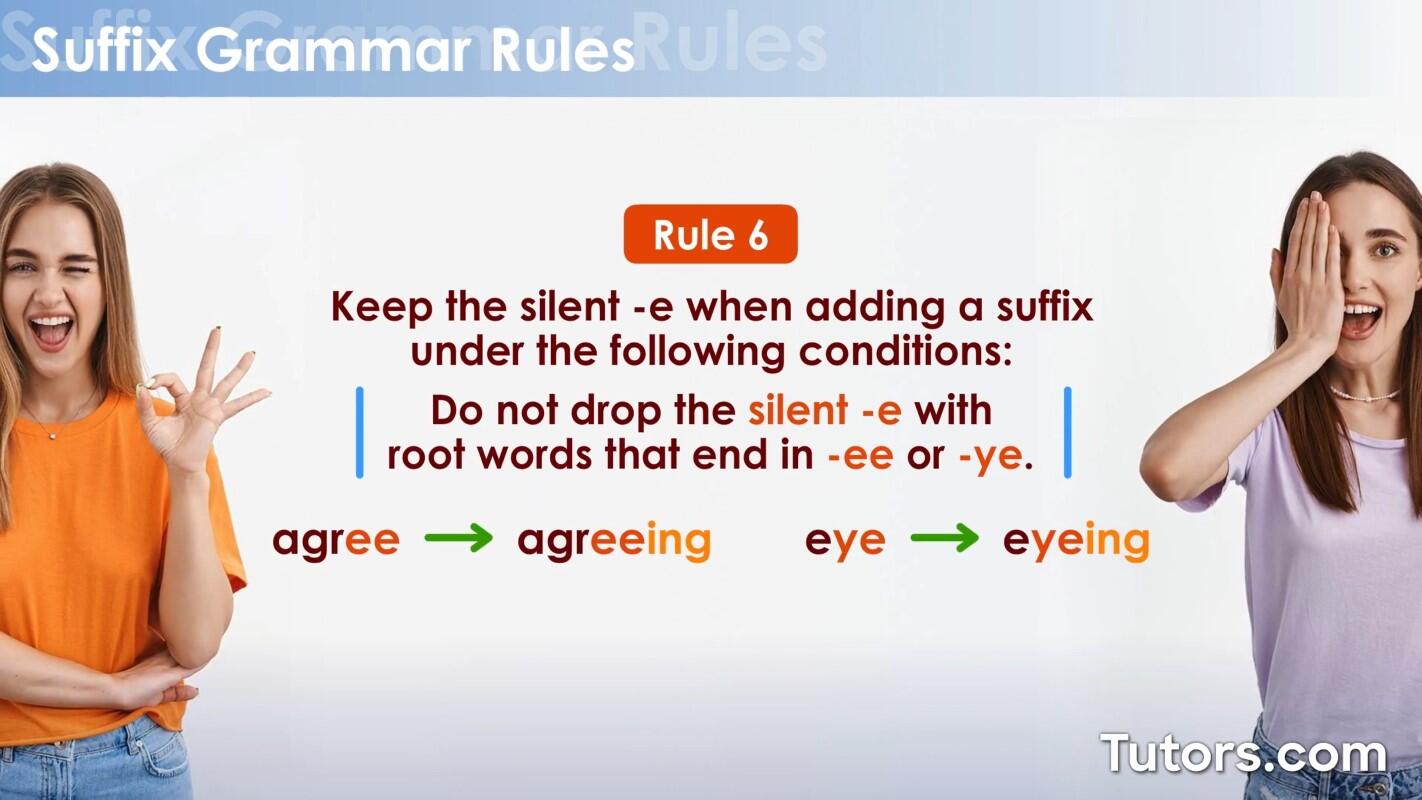
Rule 6: Keep the silent -e when adding a suffix under the following conditions:
Do not drop the silent -e with root words that end in -ee or -ye.
agree → agreeing
eye → eyeing
With root words that end in -ce and -ge, keep the silent -e for suffixes that begin with -a or -o.
advantage → advantageous
notice → noticeable
Keep the -e when adding the suffix -ly.
late → lately
When adding the suffix -ful, do not remove the silent -e.
peace → peaceful
Prefix and suffix
Unlike a suffix, prefixes are attached to the beginning of a word; however, both can change the meaning or the tense of a word. Examples of prefixes include the following:
| Prefix | Meaning | Example Words |
|---|---|---|
| inter- | between | interact, international, internet |
| pre- | before | preface, pregame, prehistoric |
| re- | again or back | redo, rewrite, revert |
| sub- | under | submarine, submerge, subtitle |
| un- | reverse or not | undo, unpack, unavailable |
Suffix examples
Below are the most common suffixes used with nouns, adjectives, verbs, and adverbs. This list is not exhaustive, as there are over 400 suffixes used in the English language.
| Suffix | Meaning | Example Words |
|---|---|---|
| -acy | state or quality | accuracy, democracy, literacy |
| -age | action, state, or process | baggage, marriage, postage |
| -al | the action or process of | approval, denial, refusal |
| -ance, -ence | state or quality of | acceptance, existence, preference |
| -ation, -tion | action or resulting state | celebration, education, immigration |
| -dom | place or state of being | boredom, freedom, kingdom |
| -er | someone who performs an action | dancer, singer, teacher |
| -ism | doctrine or belief | capitalism, criticism, optimism |
| -ist | person who practices | journalist, bicyclist, novelist |
| -ity | quality or condition of | abnormality, curiosity, mobility |
| -ment | condition | abandonment, movement, retirement |
| -ness | state or quality | kindness, truthfulness, sleepiness |
| -or | person who is something | contributor, investigator, translator |
| -ship | position held | internship, friendship, membership |
| -sion | state of being | confusion, depression, profession |
| Suffix | Meaning | Example Words |
|---|---|---|
| -able, -ible | capable of being | adaptable, reliable, responsible |
| -al | having the form or character of | natural, theatrical, seasonal |
| -ant | being or performing | defiant, elegant, redundant |
| -ary | of or relating to | dietary, customary, ordinary |
| -esque | in a manner of or resembling | picturesque, grotesque, statuesque |
| -ful | notable for or full of | beautiful, delightful, successful |
| -ic | relating to | heroic, futuristic, photographic |
| -ical | having the form or character of | alphabetical, logical, magical |
| -ing | something used in an action or process | lining, scaffolding, covering |
| -ious, -ous | characterized by | cautious, humorous, mysterious |
| -ish | having the quality of | childish, sheepish, selfish |
| -ive | having the nature of | conservative, excessive, supportive |
| -less | without | careless, fearless, motionless |
| -like | like | birdlike, childlike, flu-like |
| -y | characterized by | funny, rainy, messy |
| Suffix | Meaning | Example Words |
|---|---|---|
| -ate | to make | animate, cooperate, decorate |
| -en | become | awaken, flatten, darken |
| -ify, -fy | make or produce | classify, simplify, terrify |
| -ing | action or process | running, jumping, sleeping |
| -ize | to cause or become | apologize, characterize, stabilize |
| Suffix | Meaning | Example Words |
|---|---|---|
| -ly | related to or quality | gladly, loudly, hungrily |
| -ward | direction | onward, forward, toward |
| -ways, -wise | in relation to | sideways, clockwise, lengthwise |
The following sentences incorporate noun, verb, adjective, and adverb suffixes:
Noun
The completion of the highway helped limit traffic.
Steve had to stop at the florist before going home.
Her assistant was late for work because of the snowstorm.
They dove into the ocean after discovering the location of the wreckage.
The teacher stressed the importance of today's lesson.
Adjective
Courtney thought all of the baked goods were delicious.
The store typically hires seasonal workers around the holidays.
After finishing the recital, she heard joyful cheers from the audience.
Tony looks at life with childlike simplicity.
Polly's speech was effective in persuading the city to add more stop signs.
Verb
The instructor had to demonstrate how to perform CPR.
The state needed to close the road to widen the highway.
They were able to identify the car's owner.
To help the workers perform better, the boss decided to simplify their tasks.
Lisa was thinking of ways to generate publicity for her restaurant.
Adverb
The dancer moved gracefully across the stage.
Luckily, Tom wasn't hurt when he fell down the steps.
Both candidates found the commercial to be politically motivated.
The money seemed to appear in his wallet magically.
His neighbor's cat slyly crept into their house through the window.
Summarize with AI:
Did you like this article? Rate it!

 Loading...